〜ごとき means “like / as if (literary)”. It is a JLPT N1 pattern: below are its construction, the nuances that trip learners up, and the sentences where real Japanese writers use it.
A free one-page study card for 〜ごとき (like / as if (literary)), JLPT N1: what it means, how it attaches, 3 example sentences with furigana, and the nuances that trip learners up. Read it right here, or take the PDF or PNG with you. We never ask for an email for this card.
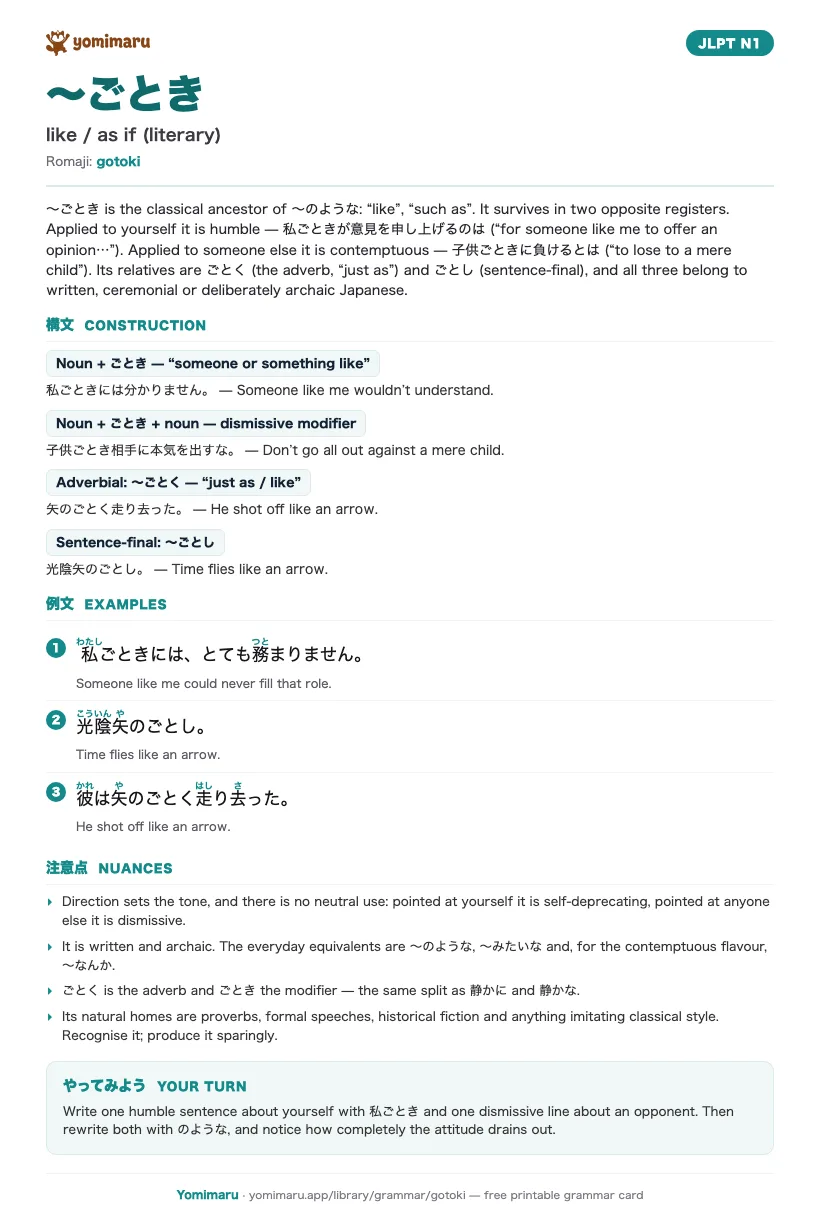
It survives in two opposite registers. Applied to yourself it is humble — 私ごときが意見を申し上げるのは (“for someone like me to offer an opinion…”). Applied to someone else it is contemptuous — 子供ごときに負けるとは (“to lose to a mere child”). Its relatives are ごとく (the adverb, “just as”) and ごとし (sentence-final), and all three belong to written, ceremonial or deliberately archaic Japanese.
構文Construction
Noun + ごとき — “someone or something like”
私ごときには分かりません。 — Someone like me wouldn’t understand.
Noun + ごとき + noun — dismissive modifier
子供ごとき相手に本気を出すな。 — Don’t go all out against a mere child.
Adverbial: 〜ごとく — “just as / like”
矢のごとく走り去った。 — He shot off like an arrow.
Sentence-final: 〜ごとし
光陰矢のごとし。 — Time flies like an arrow.
例文In a sentence
私ごときには、とても務まりません。
Someone like me could never fill that role.
光陰矢のごとし。
Time flies like an arrow.
彼は矢のごとく走り去った。
He shot off like an arrow.
注意点Nuances
It is written and archaic. The everyday equivalents are 〜のような, 〜みたいな and, for the contemptuous flavour, 〜なんか.
ごとく is the adverb and ごとき the modifier — the same split as 静かに and 静かな.
Its natural homes are proverbs, formal speeches, historical fiction and anything imitating classical style. Recognise it; produce it sparingly.
How 〜ごとき differs from similar patterns
〜のような — 〜のような is the ordinary modern “like”, with no attitude attached. ごとき always brings either humility or contempt with it.
ごとし(如し) — ごとし is the sentence-final form of this same word, kept alive mostly in proverbs like 光陰矢のごとし.
〜みたい — 〜みたい is the casual spoken “like”. It sits at the opposite end of the register scale from ごとき, and the two never turn up in the same sentence.
練習Your Turn
Tip
Write one humble sentence about yourself with 私ごとき and one dismissive line about an opponent. Then rewrite both with のような, and notice how completely the attitude drains out.
〜ごとき (like / as if (literary)) in real sentences
Each one is quoted from a published Japanese text in this library and links to the story it came from. Some use older spellings, or break off where the sentence carried on. They are transcribed exactly as their authors wrote them.
〜ごとき sits at JLPT N1 in the 302-point taxonomy every text in this library is tagged against. Each text is read for the patterns it contains, which is what lets this page list every text that uses 〜ごとき and pull its example sentences out of them.
The example sentences were not written to demonstrate the rule. They are quoted from published Japanese texts in this library (World Famous Ghost Stories and Beginning: The Telephone Incident among them), and each one links back to the story it came from, so you can read the sentence where it actually happened.
質問Questions
〜ごとき: questions & answers
What does 〜ごとき mean?
It means “like” or “such as”, and it is the classical form behind 〜のような. What makes it distinctive is the attitude: 私ごとき is modest about yourself, while あいつごとき is contemptuous about someone else.
What is the difference between ごとき, ごとく and ごとし?
They are three forms of one word. ごとき modifies a noun (矢のごとき速さ), ごとく modifies a verb (矢のごとく走る), and ごとし ends a sentence (光陰矢のごとし). Modern Japanese would use ような, ように and ようだ.
Is 〜ごとき rude?
It can be, and deliberately so. Used of another person it belittles them — 新人ごときに負けるな. Used of yourself it is the opposite, a formal show of humility. Because there is no neutral middle, learners are safer with のような.
Is there a printable 〜ごとき cheat sheet?
Yes. A free one-page 〜ごとき (like / as if (literary)) study card sits at the top of this page, as both a PDF and a PNG. It carries the JLPT N1 meaning, how the pattern attaches, 3 example sentences with furigana, and the nuances learners get wrong. You do not need an account or an email address to download it.
始めるStart free
Read the grammar you just studied
Yomimaru turns every text in the library into a reading lesson: furigana tuned to your JLPT level, tap-to-look-up on any word, and an English breakdown of the vocabulary and grammar in each sentence. It is all free, and we never ask for a card.