〜ぬ means “classical negative (= ない)”. It is a JLPT N1 pattern: below are its construction, the nuances that trip learners up, and the sentences where real Japanese writers use it.
A free one-page study card for 〜ぬ (classical negative (= ない)), JLPT N1: what it means, how it attaches, 3 example sentences with furigana, and the nuances that trip learners up. Read it right here, or take the PDF or PNG with you. We never ask for an email for this card.
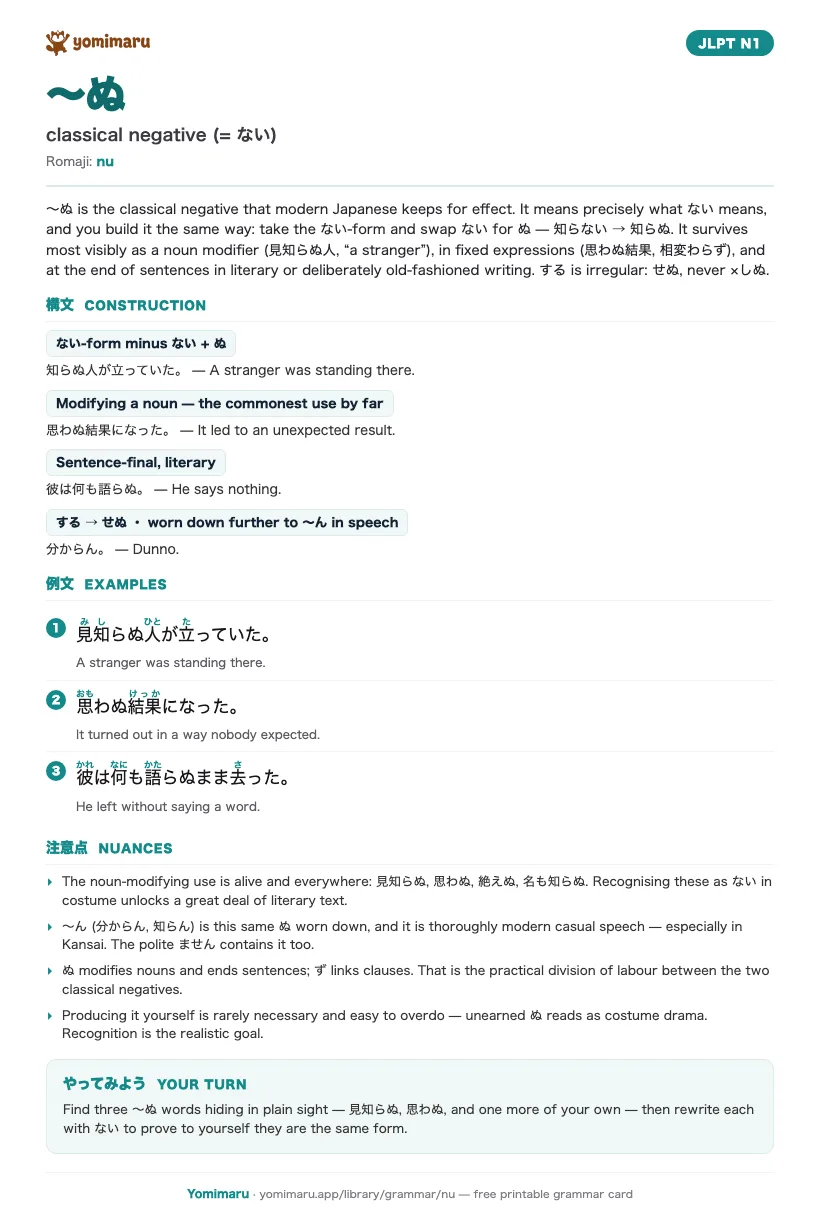
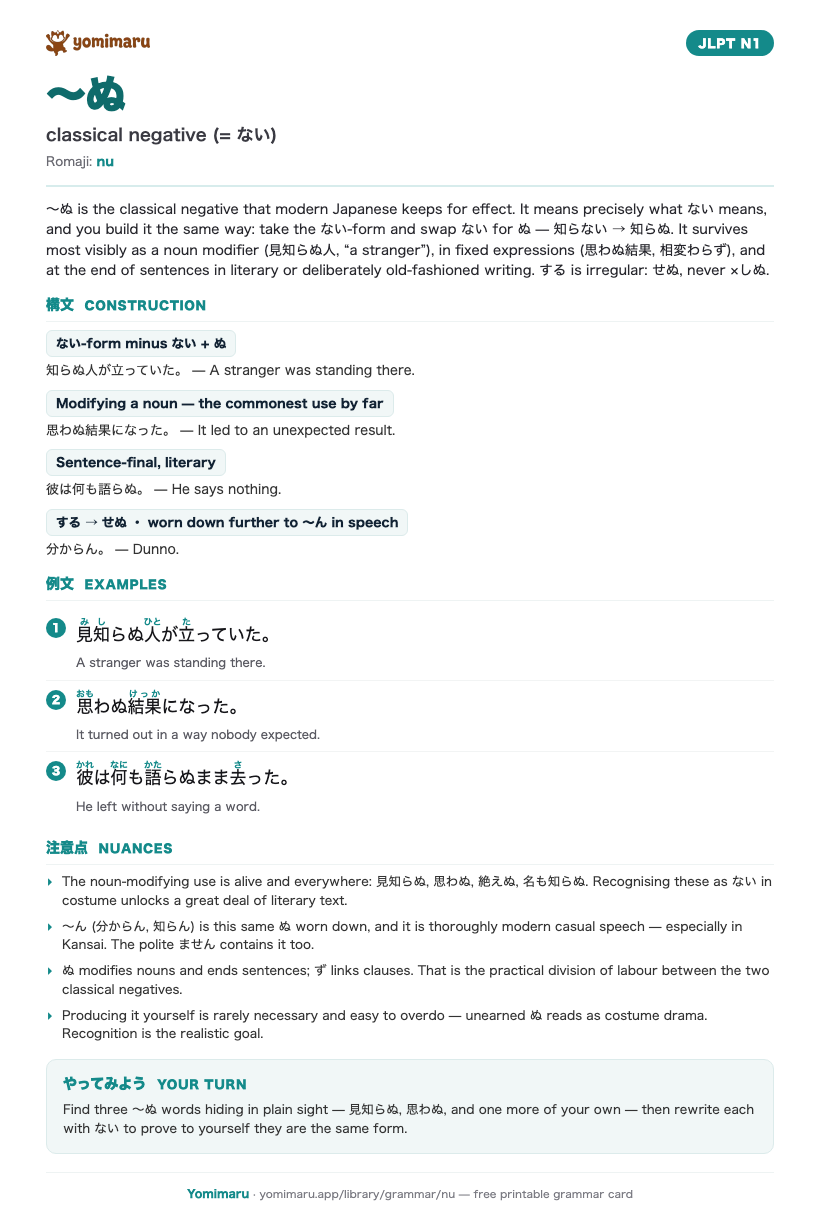
It means precisely what ない means, and you build it the same way: take the ない-form and swap ない for ぬ — 知らない → 知らぬ. It survives most visibly as a noun modifier (見知らぬ人, “a stranger”), in fixed expressions (思わぬ結果, 相変わらず), and at the end of sentences in literary or deliberately old-fashioned writing. する is irregular: せぬ, never ×しぬ.
構文Construction
ない-form minus ない + ぬ
知らぬ人が立っていた。 — A stranger was standing there.
Modifying a noun — the commonest use by far
思わぬ結果になった。 — It led to an unexpected result.
Sentence-final, literary
彼は何も語らぬ。 — He says nothing.
する → せぬ ・ worn down further to 〜ん in speech
分からん。 — Dunno.
例文In a sentence
見知らぬ人が立っていた。
A stranger was standing there.
思わぬ結果になった。
It turned out in a way nobody expected.
彼は何も語らぬまま去った。
He left without saying a word.
注意点Nuances
Recognising these as ない in costume unlocks a great deal of literary text.
〜ん (分からん, 知らん) is this same ぬ worn down, and it is thoroughly modern casual speech — especially in Kansai. The polite ません contains it too.
ぬ modifies nouns and ends sentences; ず links clauses. That is the practical division of labour between the two classical negatives.
Producing it yourself is rarely necessary and easy to overdo — unearned ぬ reads as costume drama. Recognition is the realistic goal.
How 〜ぬ differs from similar patterns
〜ず — 〜ず is the same classical negative in its clause-linking role: 言わずに帰った. Use ず to join clauses, ぬ to modify a noun or close a sentence.
〜べからず — 〜べからず is a fossilised compound built on this negative — literally “must not”, and mostly seen on old signs.
〜ないで — 〜ないで is the everyday spoken form that does the work ぬ and ず do in writing.
練習Your Turn
Tip
Find three 〜ぬ words hiding in plain sight — 見知らぬ, 思わぬ, and one more of your own — then rewrite each with ない to prove to yourself they are the same form.
〜ぬ (classical negative (= ない)) in real sentences
Each one is quoted from a published Japanese text in this library and links to the story it came from. Some use older spellings, or break off where the sentence carried on. They are transcribed exactly as their authors wrote them.
〜ぬ sits at JLPT N1 in the 302-point taxonomy every text in this library is tagged against. Each text is read for the patterns it contains, which is what lets this page list every text that uses 〜ぬ and pull its example sentences out of them.
The example sentences were not written to demonstrate the rule. They are quoted from published Japanese texts in this library (The Head and the Belly and The Ghost of the Residence among them), and each one links back to the story it came from, so you can read the sentence where it actually happened.
質問Questions
〜ぬ: questions & answers
What is 〜ぬ?
The classical negative ending, equivalent to modern ない. Form it from the ない-form: 行かない → 行かぬ, 知らない → 知らぬ. する is the exception, becoming せぬ.
What is the difference between 〜ぬ and 〜ず?
They are two forms of the same classical negative with different jobs. ぬ modifies nouns and ends sentences (見知らぬ人, 何も語らぬ); ず links one clause to the next (何も言わず、出て行った).
Is 分からん related to 〜ぬ?
Yes — 〜ん is ぬ worn down by centuries of speech. 分からん, 知らん and できん are all casual negatives, common in Kansai and in men’s speech, and the polite ending ません descends from the same source.
Is there a printable 〜ぬ cheat sheet?
Yes. A free one-page 〜ぬ (classical negative (= ない)) study card sits at the top of this page, as both a PDF and a PNG. It carries the JLPT N1 meaning, how the pattern attaches, 3 example sentences with furigana, and the nuances learners get wrong. You do not need an account or an email address to download it.
始めるStart free
Read the grammar you just studied
Yomimaru turns every text in the library into a reading lesson: furigana tuned to your JLPT level, tap-to-look-up on any word, and an English breakdown of the vocabulary and grammar in each sentence. It is all free, and we never ask for a card.