〜たるin the capacity of (literary): Meaning & Examples
taru · JLPT N1
JLPT N111 textsStudy card
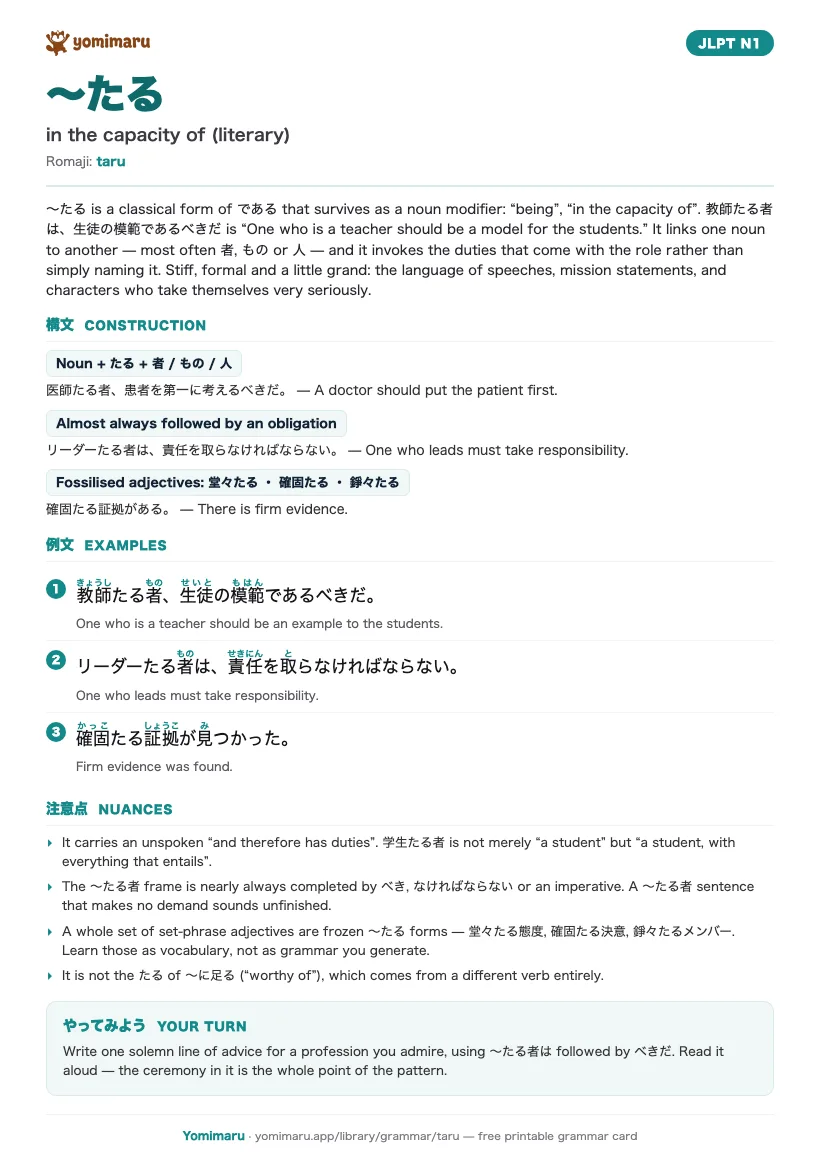
〜たる means “in the capacity of (literary)”. It is a JLPT N1 pattern: below are its construction, the nuances that trip learners up, and the sentences where real Japanese writers use it.
A free one-page study card for 〜たる (in the capacity of (literary)), JLPT N1: what it means, how it attaches, 3 example sentences with furigana, and the nuances that trip learners up. Read it right here, or take the PDF or PNG with you. We never ask for an email for this card.
教師たる者は、生徒の模範であるべきだ is “One who is a teacher should be a model for the students.” It links one noun to another — most often 者, もの or 人 — and it invokes the duties that come with the role rather than simply naming it. Stiff, formal and a little grand: the language of speeches, mission statements, and characters who take themselves very seriously.
構文Construction
Noun + たる + 者 / もの / 人
医師たる者、患者を第一に考えるべきだ。 — A doctor should put the patient first.
Almost always followed by an obligation
リーダーたる者は、責任を取らなければならない。 — One who leads must take responsibility.
Fossilised adjectives: 堂々たる ・ 確固たる ・ 錚々たる
確固たる証拠がある。 — There is firm evidence.
例文In a sentence
教師たる者、生徒の模範であるべきだ。
One who is a teacher should be an example to the students.
リーダーたる者は、責任を取らなければならない。
One who leads must take responsibility.
確固たる証拠が見つかった。
Firm evidence was found.
注意点Nuances
学生たる者 is not merely “a student” but “a student, with everything that entails”.
The 〜たる者 frame is nearly always completed by べき, なければならない or an imperative. A 〜たる者 sentence that makes no demand sounds unfinished.
A whole set of set-phrase adjectives are frozen 〜たる forms — 堂々たる態度, 確固たる決意, 錚々たるメンバー. Learn those as vocabulary, not as grammar you generate.
It is not the たる of 〜に足る (“worthy of”), which comes from a different verb entirely.
How 〜たる differs from similar patterns
〜として — 〜として states a role neutrally (“as a teacher”); 〜たる adds the weight of what that role demands of you.
〜に足る — 〜に足る is an unrelated pattern meaning “worthy of” — 信頼に足る人物. Same syllable, different verb, different job.
〜ごとき — Both are classical survivors used as noun modifiers, and both raise the register sharply. ごとき compares; たる assigns a role.
練習Your Turn
Tip
Write one solemn line of advice for a profession you admire, using 〜たる者は followed by べきだ. Read it aloud — the ceremony in it is the whole point of the pattern.
〜たる (in the capacity of (literary)) in real sentences
Each one is quoted from a published Japanese text in this library and links to the story it came from. Some use older spellings, or break off where the sentence carried on. They are transcribed exactly as their authors wrote them.
〜たる sits at JLPT N1 in the 302-point taxonomy every text in this library is tagged against. Each text is read for the patterns it contains, which is what lets this page list every text that uses 〜たる and pull its example sentences out of them.
The example sentences were not written to demonstrate the rule. They are quoted from published Japanese texts in this library (The Tengu Rock Murderer and Household Holiday among them), and each one links back to the story it came from, so you can read the sentence where it actually happened.
質問Questions
〜たる: questions & answers
What does 〜たる mean?
It is a classical equivalent of である used to modify a noun: “being”, “in the capacity of”. 社会人たる者 means “one who is a working adult”, with the responsibilities of that status implied.
What usually follows 〜たる者?
An obligation. べきだ, なければならない, or a direct instruction: 武士たる者、恥を知れ. The pattern exists to set up a duty, so the sentence feels incomplete without one.
Is 堂々たる the same たる?
Yes, historically — 堂々たる, 確固たる and 錚々たる are frozen 〜たる forms that now work as ordinary adjectives. Treat them as vocabulary; you cannot form new ones freely.
Is there a printable 〜たる cheat sheet?
Yes. A free one-page 〜たる (in the capacity of (literary)) study card sits at the top of this page, as both a PDF and a PNG. It carries the JLPT N1 meaning, how the pattern attaches, 3 example sentences with furigana, and the nuances learners get wrong. You do not need an account or an email address to download it.
始めるStart free
Read the grammar you just studied
Yomimaru turns every text in the library into a reading lesson: furigana tuned to your JLPT level, tap-to-look-up on any word, and an English breakdown of the vocabulary and grammar in each sentence. It is all free, and we never ask for a card.