〜が最後 means “once you do, that's it”. It is a JLPT N1 pattern: below are its construction, the nuances that trip learners up, and the sentences where real Japanese writers use it.
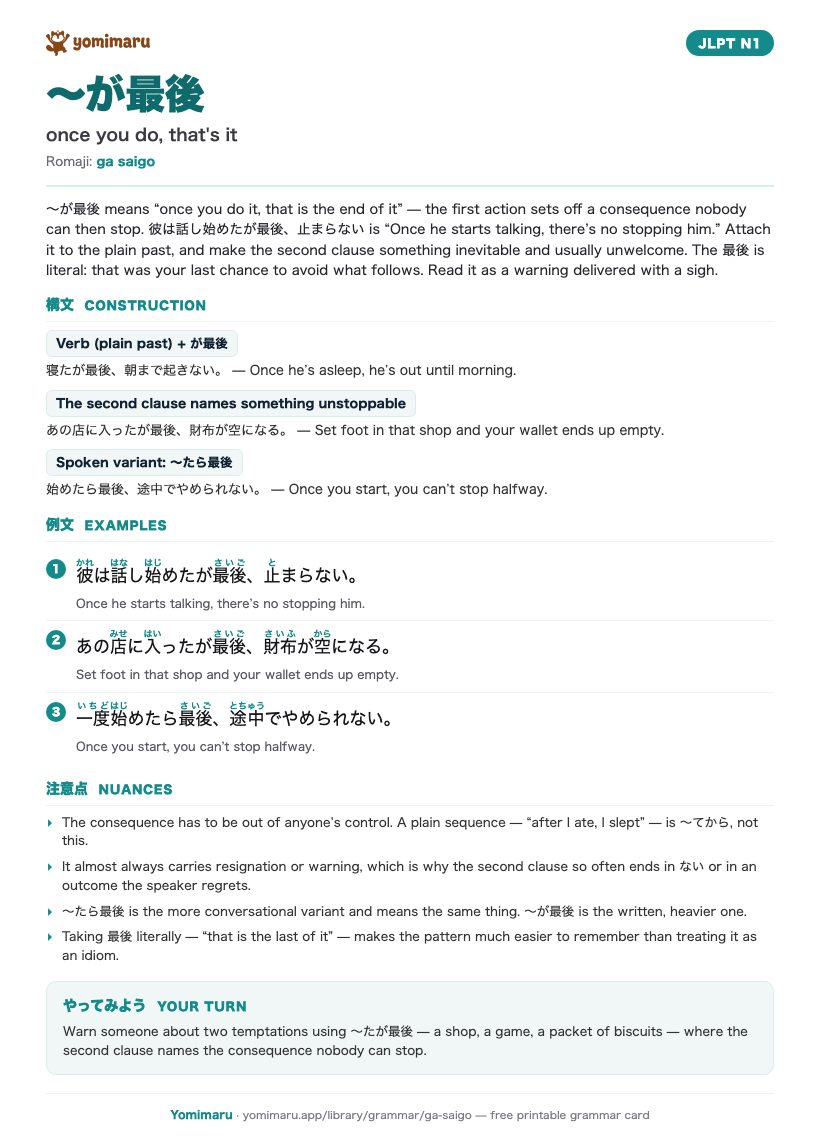
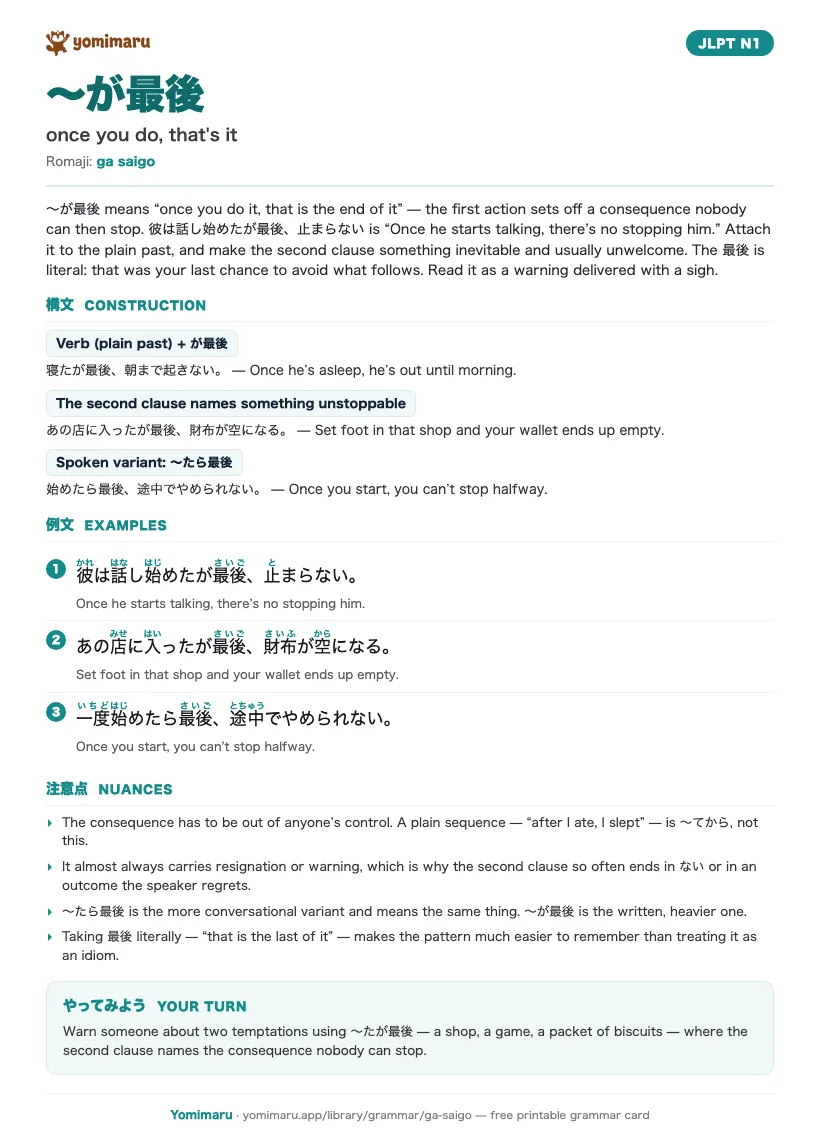
A free one-page study card for 〜が最後 (once you do, that's it), JLPT N1: what it means, how it attaches, 3 example sentences with furigana, and the nuances that trip learners up. Read it right here, or take the PDF or PNG with you. We never ask for an email for this card.
彼は話し始めたが最後、止まらない is “Once he starts talking, there’s no stopping him.” Attach it to the plain past, and make the second clause something inevitable and usually unwelcome. The 最後 is literal: that was your last chance to avoid what follows. Read it as a warning delivered with a sigh.
構文Construction
Verb (plain past) + が最後
寝たが最後、朝まで起きない。 — Once he’s asleep, he’s out until morning.
The second clause names something unstoppable
あの店に入ったが最後、財布が空になる。 — Set foot in that shop and your wallet ends up empty.
Spoken variant: 〜たら最後
始めたら最後、途中でやめられない。 — Once you start, you can’t stop halfway.
例文In a sentence
彼は話し始めたが最後、止まらない。
Once he starts talking, there’s no stopping him.
あの店に入ったが最後、財布が空になる。
Set foot in that shop and your wallet ends up empty.
一度始めたら最後、途中でやめられない。
Once you start, you can’t stop halfway.
注意点Nuances
A plain sequence — “after I ate, I slept” — is 〜てから, not this.
It almost always carries resignation or warning, which is why the second clause so often ends in ない or in an outcome the speaker regrets.
〜たら最後 is the more conversational variant and means the same thing. 〜が最後 is the written, heavier one.
Taking 最後 literally — “that is the last of it” — makes the pattern much easier to remember than treating it as an idiom.
How 〜が最後 differs from similar patterns
〜が早いか — 〜が早いか is purely about speed — the second thing followed instantly. 〜が最後 is about inevitability, and does not care how long the consequence takes to arrive.
〜てしまう — 〜てしまう marks an action as finished and often regretted; 〜が最後 marks it as the point of no return, with the regret still ahead.
〜たところで — 〜たところで dismisses an action as futile before it happens; 〜が最後 says the action will certainly have its effect — and you will not like it.
練習Your Turn
Tip
Warn someone about two temptations using 〜たが最後 — a shop, a game, a packet of biscuits — where the second clause names the consequence nobody can stop.
〜が最後 (once you do, that's it) in real sentences
Each one is quoted from a published Japanese text in this library and links to the story it came from. Some use older spellings, or break off where the sentence carried on. They are transcribed exactly as their authors wrote them.
〜が最後 sits at JLPT N1 in the 302-point taxonomy every text in this library is tagged against. Each text is read for the patterns it contains, which is what lets this page list every text that uses 〜が最後 and pull its example sentences out of them.
The example sentences were not written to demonstrate the rule. They are quoted from published Japanese texts in this library (The Election Murder Case and April Fool among them), and each one links back to the story it came from, so you can read the sentence where it actually happened.
質問Questions
〜が最後: questions & answers
What does 〜が最後 mean?
It means “once you do this, there is no going back”. The first clause names an action, and the second names the consequence that then becomes unavoidable: 座ったが最後、立ち上がれない (“once you sit down, you’ll never get up again”).
What form comes before が最後?
The plain past: 見たが最後, 始めたが最後, 入ったが最後. The past shape marks the action as completed, which is what makes the consequence irreversible — it carries no past meaning of its own.
What is 〜たら最後?
The conversational variant of the same pattern, with the same meaning: 触ったら最後、離れなくなる. Use 〜たら最後 when speaking and 〜が最後 in writing.
Is there a printable 〜が最後 cheat sheet?
Yes. A free one-page 〜が最後 (once you do, that's it) study card sits at the top of this page, as both a PDF and a PNG. It carries the JLPT N1 meaning, how the pattern attaches, 3 example sentences with furigana, and the nuances learners get wrong. You do not need an account or an email address to download it.
始めるStart free
Read the grammar you just studied
Yomimaru turns every text in the library into a reading lesson: furigana tuned to your JLPT level, tap-to-look-up on any word, and an English breakdown of the vocabulary and grammar in each sentence. It is all free, and we never ask for a card.


 確認
確認