〜てしまう means “ended up (regret)”. It is a JLPT N4 pattern: below are its construction, the nuances that trip learners up, and the sentences where real Japanese writers use it.
A free one-page study card for 〜てしまう (ended up (regret)), JLPT N4: what it means, how it attaches, 3 example sentences with furigana, and the nuances that trip learners up. Read it right here, or take the PDF or PNG with you. We never ask for an email for this card.
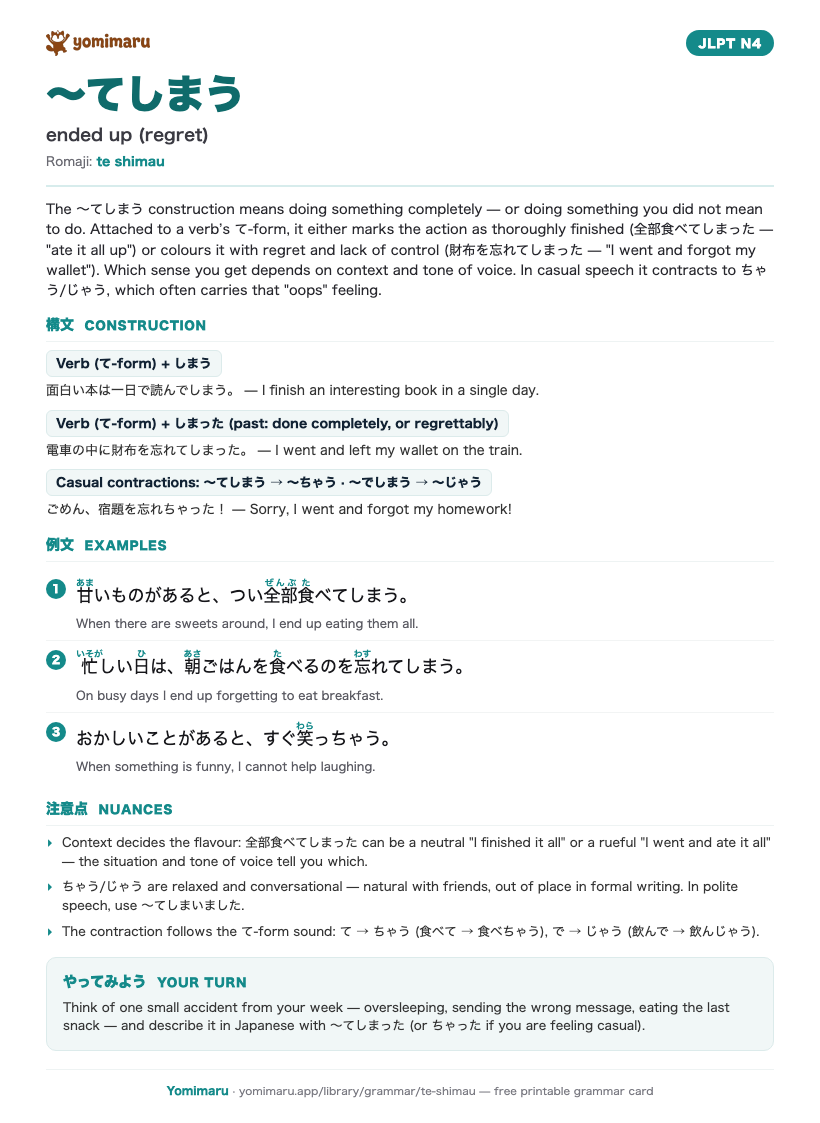
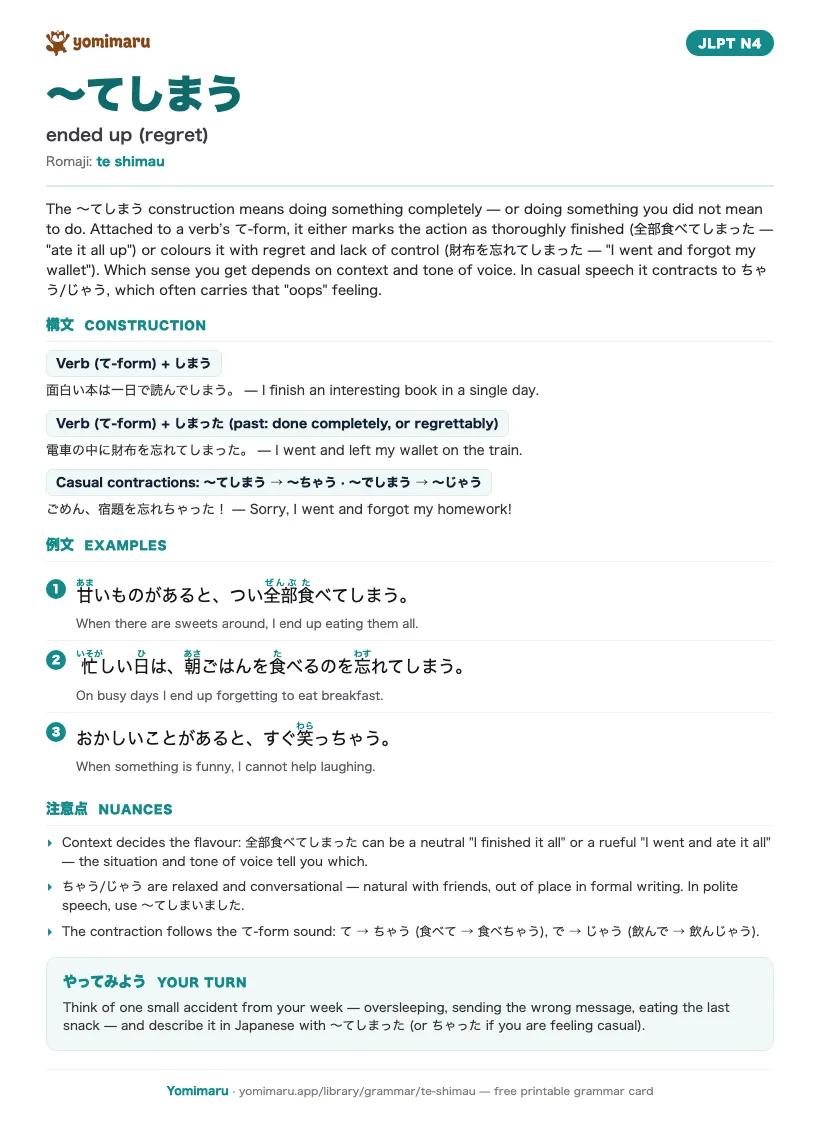
Attached to a verb’s て-form, it either marks the action as thoroughly finished (全部食べてしまった — "ate it all up") or colours it with regret and lack of control (財布を忘れてしまった — "I went and forgot my wallet"). Which sense you get depends on context and tone of voice. In casual speech it contracts to ちゃう/じゃう, which often carries that "oops" feeling.
構文Construction
Verb (て-form) + しまう
面白い本は一日で読んでしまう。 — I finish an interesting book in a single day.
Verb (て-form) + しまった (past: done completely, or regrettably)
電車の中に財布を忘れてしまった。 — I went and left my wallet on the train.
Casual contractions: 〜てしまう → 〜ちゃう · 〜でしまう → 〜じゃう
ごめん、宿題を忘れちゃった! — Sorry, I went and forgot my homework!
例文In a sentence
甘いものがあると、つい全部食べてしまう。
When there are sweets around, I end up eating them all.
忙しい日は、朝ごはんを食べるのを忘れてしまう。
On busy days I end up forgetting to eat breakfast.
おかしいことがあると、すぐ笑っちゃう。
When something is funny, I cannot help laughing.
注意点Nuances
ちゃう/じゃう are relaxed and conversational — natural with friends, out of place in formal writing. In polite speech, use 〜てしまいました.
The contraction follows the て-form sound: て → ちゃう (食べて → 食べちゃう), で → じゃう (飲んで → 飲んじゃう).
How 〜てしまう differs from similar patterns
〜ておく — 〜ておく is doing something on purpose in advance so you’re ready later; 〜てしまう marks the action as fully done — often with feeling, as when things slip out of your control.
てみる — 〜てみる is trying an action to see what happens; 〜てしまう says the action is done — completely, or when you wish it were not.
練習Your Turn
Tip
Think of one small accident from your week — oversleeping, sending the wrong message, eating the last snack — and describe it in Japanese with 〜てしまった (or ちゃった if you are feeling casual).
〜てしまう (ended up (regret)) in real sentences
Each one is quoted from a published Japanese text in this library and links to the story it came from. Some use older spellings, or break off where the sentence carried on. They are transcribed exactly as their authors wrote them.
〜てしまう sits at JLPT N4 in the 302-point taxonomy every text in this library is tagged against. Each text is read for the patterns it contains, which is what lets this page list every text that uses 〜てしまう and pull its example sentences out of them.
The example sentences were not written to demonstrate the rule. They are quoted from published Japanese texts in this library (Jemmy's Adventure and The Earthworm Teacher's Song among them), and each one links back to the story it came from, so you can read the sentence where it actually happened.
質問Questions
〜てしまう: questions & answers
What is the difference between 〜てしまう and ちゃった?
They are the same grammar at different registers. ちゃう is the casual spoken contraction of 〜てしまう, and ちゃった is its past form (= てしまった): 食べてしまった and 食べちゃった both mean "I ended up eating it" — the second just sounds more relaxed. After a て-form ending in で, the contraction is じゃう instead (飲んで → 飲んじゃった).
Does 〜てしまう always express regret?
No — it has two faces. It can mark plain, thorough completion (宿題をやってしまう, "get the homework completely done") or an action the speaker regrets or never intended (財布をなくしてしまった, "I went and lost my wallet"). Context and tone of voice tell you which one you are hearing.
How do I practise 〜てしまう?
Meet it in real sentences rather than isolated drills — てしまう and ちゃう are everywhere in native narration and dialogue. Reading graded Japanese texts on Yomimaru, pause at each occurrence and ask whether it signals completion or regret; that one habit builds the intuition faster than memorising rules.
Is there a printable 〜てしまう cheat sheet?
Yes. A free one-page 〜てしまう (ended up (regret)) study card sits at the top of this page, as both a PDF and a PNG. It carries the JLPT N4 meaning, how the pattern attaches, 3 example sentences with furigana, and the nuances learners get wrong. You do not need an account or an email address to download it.
始めるStart free
Read the grammar you just studied
Yomimaru turns every text in the library into a reading lesson: furigana tuned to your JLPT level, tap-to-look-up on any word, and an English breakdown of the vocabulary and grammar in each sentence. It is all free, and we never ask for a card.


 確認
確認