How 〜という〜 differs from similar patterns
- と — The plain quote particle と marks what someone actually says or thinks (〜と言った, 〜と思う); という as a set phrase names or defines a noun without any real act of saying.
文法Grammar Point
to iu · JLPT N4
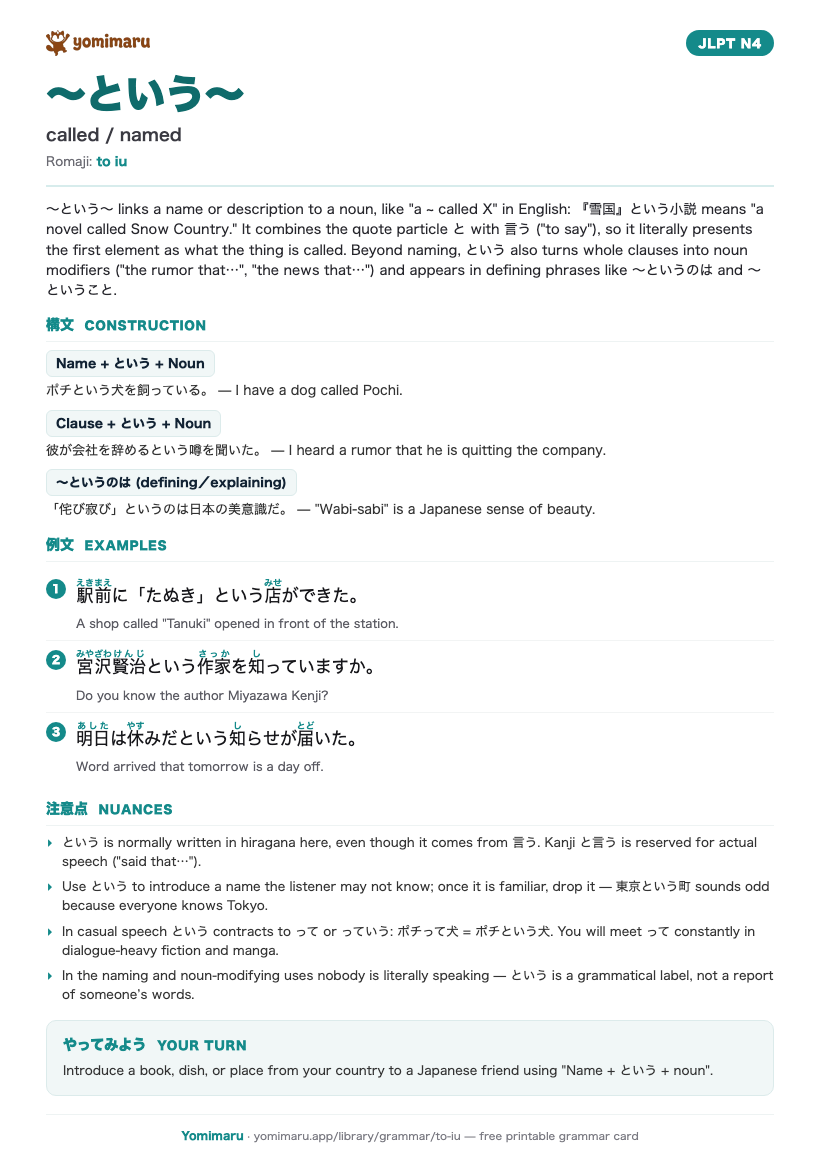
〜という〜 means “called / named”. It is a JLPT N4 pattern: below are its construction, the nuances that trip learners up, and the sentences where real Japanese writers use it.
A free one-page study card for 〜という〜 (called / named), JLPT N4: what it means, how it attaches, 3 example sentences with furigana, and the nuances that trip learners up. Read it right here, or take the PDF or PNG with you. We never ask for an email for this card.
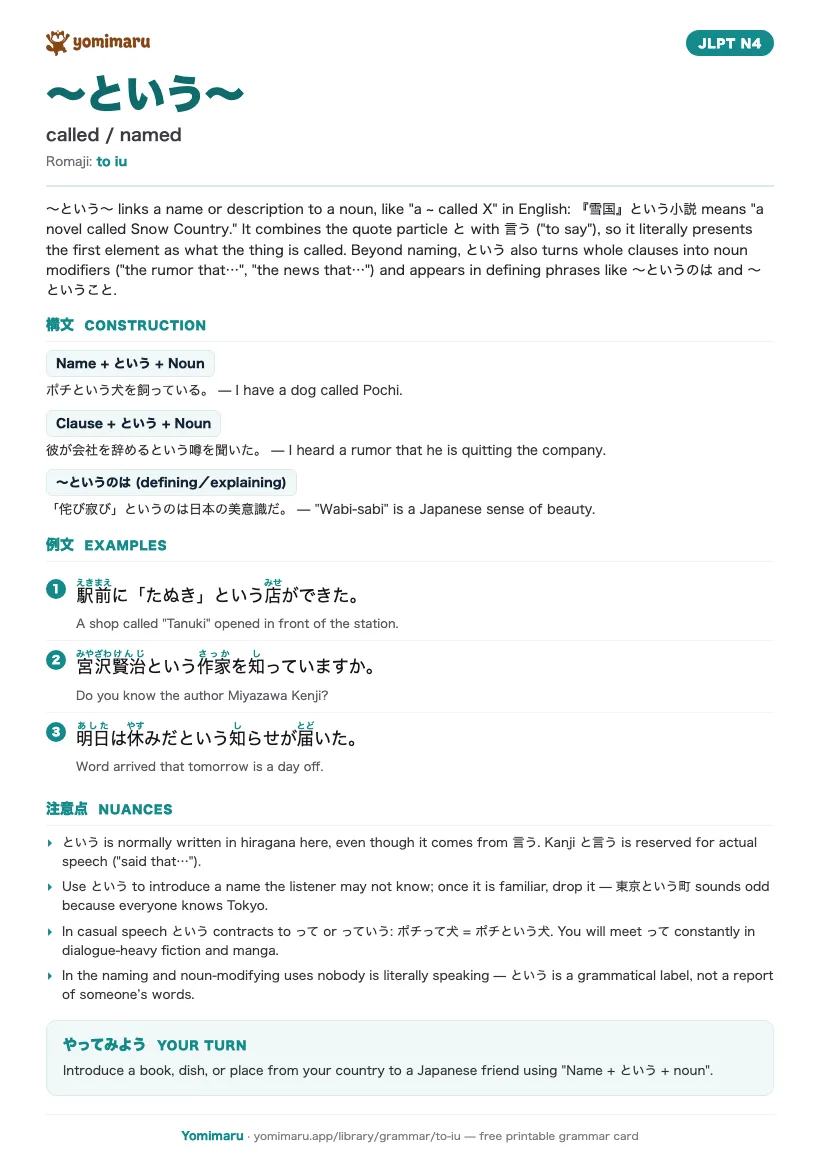
Beyond naming, という also turns whole clauses into noun modifiers ("the rumor that…", "the news that…") and appears in defining phrases like 〜というのは and 〜ということ.
構文Construction
Name + という + Noun
ポチという犬を飼っている。 — I have a dog called Pochi.
Clause + という + Noun
彼が会社を辞めるという噂を聞いた。 — I heard a rumor that he is quitting the company.
〜というのは (defining/explaining)
「侘び寂び」というのは日本の美意識だ。 — "Wabi-sabi" is a Japanese sense of beauty.
例文In a sentence
駅前に「たぬき」という店ができた。
宮沢賢治という作家を知っていますか。
明日は休みだという知らせが届いた。
注意点Nuances
練習Your Turn
Each one is quoted from a published Japanese text in this library and links to the story it came from. Some use older spellings, or break off where the sentence carried on. They are transcribed exactly as their authors wrote them.
きょうは がちょうさんの たんじょうびと いうので、みんなは がちょうの ところへ ごちそうに まねかれて いきました。
— from Goose's Birthday (N4)
南昌に彭徳孚という秀才があった。
— from The Lotus Princess (N2)
それはエビス鮫というのである。
— from Tokyo Bay Monster Tales (N2)
美男子というものは、顔が小さくきちんとまとまっているものである。
— from My Expanding Face (N2)
4 sentences taken from real Japanese texts, with the grammar removed. Pick what belongs in the gap.
Question 1 of 4
ストロボダインblank新受信機が大分おおげさに吹聴してあったようですね。
Answer: という — from The Broken Variable Capacitor (N1)
殺人鬼権六blank男だ。
Answer: という — from The Tengu Rock Murderer (N1)
南昌に彭徳孚blank秀才があった。
Answer: という — from The Lotus Princess (N2)
それはエビス鮫blankのである。
Answer: という — from Tokyo Bay Monster Tales (N2)
Read the texts these came from
Every sentence above came from a free text you can read here in full, with the rest of the story around it.
Appears in 24 of 367 texts in our library.
蔵書The texts
Free to read in full. Furigana over every kanji, a dictionary on any word you tap, and an English breakdown of each sentence.
 Read
ろくろ首
The Long-Necked Monster
小泉 八雲
Read
ろくろ首
The Long-Necked Monster
小泉 八雲
 Read
がちょうの たんじょうび
Goose's Birthday
新美 南吉
Read
がちょうの たんじょうび
Goose's Birthday
新美 南吉
 Read
くさい たこ
The Stinky Octopus
Yomimaru
Read
くさい たこ
The Stinky Octopus
Yomimaru
 Read
カイダイ
Kaidai
平山 千代子
Read
カイダイ
Kaidai
平山 千代子
 Read
「の」の字の世界
The World of 'No'
佐藤 春夫
Read
「の」の字の世界
The World of 'No'
佐藤 春夫
 Read
平山婆
The Old Woman of Hirayama
田中 貢太郎
Read
四十不惑
Forty and Unconfused
佐々木 邦
Read
平山婆
The Old Woman of Hirayama
田中 貢太郎
Read
四十不惑
Forty and Unconfused
佐々木 邦
 Read
荷花公主
The Lotus Princess
田中 貢太郎
Read
天狗岩の殺人魔
The Tengu Rock Murderer
山本 周五郎
Read
東京湾怪物譚
Tokyo Bay Monster Tales
佐藤 垢石
Read
荷花公主
The Lotus Princess
田中 貢太郎
Read
天狗岩の殺人魔
The Tengu Rock Murderer
山本 周五郎
Read
東京湾怪物譚
Tokyo Bay Monster Tales
佐藤 垢石
 Read
迷子ノジヤガイモ
The Lost Potato
村山 籌子
Read
魔の電柱
The Demon Pole
田中 貢太郎
Read
母親に憑る霊
The Spirit Possessing the Mother
田中 貢太郎
Read
迷子ノジヤガイモ
The Lost Potato
村山 籌子
Read
魔の電柱
The Demon Pole
田中 貢太郎
Read
母親に憑る霊
The Spirit Possessing the Mother
田中 貢太郎
 Read
容貌
My Expanding Face
太宰 治
Read
オホサウヂ
The Big Cleaning
村山 籌子
Read
容貌
My Expanding Face
太宰 治
Read
オホサウヂ
The Big Cleaning
村山 籌子
 Read
親孝行
Filial Piety
牧野 信一
Read
親孝行
Filial Piety
牧野 信一
 Read
人を呪わば
The Curse
国枝 史郎
Read
人を呪わば
The Curse
国枝 史郎
 Read
女仙
The Female Immortal
芥川 竜之介
Read
寒さ
Cold
芥川 竜之介
Read
壊れたバリコン
The Broken Variable Capacitor
海野 十三
Read
女仙
The Female Immortal
芥川 竜之介
Read
寒さ
Cold
芥川 竜之介
Read
壊れたバリコン
The Broken Variable Capacitor
海野 十三
 Read
ハナとタマシヒ
Hana and the Soul
平山 千代子
Read
カタツムリノ ウタ
The Snail's Song
新美 南吉
Read
一緒に歩く亡霊
The Ghost That Walks Together
田中 貢太郎
Read
小夜の中山夜啼石
The Night-Crying Stone of Sayo no Nakayama
岡本 綺堂
Read
ハナとタマシヒ
Hana and the Soul
平山 千代子
Read
カタツムリノ ウタ
The Snail's Song
新美 南吉
Read
一緒に歩く亡霊
The Ghost That Walks Together
田中 貢太郎
Read
小夜の中山夜啼石
The Night-Crying Stone of Sayo no Nakayama
岡本 綺堂
解説Background
〜という〜 sits at JLPT N4 in the 302-point taxonomy every text in this library is tagged against. Each text is read for the patterns it contains, which is what lets this page list every text that uses 〜という〜 and pull its example sentences out of them.
The example sentences were not written to demonstrate the rule. They are quoted from published Japanese texts in this library (Goose's Birthday and The Lotus Princess among them), and each one links back to the story it came from, so you can read the sentence where it actually happened.
質問Questions
Use という to introduce a name you assume the listener does not know: 「余市」という町 ("a town called Yoichi"). Once the name is familiar or famous to both of you, drop it — 東京という町 sounds strange because no one needs Tokyo explained.
In the naming and noun-modifying uses it is conventionally written in hiragana. Kanji と言う is kept for literal speech, as in 「はい」と言った ("said yes"). Mixing them is not a grammar error, but hiragana という is what you will see in print.
In casual speech って stands in for both the quote particle と and という: ポチって犬 = ポチという犬. It is everywhere in conversation and manga, so reading dialogue-heavy stories on Yomimaru is a quick way to get used to seeing both forms.
Yes. A free one-page 〜という〜 (called / named) study card sits at the top of this page, as both a PDF and a PNG. It carries the JLPT N4 meaning, how the pattern attaches, 3 example sentences with furigana, and the nuances learners get wrong. You do not need an account or an email address to download it.
始めるStart free
Read the grammar you just studied
Yomimaru turns every text in the library into a reading lesson: furigana tuned to your JLPT level, tap-to-look-up on any word, and an English breakdown of the vocabulary and grammar in each sentence. It is all free, and we never ask for a card.

 確認
確認