と means “and / with / quotation”. It is a JLPT N5 pattern: below are its construction, the nuances that trip learners up, and the sentences where real Japanese writers use it.
A free one-page study card for と (and / with / quotation), JLPT N5: what it means, how it attaches, 3 example sentences with furigana, and the nuances that trip learners up. Read it right here, or take the PDF or PNG with you. We never ask for an email for this card.
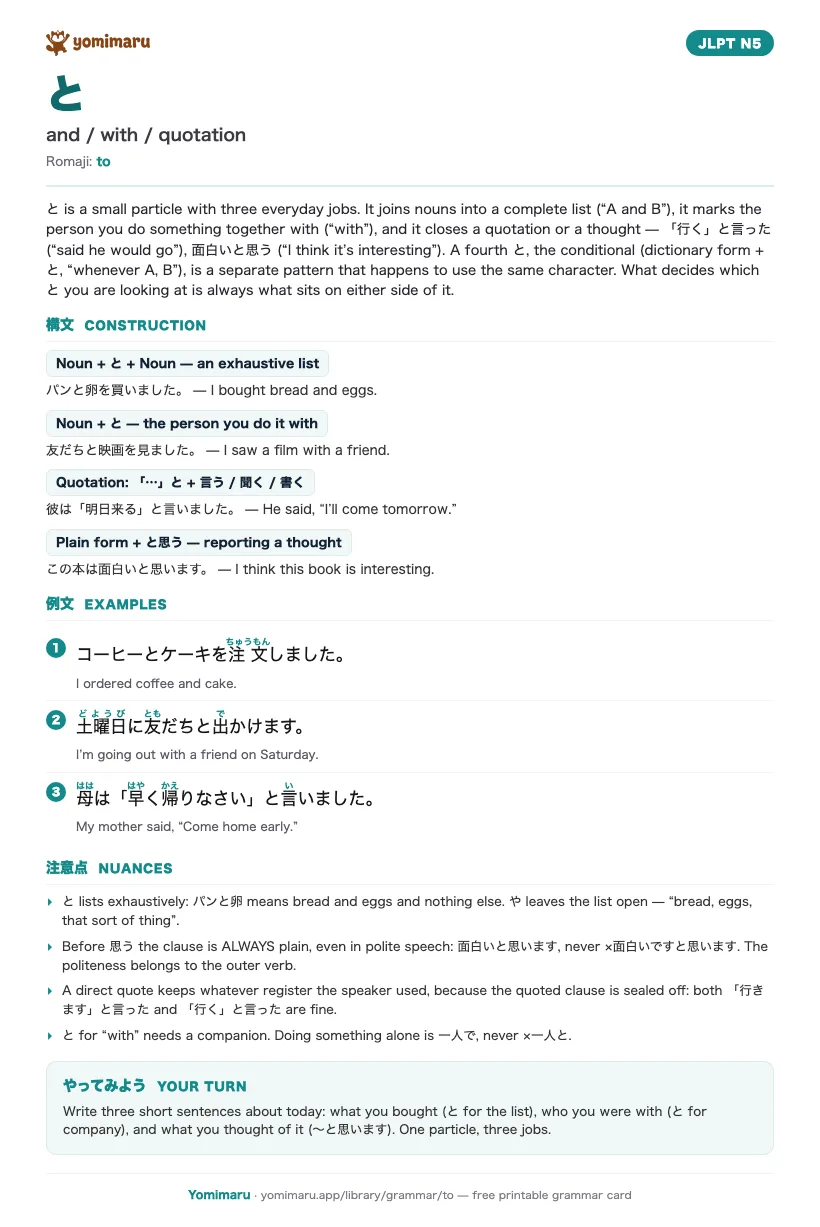
It joins nouns into a complete list (“A and B”), it marks the person you do something together with (“with”), and it closes a quotation or a thought — 「行く」と言った (“said he would go”), 面白いと思う (“I think it’s interesting”). A fourth と, the conditional (dictionary form + と, “whenever A, B”), is a separate pattern that happens to use the same character. What decides which と you are looking at is always what sits on either side of it.
構文Construction
Noun + と + Noun — an exhaustive list
パンと卵を買いました。 — I bought bread and eggs.
Noun + と — the person you do it with
友だちと映画を見ました。 — I saw a film with a friend.
Quotation: 「…」と + 言う / 聞く / 書く
彼は「明日来る」と言いました。 — He said, “I’ll come tomorrow.”
Plain form + と思う — reporting a thought
この本は面白いと思います。 — I think this book is interesting.
例文In a sentence
コーヒーとケーキを注文しました。
I ordered coffee and cake.
土曜日に友だちと出かけます。
I’m going out with a friend on Saturday.
母は「早く帰りなさい」と言いました。
My mother said, “Come home early.”
注意点Nuances
や leaves the list open — “bread, eggs, that sort of thing”.
Before 思う the clause is ALWAYS plain, even in polite speech: 面白いと思います, never ×面白いですと思います. The politeness belongs to the outer verb.
A direct quote keeps whatever register the speaker used, because the quoted clause is sealed off: both 「行きます」と言った and 「行く」と言った are fine.
と for “with” needs a companion. Doing something alone is 一人で, never ×一人と.
How と differs from similar patterns
〜という〜 — 〜という is this same quoting と welded to 言う, used to name or define something (東京という町) rather than to report what anyone actually said.
や — や lists examples and implies there is more; と lists everything there is. 本やノート suggests other stationery too, 本とノート does not.
Dictionary form+と — Dictionary form + と is the conditional と — “whenever A happens, B follows” (春になると花が咲く). Same character, unrelated job.
練習Your Turn
Tip
Write three short sentences about today: what you bought (と for the list), who you were with (と for company), and what you thought of it (〜と思います). One particle, three jobs.
と (and / with / quotation) in real sentences
Each one is quoted from a published Japanese text in this library and links to the story it came from. Some use older spellings, or break off where the sentence carried on. They are transcribed exactly as their authors wrote them.
と sits at JLPT N5 in the 302-point taxonomy every text in this library is tagged against. Each text is read for the patterns it contains, which is what lets this page list every text that uses と and pull its example sentences out of them.
The example sentences were not written to demonstrate the rule. They are quoted from published Japanese texts in this library (The Young Monk and the Rabbit and Hint among them), and each one links back to the story it came from, so you can read the sentence where it actually happened.
質問Questions
と: questions & answers
What are the main uses of the particle と?
Three in everyday Japanese: joining nouns into a complete list (パンと卵), marking who you did something with (友だちと), and closing a quotation or thought before 言う, 思う, 聞く and similar verbs. A fourth use, dictionary form + と, is the conditional “whenever”.
What is the difference between と and や when listing things?
と is exhaustive and や is not. 机の上に本とノートがあります says those two things are on the desk; 机の上に本やノートがあります says there are books, notebooks and other bits and pieces.
Why is it 面白いと思います and not 面白いですと思います?
The clause quoted by と stays in plain form, and the politeness is carried by the final verb. So you keep 面白い plain and make 思います polite. The same rule applies to 〜と言いました and 〜と書いてあります.
Is there a printable と cheat sheet?
Yes. A free one-page と (and / with / quotation) study card sits at the top of this page, as both a PDF and a PNG. It carries the JLPT N5 meaning, how the pattern attaches, 3 example sentences with furigana, and the nuances learners get wrong. You do not need an account or an email address to download it.
始めるStart free
Read the grammar you just studied
Yomimaru turns every text in the library into a reading lesson: furigana tuned to your JLPT level, tap-to-look-up on any word, and an English breakdown of the vocabulary and grammar in each sentence. It is all free, and we never ask for a card.