ので means “because (soft)”. It is a JLPT N5 pattern: below are its construction, the nuances that trip learners up, and the sentences where real Japanese writers use it.
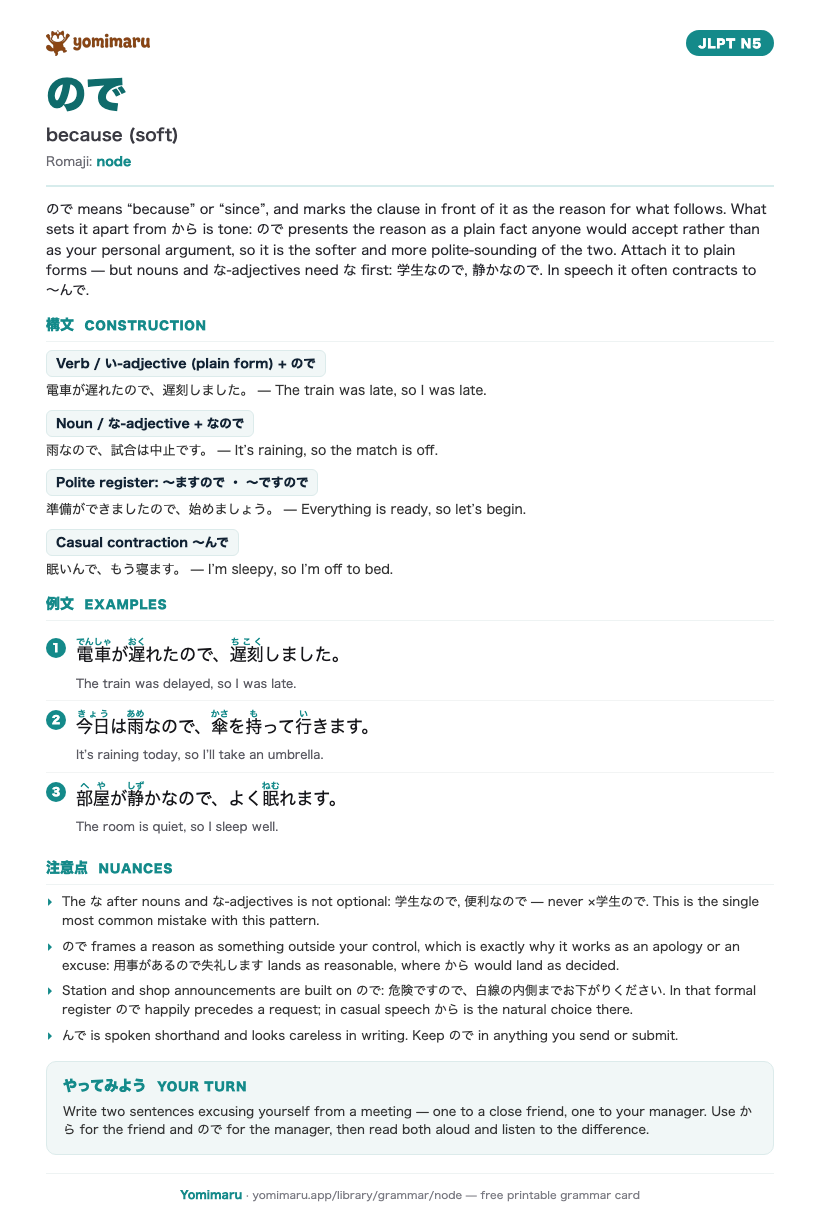
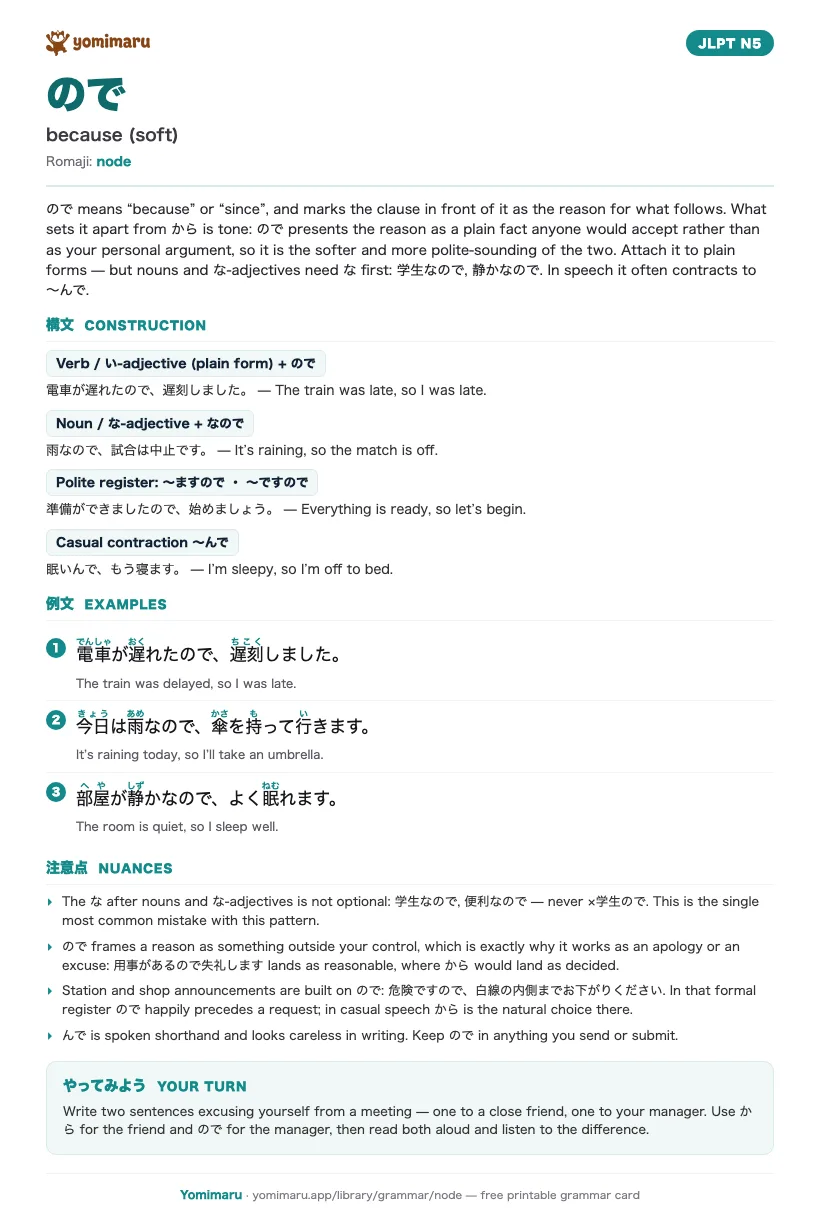
A free one-page study card for ので (because (soft)), JLPT N5: what it means, how it attaches, 3 example sentences with furigana, and the nuances that trip learners up. Read it right here, or take the PDF or PNG with you. We never ask for an email for this card.
What sets it apart from から is tone: ので presents the reason as a plain fact anyone would accept rather than as your personal argument, so it is the softer and more polite-sounding of the two. Attach it to plain forms — but nouns and な-adjectives need な first: 学生なので, 静かなので. In speech it often contracts to 〜んで.
構文Construction
Verb / い-adjective (plain form) + ので
電車が遅れたので、遅刻しました。 — The train was late, so I was late.
Noun / な-adjective + なので
雨なので、試合は中止です。 — It’s raining, so the match is off.
Polite register: 〜ますので ・ 〜ですので
準備ができましたので、始めましょう。 — Everything is ready, so let’s begin.
Casual contraction 〜んで
眠いんで、もう寝ます。 — I’m sleepy, so I’m off to bed.
例文In a sentence
電車が遅れたので、遅刻しました。
The train was delayed, so I was late.
今日は雨なので、傘を持って行きます。
It’s raining today, so I’ll take an umbrella.
部屋が静かなので、よく眠れます。
The room is quiet, so I sleep well.
注意点Nuances
This is the single most common mistake with this pattern.
ので frames a reason as something outside your control, which is exactly why it works as an apology or an excuse: 用事があるので失礼します lands as reasonable, where から would land as decided.
Station and shop announcements are built on ので: 危険ですので、白線の内側までお下がりください. In that formal register ので happily precedes a request; in casual speech から is the natural choice there.
んで is spoken shorthand and looks careless in writing. Keep ので in anything you send or submit.
How ので differs from similar patterns
〜から — から asserts the reason as your judgement and can push; ので presents it as a fact and steps back. Grammatically interchangeable in most sentences, socially not.
〜んです — んです wraps a whole statement in an explanatory tone and lets context supply what is being explained; ので links a reason clause to a result clause inside one sentence.
練習Your Turn
Tip
Write two sentences excusing yourself from a meeting — one to a close friend, one to your manager. Use から for the friend and ので for the manager, then read both aloud and listen to the difference.
ので (because (soft)) in real sentences
Each one is quoted from a published Japanese text in this library and links to the story it came from. Some use older spellings, or break off where the sentence carried on. They are transcribed exactly as their authors wrote them.
ので sits at JLPT N5 in the 302-point taxonomy every text in this library is tagged against. Each text is read for the patterns it contains, which is what lets this page list every text that uses ので and pull its example sentences out of them.
The example sentences were not written to demonstrate the rule. They are quoted from published Japanese texts in this library (The Young Monk and the Rabbit and Kewpie among them), and each one links back to the story it came from, so you can read the sentence where it actually happened.
質問Questions
ので: questions & answers
What is the difference between ので and から?
They translate the same way, but ので presents the reason as an objective fact and から presents it as your own judgement. That makes ので the safer choice when you are explaining yourself to someone senior, and から the natural choice with friends or in front of a warning like 危ないから気をつけて.
Why is it 静かなので and not 静かので?
Nouns and な-adjectives need な before ので, the same な they take before a noun. So 学生なので, 便利なので, 元気なので. Verbs and い-adjectives attach directly: 降るので, 寒いので.
Can I use ので with a request or an order?
In formal or public language, yes — 混雑しておりますので、お待ちください is standard announcement Japanese. In casual speech it sounds oddly official, and から is what people actually say: 危ないから、やめて.
Is there a printable ので cheat sheet?
Yes. A free one-page ので (because (soft)) study card sits at the top of this page, as both a PDF and a PNG. It carries the JLPT N5 meaning, how the pattern attaches, 3 example sentences with furigana, and the nuances learners get wrong. You do not need an account or an email address to download it.
始めるStart free
Read the grammar you just studied
Yomimaru turns every text in the library into a reading lesson: furigana tuned to your JLPT level, tap-to-look-up on any word, and an English breakdown of the vocabulary and grammar in each sentence. It is all free, and we never ask for a card.


 確認
確認