〜てから means “after doing”. It is a JLPT N5 pattern: below are its construction, the nuances that trip learners up, and the sentences where real Japanese writers use it.
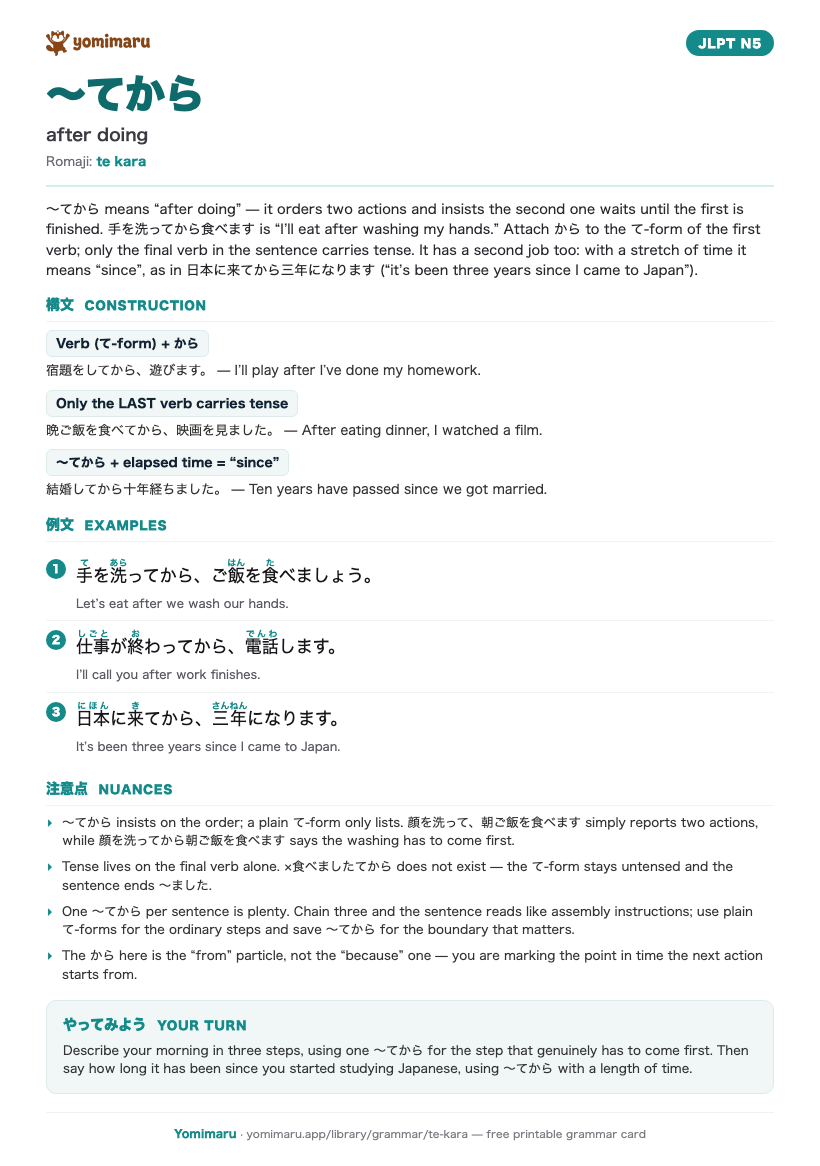
A free one-page study card for 〜てから (after doing), JLPT N5: what it means, how it attaches, 3 example sentences with furigana, and the nuances that trip learners up. Read it right here, or take the PDF or PNG with you. We never ask for an email for this card.
手を洗ってから食べます is “I’ll eat after washing my hands.” Attach から to the て-form of the first verb; only the final verb in the sentence carries tense. It has a second job too: with a stretch of time it means “since”, as in 日本に来てから三年になります (“it’s been three years since I came to Japan”).
構文Construction
Verb (て-form) + から
宿題をしてから、遊びます。 — I’ll play after I’ve done my homework.
Only the LAST verb carries tense
晩ご飯を食べてから、映画を見ました。 — After eating dinner, I watched a film.
〜てから + elapsed time = “since”
結婚してから十年経ちました。 — Ten years have passed since we got married.
例文In a sentence
手を洗ってから、ご飯を食べましょう。
Let’s eat after we wash our hands.
仕事が終わってから、電話します。
I’ll call you after work finishes.
日本に来てから、三年になります。
It’s been three years since I came to Japan.
注意点Nuances
顔を洗って、朝ご飯を食べます simply reports two actions, while 顔を洗ってから朝ご飯を食べます says the washing has to come first.
Tense lives on the final verb alone. ×食べましたてから does not exist — the て-form stays untensed and the sentence ends 〜ました.
One 〜てから per sentence is plenty. Chain three and the sentence reads like assembly instructions; use plain て-forms for the ordinary steps and save 〜てから for the boundary that matters.
The から here is the “from” particle, not the “because” one — you are marking the point in time the next action starts from.
How 〜てから differs from similar patterns
〜まえに — 〜まえに is the mirror image: 食べる前に手を洗う (“wash your hands before eating”) keeps the verb in dictionary form, where 〜てから takes the て-form.
〜たばかり — 〜たばかり says something finished moments ago; 〜てから says the next thing waits until it is done. One is about recency, the other about sequence.
〜から — The same character, a different job: a clause + から gives a reason (寒いから), while a て-form + から gives a sequence (閉めてから).
練習Your Turn
Tip
Describe your morning in three steps, using one 〜てから for the step that genuinely has to come first. Then say how long it has been since you started studying Japanese, using 〜てから with a length of time.
〜てから (after doing) in real sentences
Each one is quoted from a published Japanese text in this library and links to the story it came from. Some use older spellings, or break off where the sentence carried on. They are transcribed exactly as their authors wrote them.
〜てから sits at JLPT N5 in the 302-point taxonomy every text in this library is tagged against. Each text is read for the patterns it contains, which is what lets this page list every text that uses 〜てから and pull its example sentences out of them.
The example sentences were not written to demonstrate the rule. They are quoted from published Japanese texts in this library (The Paper Lantern and The Spirit Possessing the Mother among them), and each one links back to the story it came from, so you can read the sentence where it actually happened.
質問Questions
〜てから: questions & answers
What is the difference between 〜てから and the plain て-form?
The plain て-form just links actions in the order they happened. 〜てから adds the claim that the first one must finish before the second starts. Use it when the sequence is the point — 予約してから行ってください (“book first, then go”).
Can 〜てから mean “since”?
Yes. Followed by a length of time it marks the starting point rather than a sequence: 日本語を勉強してから五年になります (“it’s been five years since I started studying Japanese”). The verb is still in て-form; only the second half changes.
Which verb takes the tense in a 〜てから sentence?
Only the last one. The verb before から always stays in plain て-form regardless of when the action happened, and the final verb carries past, present or polite marking for the whole sentence.
Is there a printable 〜てから cheat sheet?
Yes. A free one-page 〜てから (after doing) study card sits at the top of this page, as both a PDF and a PNG. It carries the JLPT N5 meaning, how the pattern attaches, 3 example sentences with furigana, and the nuances learners get wrong. You do not need an account or an email address to download it.
始めるStart free
Read the grammar you just studied
Yomimaru turns every text in the library into a reading lesson: furigana tuned to your JLPT level, tap-to-look-up on any word, and an English breakdown of the vocabulary and grammar in each sentence. It is all free, and we never ask for a card.


 確認
確認