How 〜たことがある differs from similar patterns
- 〜たばかり — 〜たばかり means "just did" — a completion moments or days ago. 〜たことがある is a lifetime experience, with no sense of recency.
文法Grammar Point
ta koto ga aru · JLPT N5
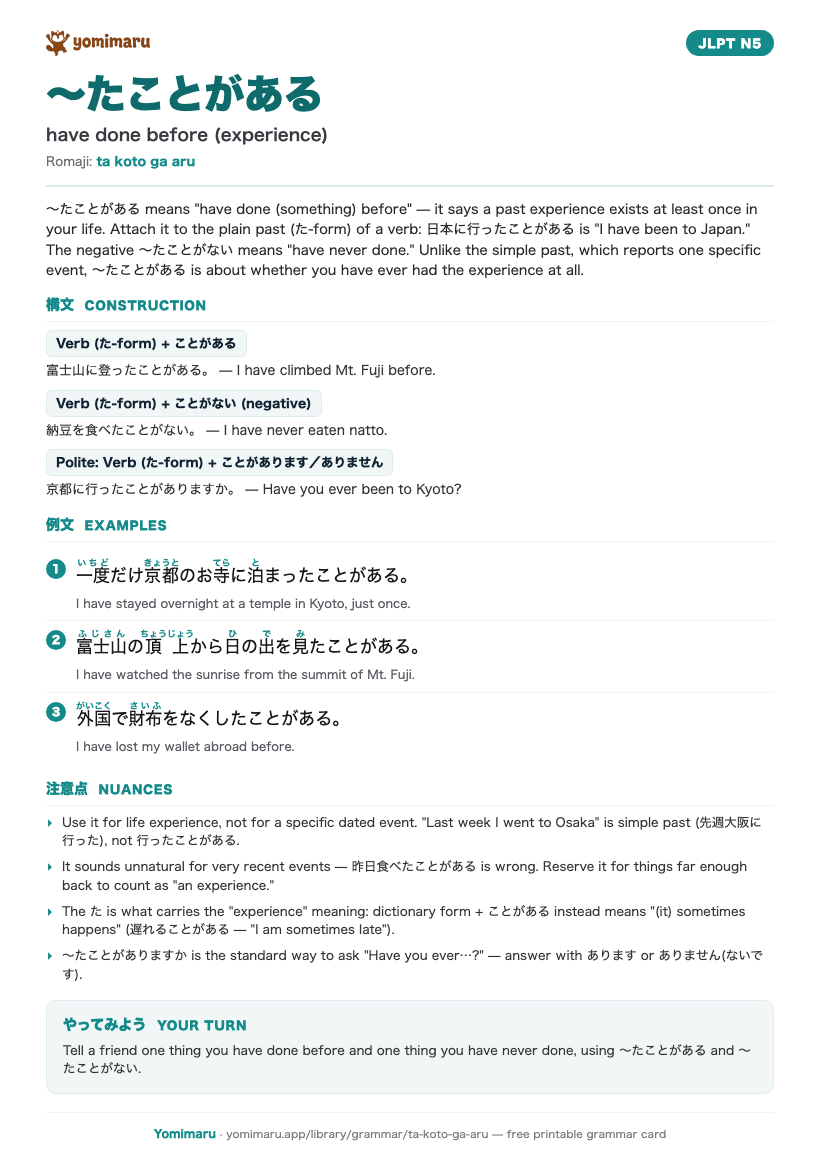
〜たことがある means “have done before (experience)”. It is a JLPT N5 pattern: below are its construction, the nuances that trip learners up, and the sentences where real Japanese writers use it.
A free one-page study card for 〜たことがある (have done before (experience)), JLPT N5: what it means, how it attaches, 3 example sentences with furigana, and the nuances that trip learners up. Read it right here, or take the PDF or PNG with you. We never ask for an email for this card.
Attach it to the plain past (た-form) of a verb: 日本に行ったことがある is "I have been to Japan." The negative 〜たことがない means "have never done." Unlike the simple past, which reports one specific event, 〜たことがある is about whether you have ever had the experience at all.
構文Construction
Verb (た-form) + ことがある
富士山に登ったことがある。 — I have climbed Mt. Fuji before.
Verb (た-form) + ことがない (negative)
納豆を食べたことがない。 — I have never eaten natto.
Polite: Verb (た-form) + ことがあります/ありません
京都に行ったことがありますか。 — Have you ever been to Kyoto?
例文In a sentence
一度だけ京都のお寺に泊まったことがある。
富士山の頂上から日の出を見たことがある。
外国で財布をなくしたことがある。
注意点Nuances
練習Your Turn
Each one is quoted from a published Japanese text in this library and links to the story it came from. Some use older spellings, or break off where the sentence carried on. They are transcribed exactly as their authors wrote them.
王さまが病気にかかったことがある。
— from The Godfather of Death (N2)
一ぺんも怒ったことがないのでした。
— from The Good-Natured Volcanic Bomb (N3)
容貌については、ひそかに修養したこともあったのだろうと思われる。
— from My Expanding Face (N2)
文展の〈月蝕の宵〉を描いた時には、モデルになってもらって、横向きやら、七三やらの姿を写させて貰った事がある。
— from The Shamisen Body (N2)
Appears in 17 of 367 texts in our library.
蔵書The texts
Free to read in full. Furigana over every kanji, a dictionary on any word you tap, and an English breakdown of each sentence.
 Read
ろくろ首
The Long-Necked Monster
小泉 八雲
Read
ろくろ首
The Long-Necked Monster
小泉 八雲
 Read
木曽の怪物
The Monster of Kiso
岡本 綺堂
Read
天草四郎の妖術
Amakusa Shiro's Sorcery
国枝 史郎
Read
木曽の怪物
The Monster of Kiso
岡本 綺堂
Read
天草四郎の妖術
Amakusa Shiro's Sorcery
国枝 史郎
 Read
気のいい火山弾
The Good-Natured Volcanic Bomb
宮沢 賢治
Read
鬼
The Demon
織田 作之助
Read
五色蟹
The Five-Colored Crab
岡本 綺堂
Read
気のいい火山弾
The Good-Natured Volcanic Bomb
宮沢 賢治
Read
鬼
The Demon
織田 作之助
Read
五色蟹
The Five-Colored Crab
岡本 綺堂
 Read
容貌
My Expanding Face
太宰 治
Read
怪談会の怪異
The Strange Incident at the Ghost Story Session
田中 貢太郎
Read
三味線の胴
The Shamisen Body
上村 松園
Read
容貌
My Expanding Face
太宰 治
Read
怪談会の怪異
The Strange Incident at the Ghost Story Session
田中 貢太郎
Read
三味線の胴
The Shamisen Body
上村 松園
 Read
赤い蝋燭
Red Candle
新美 南吉
Read
赤い蝋燭
Red Candle
新美 南吉
 Read
死神の名づけ親(第一話)
The Godfather of Death
グリム ヤーコプ・ルートヴィッヒ・カール
Read
うどんのお化け
The Udon Ghost
古川 緑波
Read
死神の名づけ親(第一話)
The Godfather of Death
グリム ヤーコプ・ルートヴィッヒ・カール
Read
うどんのお化け
The Udon Ghost
古川 緑波
解説Background
〜たことがある sits at JLPT N5 in the 302-point taxonomy every text in this library is tagged against. Each text is read for the patterns it contains, which is what lets this page list every text that uses 〜たことがある and pull its example sentences out of them.
The example sentences were not written to demonstrate the rule. They are quoted from published Japanese texts in this library (The Godfather of Death and The Good-Natured Volcanic Bomb among them), and each one links back to the story it came from, so you can read the sentence where it actually happened.
質問Questions
行った reports a specific past event ("I went to Japan"), often with a time reference. 行ったことがある says the experience exists somewhere in your past ("I have been to Japan at some point"). Use 〜たことがある when the point is whether you have ever done it, not when you did it.
Replace ある with ない: 寿司を食べたことがない means "I have never eaten sushi" (polite: 食べたことがありません). It is also the natural answer to a 〜たことがありますか question.
No — it sounds unnatural for very recent events, so use the simple past instead (昨日食べた, not 昨日食べたことがある). The pattern frames an action as a life experience, so it fits things from a while back or events you count as experiences ("I once…").
Yes. A free one-page 〜たことがある (have done before (experience)) study card sits at the top of this page, as both a PDF and a PNG. It carries the JLPT N5 meaning, how the pattern attaches, 3 example sentences with furigana, and the nuances learners get wrong. You do not need an account or an email address to download it.
始めるStart free
Read the grammar you just studied
Yomimaru turns every text in the library into a reading lesson: furigana tuned to your JLPT level, tap-to-look-up on any word, and an English breakdown of the vocabulary and grammar in each sentence. It is all free, and we never ask for a card.