〜んです means “explanatory (んだ / のだ)”. It is a JLPT N5 pattern: below are its construction, the nuances that trip learners up, and the sentences where real Japanese writers use it.
A free one-page study card for 〜んです (explanatory (んだ / のだ)), JLPT N5: what it means, how it attaches, 3 example sentences with furigana, and the nuances that trip learners up. Read it right here, or take the PDF or PNG with you. We never ask for an email for this card.
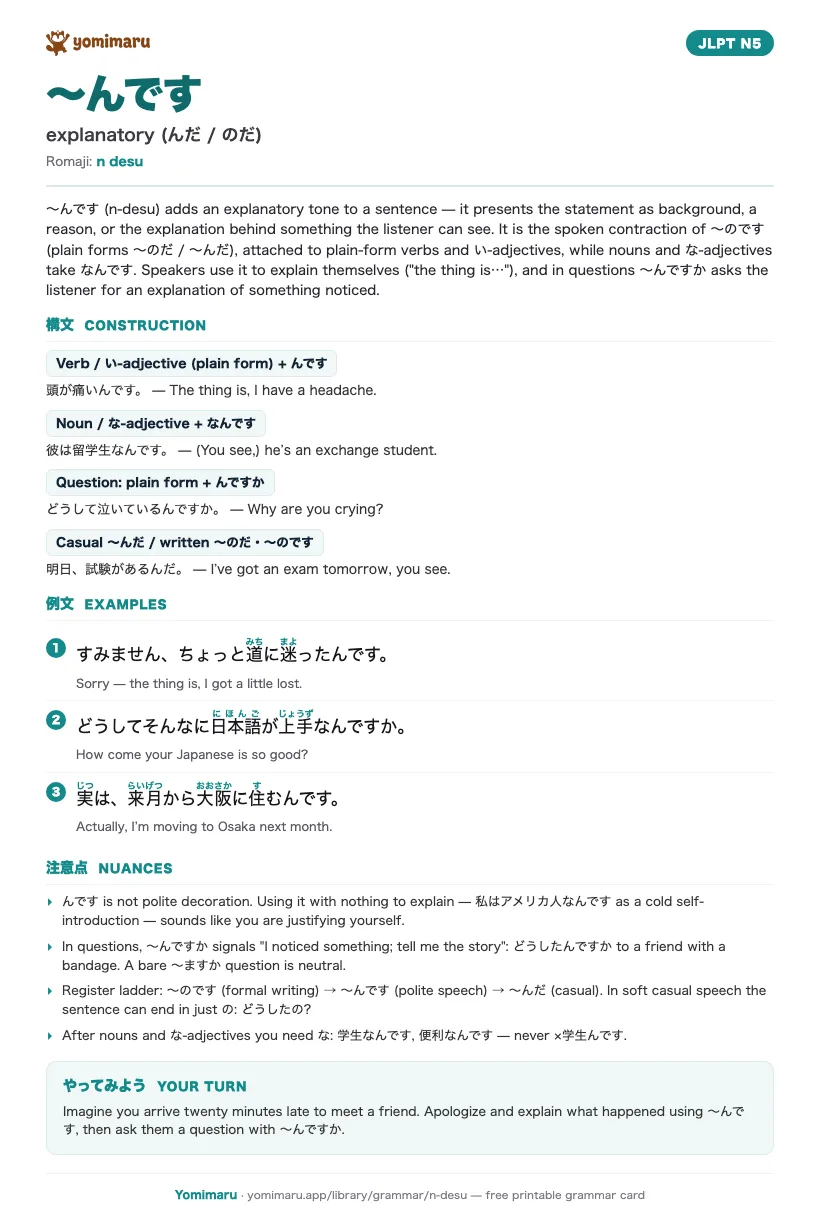
It is the spoken contraction of 〜のです (plain forms 〜のだ / 〜んだ), attached to plain-form verbs and い-adjectives, while nouns and な-adjectives take なんです. Speakers use it to explain themselves ("the thing is…"), and in questions 〜んですか asks the listener for an explanation of something noticed.
構文Construction
Verb / い-adjective (plain form) + んです
頭が痛いんです。 — The thing is, I have a headache.
Noun / な-adjective + なんです
彼は留学生なんです。 — (You see,) he’s an exchange student.
Question: plain form + んですか
どうして泣いているんですか。 — Why are you crying?
Casual 〜んだ / written 〜のだ・〜のです
明日、試験があるんだ。 — I’ve got an exam tomorrow, you see.
例文In a sentence
すみません、ちょっと道に迷ったんです。
Sorry — the thing is, I got a little lost.
どうしてそんなに日本語が上手なんですか。
How come your Japanese is so good?
実は、来月から大阪に住むんです。
Actually, I’m moving to Osaka next month.
注意点Nuances
Using it with nothing to explain — 私はアメリカ人なんです as a cold self-introduction — sounds like you are justifying yourself.
In questions, 〜んですか signals "I noticed something; tell me the story": どうしたんですか to a friend with a bandage. A bare 〜ますか question is neutral.
Register ladder: 〜のです (formal writing) → 〜んです (polite speech) → 〜んだ (casual). In soft casual speech the sentence can end in just の: どうしたの?
After nouns and な-adjectives you need な: 学生なんです, 便利なんです — never ×学生んです.
How 〜んです differs from similar patterns
ので — ので gives a reason mid-sentence, connecting clause A to clause B ("because A, B"). んです wraps a whole statement in an explanatory tone and lets context supply what is being explained.
〜から — から states a cause explicitly and can sound assertive; 電車が止まったんです explains your lateness more softly than the bare 電車が止まったから.
練習Your Turn
Tip
Imagine you arrive twenty minutes late to meet a friend. Apologize and explain what happened using 〜んです, then ask them a question with 〜んですか.
〜んです (explanatory (んだ / のだ)) in real sentences
Each one is quoted from a published Japanese text in this library and links to the story it came from. Some use older spellings, or break off where the sentence carried on. They are transcribed exactly as their authors wrote them.
〜んです sits at JLPT N5 in the 302-point taxonomy every text in this library is tagged against. Each text is read for the patterns it contains, which is what lets this page list every text that uses 〜んです and pull its example sentences out of them.
The example sentences were not written to demonstrate the rule. They are quoted from published Japanese texts in this library (Excellent English and American Jokes and The Mouse's Mistake among them), and each one links back to the story it came from, so you can read the sentence where it actually happened.
質問Questions
〜んです: questions & answers
What is the difference between んです, のです, and んだ?
They are the same grammar at different registers: 〜のです is the full form used in formal writing, 〜んです is standard polite speech, and 〜んだ is casual. In soft casual speech the sentence can also end in just の, as in どうしたの?
When should I NOT use んです?
When there is nothing to explain. Plain facts and first-time information take ordinary です/ます; adding んです out of nowhere implies the listener questioned you and you are justifying yourself.
Is どうしたんですか different from どうしましたか?
Both ask "what happened?", but 〜んですか shows you noticed something concrete — tears, a bandage, a strange noise — and want the story behind it. どうしましたか is more neutral and service-like; it is what a doctor or shop clerk says.
Is there a printable 〜んです cheat sheet?
Yes. A free one-page 〜んです (explanatory (んだ / のだ)) study card sits at the top of this page, as both a PDF and a PNG. It carries the JLPT N5 meaning, how the pattern attaches, 3 example sentences with furigana, and the nuances learners get wrong. You do not need an account or an email address to download it.
始めるStart free
Read the grammar you just studied
Yomimaru turns every text in the library into a reading lesson: furigana tuned to your JLPT level, tap-to-look-up on any word, and an English breakdown of the vocabulary and grammar in each sentence. It is all free, and we never ask for a card.