〜てはいけません means “must not / may not”. It is a JLPT N5 pattern: below are its construction, the nuances that trip learners up, and the sentences where real Japanese writers use it.
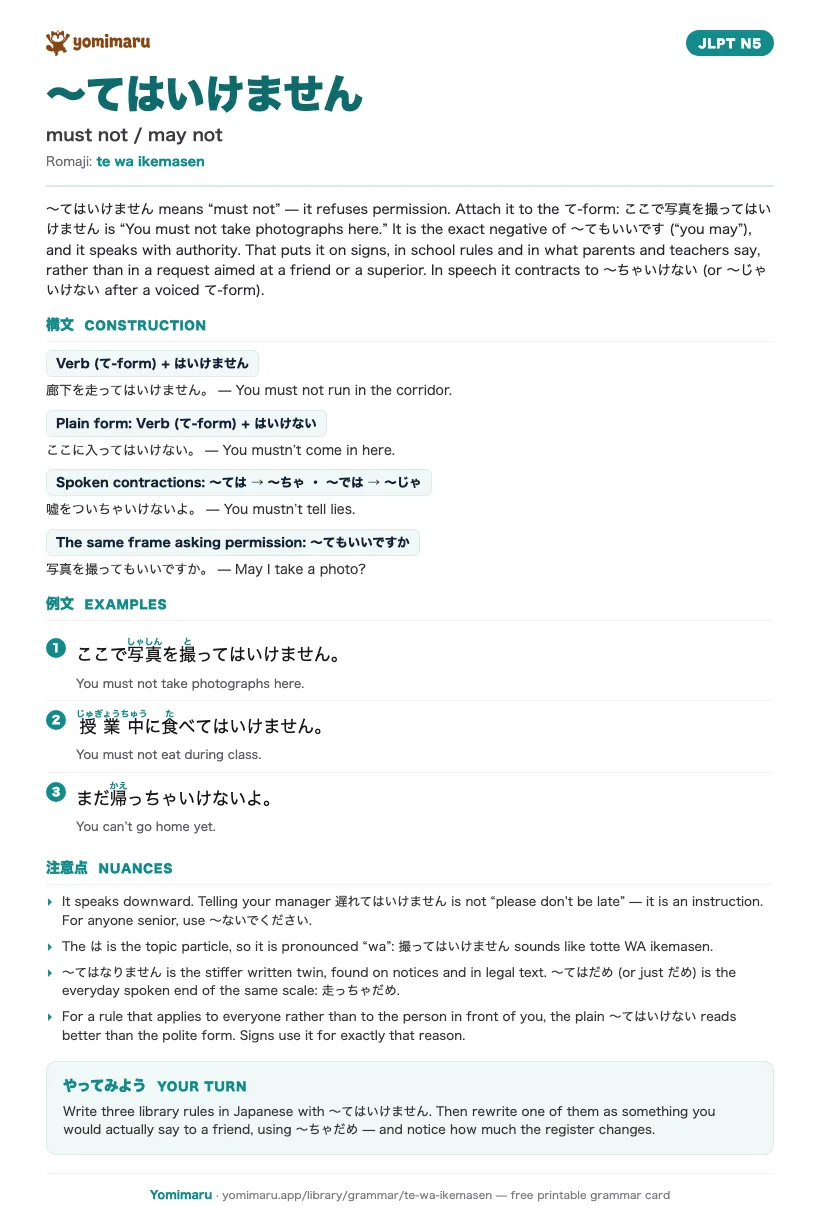
A free one-page study card for 〜てはいけません (must not / may not), JLPT N5: what it means, how it attaches, 3 example sentences with furigana, and the nuances that trip learners up. Read it right here, or take the PDF or PNG with you. We never ask for an email for this card.
Attach it to the て-form: ここで写真を撮ってはいけません is “You must not take photographs here.” It is the exact negative of 〜てもいいです (“you may”), and it speaks with authority. That puts it on signs, in school rules and in what parents and teachers say, rather than in a request aimed at a friend or a superior. In speech it contracts to 〜ちゃいけない (or 〜じゃいけない after a voiced て-form).
構文Construction
Verb (て-form) + はいけません
廊下を走ってはいけません。 — You must not run in the corridor.
Plain form: Verb (て-form) + はいけない
ここに入ってはいけない。 — You mustn’t come in here.
Spoken contractions: 〜ては → 〜ちゃ ・ 〜では → 〜じゃ
嘘をついちゃいけないよ。 — You mustn’t tell lies.
The same frame asking permission: 〜てもいいですか
写真を撮ってもいいですか。 — May I take a photo?
例文In a sentence
ここで写真を撮ってはいけません。
You must not take photographs here.
授業中に食べてはいけません。
You must not eat during class.
まだ帰っちゃいけないよ。
You can’t go home yet.
注意点Nuances
Telling your manager 遅れてはいけません is not “please don’t be late” — it is an instruction. For anyone senior, use 〜ないでください.
The は is the topic particle, so it is pronounced “wa”: 撮ってはいけません sounds like totte WA ikemasen.
〜てはなりません is the stiffer written twin, found on notices and in legal text. 〜てはだめ (or just だめ) is the everyday spoken end of the same scale: 走っちゃだめ.
For a rule that applies to everyone rather than to the person in front of you, the plain 〜てはいけない reads better than the polite form. Signs use it for exactly that reason.
How 〜てはいけません differs from similar patterns
〜なければならない — 〜なければならない is the positive obligation (“must do”); 〜てはいけません is the prohibition (“must not do”). Learners regularly reach for the wrong half of the pair.
〜てもいいです — 〜てもいいです grants exactly the permission this pattern refuses — same て-form frame, opposite answer.
ないでください — 〜ないでください asks someone not to do something; 〜てはいけません tells them they may not. One is a request, the other a rule.
練習Your Turn
Tip
Write three library rules in Japanese with 〜てはいけません. Then rewrite one of them as something you would actually say to a friend, using 〜ちゃだめ — and notice how much the register changes.
〜てはいけません (must not / may not) in real sentences
Each one is quoted from a published Japanese text in this library and links to the story it came from. Some use older spellings, or break off where the sentence carried on. They are transcribed exactly as their authors wrote them.
〜てはいけません sits at JLPT N5 in the 302-point taxonomy every text in this library is tagged against. Each text is read for the patterns it contains, which is what lets this page list every text that uses 〜てはいけません and pull its example sentences out of them.
The example sentences were not written to demonstrate the rule. They are quoted from published Japanese texts in this library (Cold and Father's Oversleeping among them), and each one links back to the story it came from, so you can read the sentence where it actually happened.
質問Questions
〜てはいけません: questions & answers
How do I say “must not” in Japanese?
Take the て-form of the verb and add はいけません: 入る → 入ってはいけません (“you must not enter”). The plain equivalent is 〜てはいけない, and the stiff written form is 〜てはなりません.
What are 〜ちゃいけない and 〜じゃいけない?
They are the spoken contractions. 〜ては shortens to 〜ちゃ (食べては → 食べちゃ) and 〜では shortens to 〜じゃ (飲んでは → 飲んじゃ). Both are casual, common in conversation, and out of place in writing.
Is 〜てはいけません rude?
Not rude, but it comes from a position of authority. It is right for signs, rules and adults talking to children, and wrong for asking a colleague or a superior to stop doing something — there, use 〜ないでください.
Is there a printable 〜てはいけません cheat sheet?
Yes. A free one-page 〜てはいけません (must not / may not) study card sits at the top of this page, as both a PDF and a PNG. It carries the JLPT N5 meaning, how the pattern attaches, 3 example sentences with furigana, and the nuances learners get wrong. You do not need an account or an email address to download it.
始めるStart free
Read the grammar you just studied
Yomimaru turns every text in the library into a reading lesson: furigana tuned to your JLPT level, tap-to-look-up on any word, and an English breakdown of the vocabulary and grammar in each sentence. It is all free, and we never ask for a card.