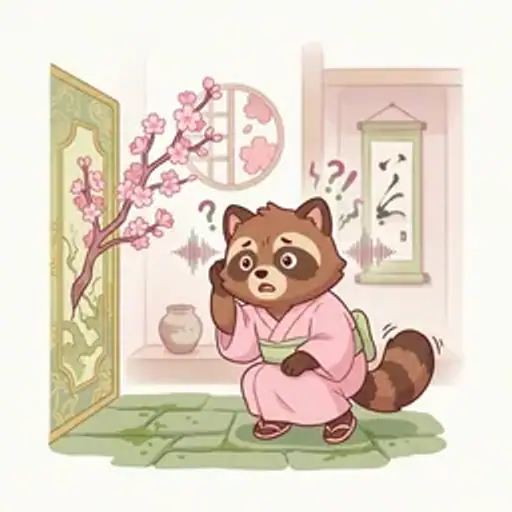
How 〜なければならない differs from similar patterns
- 〜てはいけません — 〜てはいけません forbids an action ("must not do"); 〜なければならない obligates one ("must do"). Both are built on negatives, so learners often flip the direction.
文法Grammar Point
nakereba naranai · JLPT N4
〜なければならない means “must / have to”. It is a JLPT N4 pattern: below are its construction, the nuances that trip learners up, and the sentences where real Japanese writers use it.
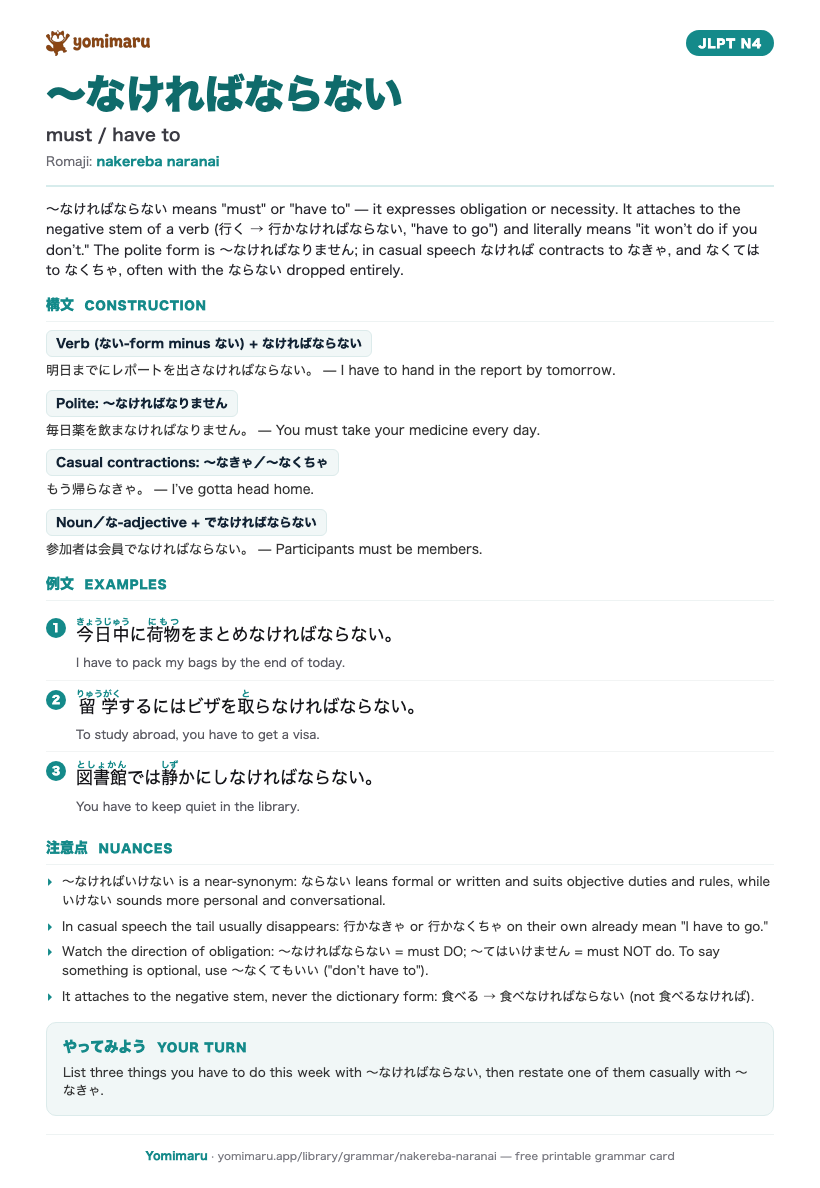
A free one-page study card for 〜なければならない (must / have to), JLPT N4: what it means, how it attaches, 3 example sentences with furigana, and the nuances that trip learners up. Read it right here, or take the PDF or PNG with you. We never ask for an email for this card.
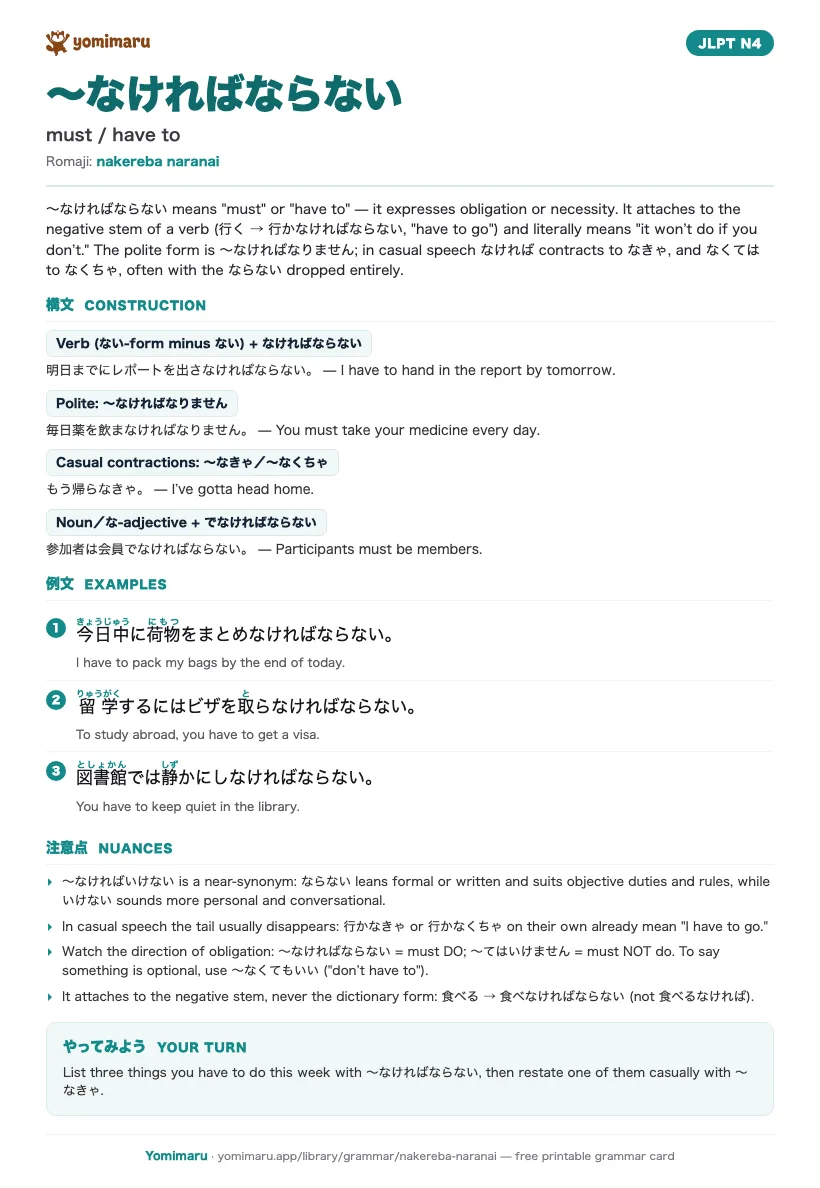
It attaches to the negative stem of a verb (行く → 行かなければならない, "have to go") and literally means "it won’t do if you don’t." The polite form is 〜なければなりません; in casual speech なければ contracts to なきゃ, and なくては to なくちゃ, often with the ならない dropped entirely.
構文Construction
Verb (ない-form minus ない) + なければならない
明日までにレポートを出さなければならない。 — I have to hand in the report by tomorrow.
Polite: 〜なければなりません
毎日薬を飲まなければなりません。 — You must take your medicine every day.
Casual contractions: 〜なきゃ/〜なくちゃ
もう帰らなきゃ。 — I’ve gotta head home.
Noun/な-adjective + でなければならない
参加者は会員でなければならない。 — Participants must be members.
例文In a sentence
今日中に荷物をまとめなければならない。
留学するにはビザを取らなければならない。
図書館では静かにしなければならない。
注意点Nuances
練習Your Turn
Each one is quoted from a published Japanese text in this library and links to the story it came from. Some use older spellings, or break off where the sentence carried on. They are transcribed exactly as their authors wrote them.
バケツに水を入れなければならない。
— from The Mouse's Adventure (N3)
大便とは、何とかして捨てなければならないが、人工衛星の軌道の上では捨てるところがない。
— from The Tale of the Honey Bucket Going to an Artificial Satellite (N2)
私は一家の秘密をも、閣下の前に暴露しなければならないからでございます。
— from Two Letters (N1)
吾々は身体を大切にしなければならない。
— from Filial Piety (N1)
4 sentences taken from real Japanese texts, with the grammar removed. Pick what belongs in the gap.
Question 1 of 4
貴方は当然私に答えて下さらblankのです。
Answer: なければならない — from The Broken Variable Capacitor (N1)
バケツに水を入れblank。
Answer: なければならない — from The Mouse's Adventure (N3)
大便とは、何とかして捨てblankが、人工衛星の軌道の上では捨てるところがない。
Answer: なければならない — from The Tale of the Honey Bucket Going to an Artificial Satellite (N2)
私は一家の秘密をも、閣下の前に暴露しblankからでございます。
Answer: なければならない — from Two Letters (N1)
Read the texts these came from
Every sentence above came from a free text you can read here in full, with the rest of the story around it.
Appears in 17 of 367 texts in our library.
蔵書The texts
Free to read in full. Furigana over every kanji, a dictionary on any word you tap, and an English breakdown of each sentence.
 Read
飴だま
The Candy Drop
新美 南吉
Read
飴だま
The Candy Drop
新美 南吉
 Read
ねずみの冒険
The Mouse's Adventure
小川 未明
Read
ねずみの冒険
The Mouse's Adventure
小川 未明
 Read
あひるさん と にはとりさん
Mr. Duck and Mr. Chicken
村山 籌子
Read
二つの手紙
Two Letters
芥川 竜之介
Read
あひるさん と にはとりさん
Mr. Duck and Mr. Chicken
村山 籌子
Read
二つの手紙
Two Letters
芥川 竜之介
 Read
人工衛星へ汲取舟が行く話
The Tale of the Honey Bucket Going to an Artificial Satellite
中谷 宇吉郎
Read
大望をいだく河童
A Kappa with Great Ambitions
坂口 安吾
Read
狐のつかい
The Fox's Errand
新美 南吉
Read
天国へいった仕立屋さん
The Tailor Who Went to Heaven
グリム ヤーコプ・ルートヴィッヒ・カール
Read
ねことおしるこ
The Cat and the Sweet Red Bean Soup
小川 未明
Read
人工衛星へ汲取舟が行く話
The Tale of the Honey Bucket Going to an Artificial Satellite
中谷 宇吉郎
Read
大望をいだく河童
A Kappa with Great Ambitions
坂口 安吾
Read
狐のつかい
The Fox's Errand
新美 南吉
Read
天国へいった仕立屋さん
The Tailor Who Went to Heaven
グリム ヤーコプ・ルートヴィッヒ・カール
Read
ねことおしるこ
The Cat and the Sweet Red Bean Soup
小川 未明
 Read
寝ぼけ
Sleepyhead
夢野 久作
Read
寝ぼけ
Sleepyhead
夢野 久作
 Read
親孝行
Filial Piety
牧野 信一
Read
壊れたバリコン
The Broken Variable Capacitor
海野 十三
Read
親孝行
Filial Piety
牧野 信一
Read
壊れたバリコン
The Broken Variable Capacitor
海野 十三
解説Background
〜なければならない sits at JLPT N4 in the 302-point taxonomy every text in this library is tagged against. Each text is read for the patterns it contains, which is what lets this page list every text that uses 〜なければならない and pull its example sentences out of them.
The example sentences were not written to demonstrate the rule. They are quoted from published Japanese texts in this library (The Mouse's Adventure and The Tale of the Honey Bucket Going to an Artificial Satellite among them), and each one links back to the story it came from, so you can read the sentence where it actually happened.
質問Questions
Both mean "must." ならない leans formal or written and fits general, objective obligations like rules and duties; いけない is more conversational and often about personal circumstances. In everyday speech you will mostly hear the contractions なきゃ and なくちゃ anyway.
They are casual contractions of なければ and なくては, and the trailing ならない/いけない is usually dropped: 行かなきゃ means "gotta go." They are fine with friends and in casual fiction, but avoid them in formal writing.
They point in opposite directions: なければならない obligates you to act ("must do"), while てはいけません forbids acting ("must not do"). And to say something is not required at all, use 〜なくてもいい ("don’t have to").
Yes. A free one-page 〜なければならない (must / have to) study card sits at the top of this page, as both a PDF and a PNG. It carries the JLPT N4 meaning, how the pattern attaches, 3 example sentences with furigana, and the nuances learners get wrong. You do not need an account or an email address to download it.
始めるStart free
Read the grammar you just studied
Yomimaru turns every text in the library into a reading lesson: furigana tuned to your JLPT level, tap-to-look-up on any word, and an English breakdown of the vocabulary and grammar in each sentence. It is all free, and we never ask for a card.

 確認
確認