しか〜ない means “only / nothing but”. It is a JLPT N4 pattern: below are its construction, the nuances that trip learners up, and the sentences where real Japanese writers use it.
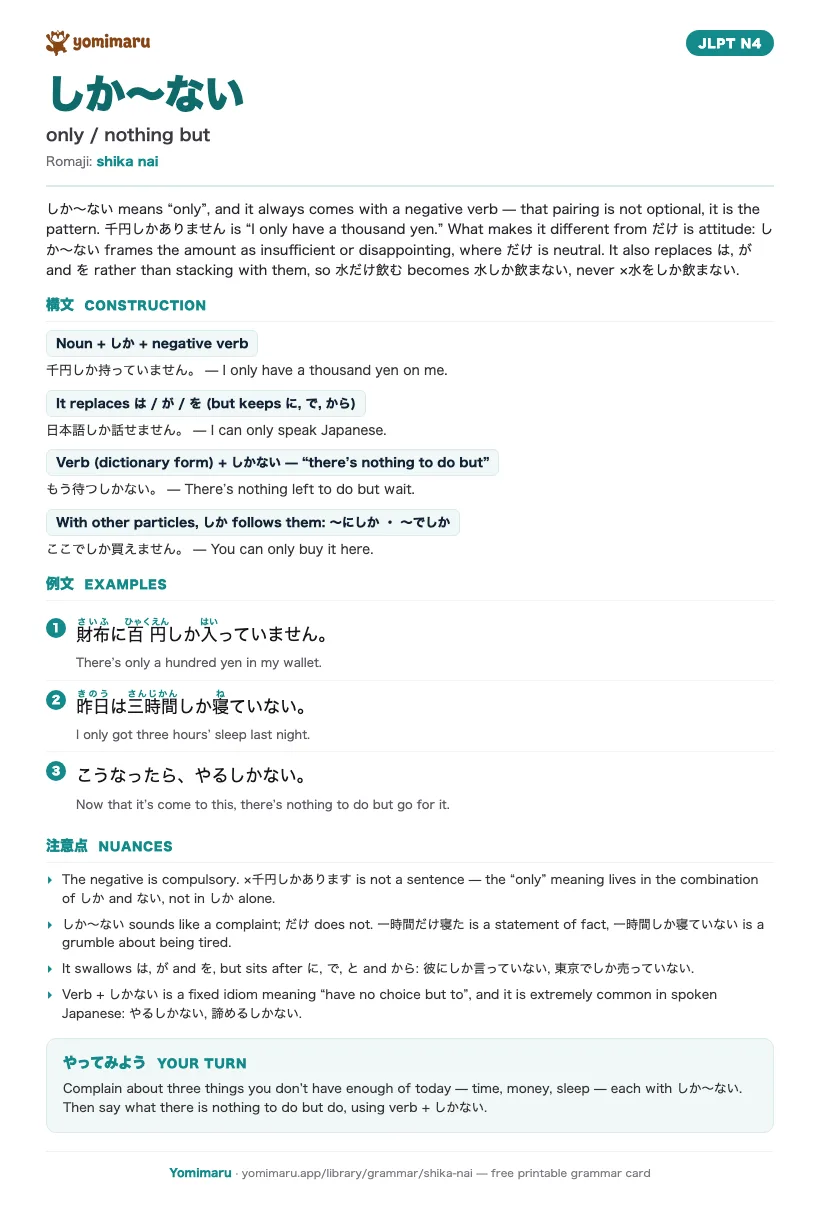
A free one-page study card for しか〜ない (only / nothing but), JLPT N4: what it means, how it attaches, 3 example sentences with furigana, and the nuances that trip learners up. Read it right here, or take the PDF or PNG with you. We never ask for an email for this card.
千円しかありません is “I only have a thousand yen.” What makes it different from だけ is attitude: しか〜ない frames the amount as insufficient or disappointing, where だけ is neutral. It also replaces は, が and を rather than stacking with them, so 水だけ飲む becomes 水しか飲まない, never ×水をしか飲まない.
構文Construction
Noun + しか + negative verb
千円しか持っていません。 — I only have a thousand yen on me.
It replaces は / が / を (but keeps に, で, から)
日本語しか話せません。 — I can only speak Japanese.
Verb (dictionary form) + しかない — “there’s nothing to do but”
もう待つしかない。 — There’s nothing left to do but wait.
With other particles, しか follows them: 〜にしか ・ 〜でしか
ここでしか買えません。 — You can only buy it here.
例文In a sentence
財布に百円しか入っていません。
There’s only a hundred yen in my wallet.
昨日は三時間しか寝ていない。
I only got three hours’ sleep last night.
こうなったら、やるしかない。
Now that it’s come to this, there’s nothing to do but go for it.
注意点Nuances
×千円しかあります is not a sentence — the “only” meaning lives in the combination of しか and ない, not in しか alone.
しか〜ない sounds like a complaint; だけ does not. 一時間だけ寝た is a statement of fact, 一時間しか寝ていない is a grumble about being tired.
It swallows は, が and を, but sits after に, で, と and から: 彼にしか言っていない, 東京でしか売っていない.
Verb + しかない is a fixed idiom meaning “have no choice but to”, and it is extremely common in spoken Japanese: やるしかない, 諦めるしかない.
How しか〜ない differs from similar patterns
〜ばかり — 〜ばかり means “nothing but” in the sense of too much of one thing (お菓子ばかり食べている); しか〜ない means too little of everything else.
〜なかなか〜ない — なかなか〜ない says something is hard to achieve; しか〜ない says the amount that was achieved falls short.
練習Your Turn
Tip
Complain about three things you don’t have enough of today — time, money, sleep — each with しか〜ない. Then say what there is nothing to do but do, using verb + しかない.
しか〜ない (only / nothing but) in real sentences
Each one is quoted from a published Japanese text in this library and links to the story it came from. Some use older spellings, or break off where the sentence carried on. They are transcribed exactly as their authors wrote them.
しか〜ない sits at JLPT N4 in the 302-point taxonomy every text in this library is tagged against. Each text is read for the patterns it contains, which is what lets this page list every text that uses しか〜ない and pull its example sentences out of them.
The example sentences were not written to demonstrate the rule. They are quoted from published Japanese texts in this library (Goose's Birthday and The Thief Cat among them), and each one links back to the story it came from, so you can read the sentence where it actually happened.
質問Questions
しか〜ない: questions & answers
Why does しか always need a negative verb?
Because the two halves make the meaning together. しか marks the one thing that is included, and ない excludes everything else — literally “apart from a thousand yen, there isn’t any”. Neither half means “only” on its own.
What is the difference between しか〜ない and だけ?
だけ is neutral (“just this much”), while しか〜ない adds disappointment (“only this much, unfortunately”). 二人だけ来た simply reports two people came; 二人しか来なかった says you expected more.
Do I keep を before しか?
No. しか replaces は, が and を: 水しか飲まない, not ×水をしか飲まない. It does sit after the other particles, though — にしか, でしか, からしか are all correct.
Is there a printable しか〜ない cheat sheet?
Yes. A free one-page しか〜ない (only / nothing but) study card sits at the top of this page, as both a PDF and a PNG. It carries the JLPT N4 meaning, how the pattern attaches, 3 example sentences with furigana, and the nuances learners get wrong. You do not need an account or an email address to download it.
始めるStart free
Read the grammar you just studied
Yomimaru turns every text in the library into a reading lesson: furigana tuned to your JLPT level, tap-to-look-up on any word, and an English breakdown of the vocabulary and grammar in each sentence. It is all free, and we never ask for a card.