〜させるmake/let someone do (causative): Meaning & Examples
saseru · JLPT N4
JLPT N48 textsStudy card
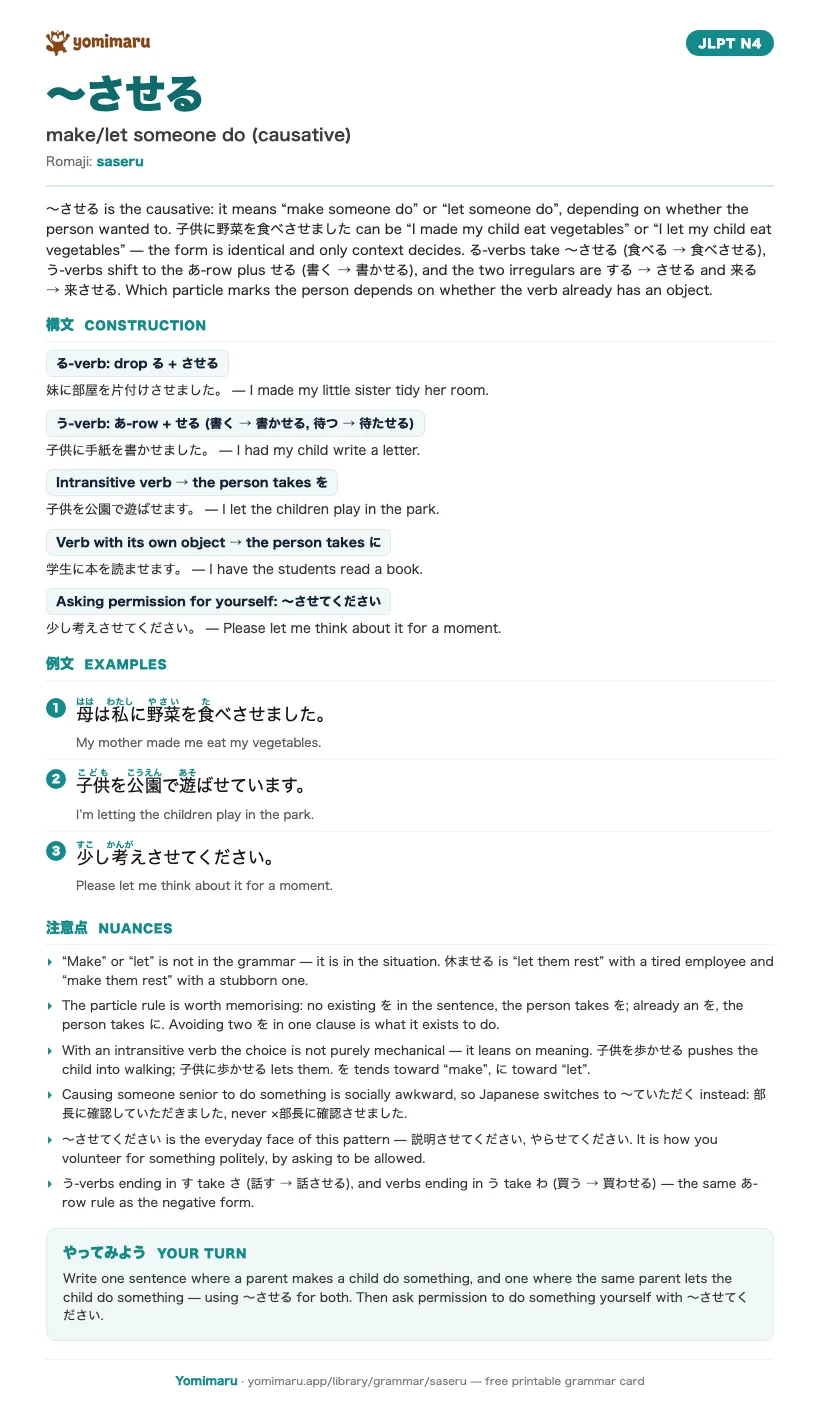
〜させる means “make/let someone do (causative)”. It is a JLPT N4 pattern: below are its construction, the nuances that trip learners up, and the sentences where real Japanese writers use it.
A free one-page study card for 〜させる (make/let someone do (causative)), JLPT N4: what it means, how it attaches, 3 example sentences with furigana, and the nuances that trip learners up. Read it right here, or take the PDF or PNG with you. We never ask for an email for this card.
子供に野菜を食べさせました can be “I made my child eat vegetables” or “I let my child eat vegetables” — the form is identical and only context decides. る-verbs take 〜させる (食べる → 食べさせる), う-verbs shift to the あ-row plus せる (書く → 書かせる), and the two irregulars are する → させる and 来る → 来させる. Which particle marks the person depends on whether the verb already has an object.
構文Construction
る-verb: drop る + させる
妹に部屋を片付けさせました。 — I made my little sister tidy her room.
う-verb: あ-row + せる (書く → 書かせる, 待つ → 待たせる)
子供に手紙を書かせました。 — I had my child write a letter.
Intransitive verb → the person takes を
子供を公園で遊ばせます。 — I let the children play in the park.
Verb with its own object → the person takes に
学生に本を読ませます。 — I have the students read a book.
Asking permission for yourself: 〜させてください
少し考えさせてください。 — Please let me think about it for a moment.
例文In a sentence
母は私に野菜を食べさせました。
My mother made me eat my vegetables.
子供を公園で遊ばせています。
I’m letting the children play in the park.
少し考えさせてください。
Please let me think about it for a moment.
注意点Nuances
休ませる is “let them rest” with a tired employee and “make them rest” with a stubborn one.
The particle rule is worth memorising: no existing を in the sentence, the person takes を; already an を, the person takes に. Avoiding two を in one clause is what it exists to do.
With an intransitive verb the choice is not purely mechanical — it leans on meaning. 子供を歩かせる pushes the child into walking; 子供に歩かせる lets them. を tends toward “make”, に toward “let”.
Causing someone senior to do something is socially awkward, so Japanese switches to 〜ていただく instead: 部長に確認していただきました, never ×部長に確認させました.
〜させてください is the everyday face of this pattern — 説明させてください, やらせてください. It is how you volunteer for something politely, by asking to be allowed.
う-verbs ending in す take さ (話す → 話させる), and verbs ending in う take わ (買う → 買わせる) — the same あ-row rule as the negative form.
How 〜させる differs from similar patterns
〜させられる — 〜させられる is the causative-passive: 食べさせられた is “I was made to eat it”, told from the point of view of the person who had no choice.
〜てもらう — 〜てもらう gets someone to do something as a favour to you and sounds grateful; 〜させる asserts your authority over them.
〜てあげる — 〜てあげる does something FOR someone; 〜させる makes or lets them do it themselves. Learners often use the causative where a benefactive is meant.
練習Your Turn
Tip
Write one sentence where a parent makes a child do something, and one where the same parent lets the child do something — using 〜させる for both. Then ask permission to do something yourself with 〜させてください.
〜させる (make/let someone do (causative)) in real sentences
Each one is quoted from a published Japanese text in this library and links to the story it came from. Some use older spellings, or break off where the sentence carried on. They are transcribed exactly as their authors wrote them.
〜させる sits at JLPT N4 in the 302-point taxonomy every text in this library is tagged against. Each text is read for the patterns it contains, which is what lets this page list every text that uses 〜させる and pull its example sentences out of them.
The example sentences were not written to demonstrate the rule. They are quoted from published Japanese texts in this library (The Mouse's Adventure and Excellent English and American Jokes among them), and each one links back to the story it came from, so you can read the sentence where it actually happened.
質問Questions
〜させる: questions & answers
Does 〜させる mean “make” or “let”?
Both — the form does not distinguish them. 子供に薬を飲ませた is “I made my child take the medicine” or “I let my child take the medicine”, and only the situation tells you which. If you need to be unambiguous about permission, use 〜てもいいと言う or 〜させてあげる.
When do I use に and when do I use を with the causative?
If the verb already has an object marked with を, the person you are causing takes に: 学生に作文を書かせる. If the verb has no object, the person takes を: 学生を立たせる. Japanese avoids two を in the same clause, and that is the whole reason for the rule.
How do I make the causative form?
る-verbs drop る and add させる (見る → 見させる). う-verbs change the final vowel to the あ-row and add せる (読む → 読ませる, 買う → 買わせる, 話す → 話させる). する becomes させる and 来る becomes 来させる.
Is there a printable 〜させる cheat sheet?
Yes. A free one-page 〜させる (make/let someone do (causative)) study card sits at the top of this page, as both a PDF and a PNG. It carries the JLPT N4 meaning, how the pattern attaches, 3 example sentences with furigana, and the nuances learners get wrong. You do not need an account or an email address to download it.
始めるStart free
Read the grammar you just studied
Yomimaru turns every text in the library into a reading lesson: furigana tuned to your JLPT level, tap-to-look-up on any word, and an English breakdown of the vocabulary and grammar in each sentence. It is all free, and we never ask for a card.