〜ことにする means “decide to”. It is a JLPT N4 pattern: below are its construction, the nuances that trip learners up, and the sentences where real Japanese writers use it.
A free one-page study card for 〜ことにする (decide to), JLPT N4: what it means, how it attaches, 3 example sentences with furigana, and the nuances that trip learners up. Read it right here, or take the PDF or PNG with you. We never ask for an email for this card.
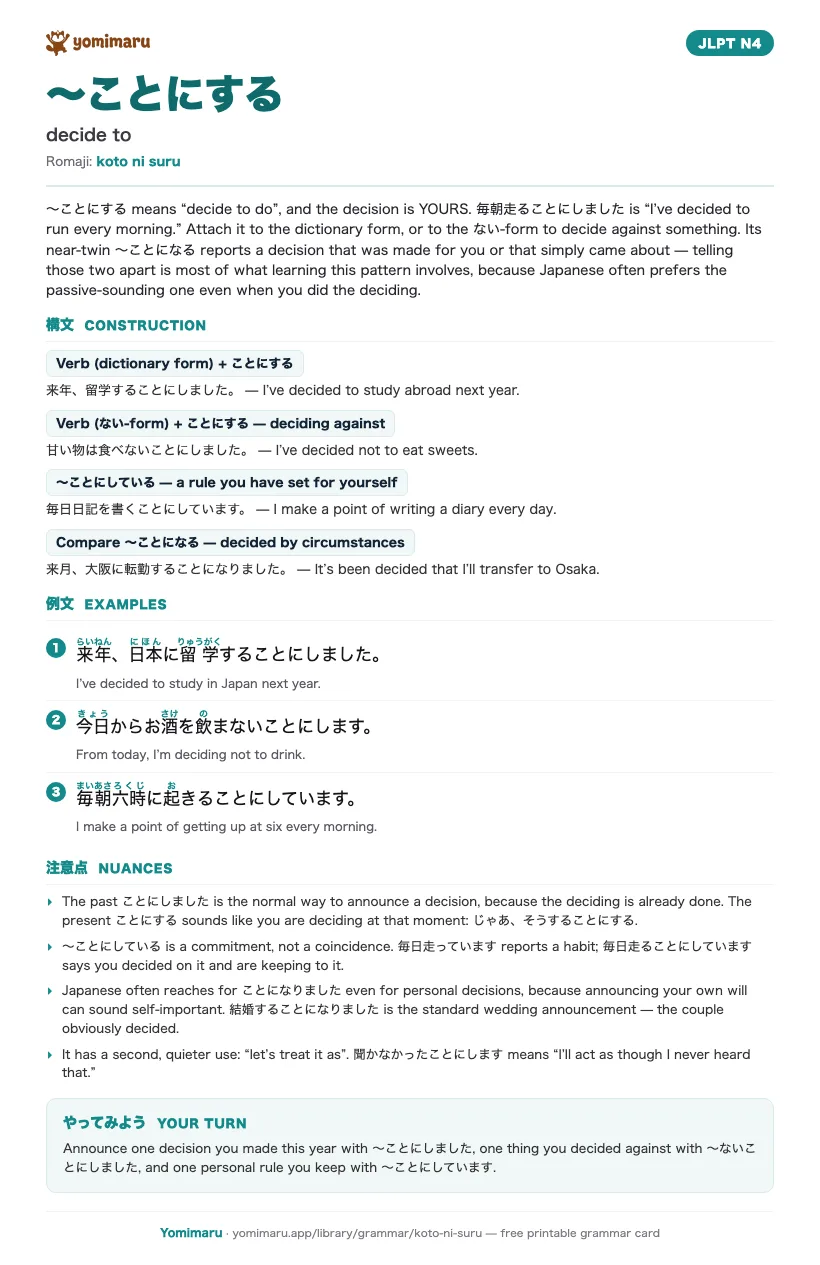
毎朝走ることにしました is “I’ve decided to run every morning.” Attach it to the dictionary form, or to the ない-form to decide against something. Its near-twin 〜ことになる reports a decision that was made for you or that simply came about — telling those two apart is most of what learning this pattern involves, because Japanese often prefers the passive-sounding one even when you did the deciding.
構文Construction
Verb (dictionary form) + ことにする
来年、留学することにしました。 — I’ve decided to study abroad next year.
Verb (ない-form) + ことにする — deciding against
甘い物は食べないことにしました。 — I’ve decided not to eat sweets.
〜ことにしている — a rule you have set for yourself
毎日日記を書くことにしています。 — I make a point of writing a diary every day.
Compare 〜ことになる — decided by circumstances
来月、大阪に転勤することになりました。 — It’s been decided that I’ll transfer to Osaka.
例文In a sentence
来年、日本に留学することにしました。
I’ve decided to study in Japan next year.
今日からお酒を飲まないことにします。
From today, I’m deciding not to drink.
毎朝六時に起きることにしています。
I make a point of getting up at six every morning.
注意点Nuances
The present ことにする sounds like you are deciding at that moment: じゃあ、そうすることにする.
〜ことにしている is a commitment, not a coincidence. 毎日走っています reports a habit; 毎日走ることにしています says you decided on it and are keeping to it.
Japanese often reaches for ことになりました even for personal decisions, because announcing your own will can sound self-important. 結婚することになりました is the standard wedding announcement — the couple obviously decided.
It has a second, quieter use: “let’s treat it as”. 聞かなかったことにします means “I’ll act as though I never heard that.”
How 〜ことにする differs from similar patterns
〜ことになる — 〜ことになる is this same frame with the agency taken out: the decision arrives from outside, or is simply how things worked out.
つもりです — つもりです states an intention you are currently holding; 〜ことにする reports the moment the decision was actually taken.
〜ようとする — 〜ようとする is an attempt in progress; 〜ことにする is the settled decision that precedes any attempt.
練習Your Turn
Tip
Announce one decision you made this year with 〜ことにしました, one thing you decided against with 〜ないことにしました, and one personal rule you keep with 〜ことにしています.
〜ことにする (decide to) in real sentences
Each one is quoted from a published Japanese text in this library and links to the story it came from. Some use older spellings, or break off where the sentence carried on. They are transcribed exactly as their authors wrote them.
〜ことにする sits at JLPT N4 in the 302-point taxonomy every text in this library is tagged against. Each text is read for the patterns it contains, which is what lets this page list every text that uses 〜ことにする and pull its example sentences out of them.
The example sentences were not written to demonstrate the rule. They are quoted from published Japanese texts in this library (The Crab's Barber Business and The Hundred-Faced Actor among them), and each one links back to the story it came from, so you can read the sentence where it actually happened.
質問Questions
〜ことにする: questions & answers
What is the difference between ことにする and ことになる?
ことにする is your own decision; ことになる is a decision that was reached for you or by circumstances. 会社を辞めることにしました says you chose to quit. 会社を辞めることになりました suggests the situation left you no choice — or is simply a modest way of announcing it.
What does ことにしている mean?
It marks a rule you have set yourself and continue to follow: 夜はコーヒーを飲まないことにしています (“I make a point of not drinking coffee at night”). The plain 〜ています would only report the habit, without the decision behind it.
How do I say I decided NOT to do something?
Use the ない-form before ことにする: 行かないことにしました (“I’ve decided not to go”). Do not negate する itself — ことにしませんでした means you never made the decision at all.
Is there a printable 〜ことにする cheat sheet?
Yes. A free one-page 〜ことにする (decide to) study card sits at the top of this page, as both a PDF and a PNG. It carries the JLPT N4 meaning, how the pattern attaches, 3 example sentences with furigana, and the nuances learners get wrong. You do not need an account or an email address to download it.
始めるStart free
Read the grammar you just studied
Yomimaru turns every text in the library into a reading lesson: furigana tuned to your JLPT level, tap-to-look-up on any word, and an English breakdown of the vocabulary and grammar in each sentence. It is all free, and we never ask for a card.