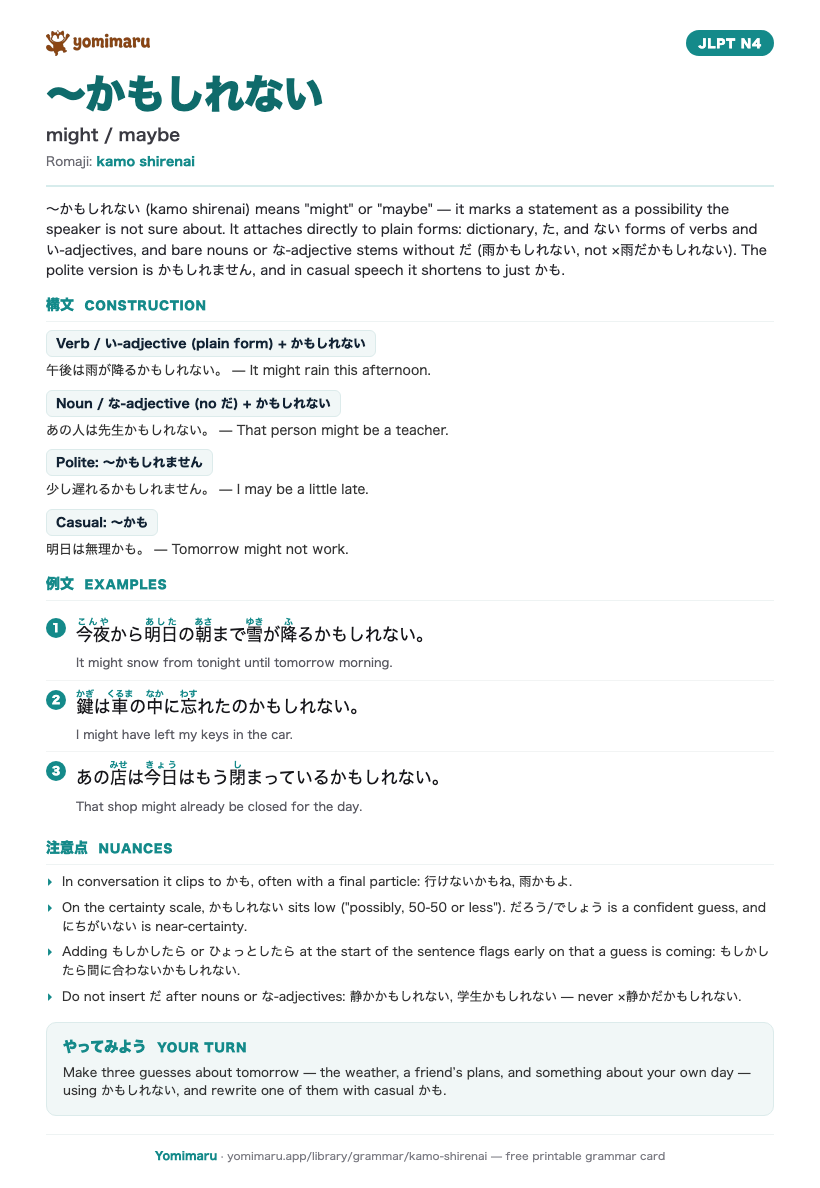
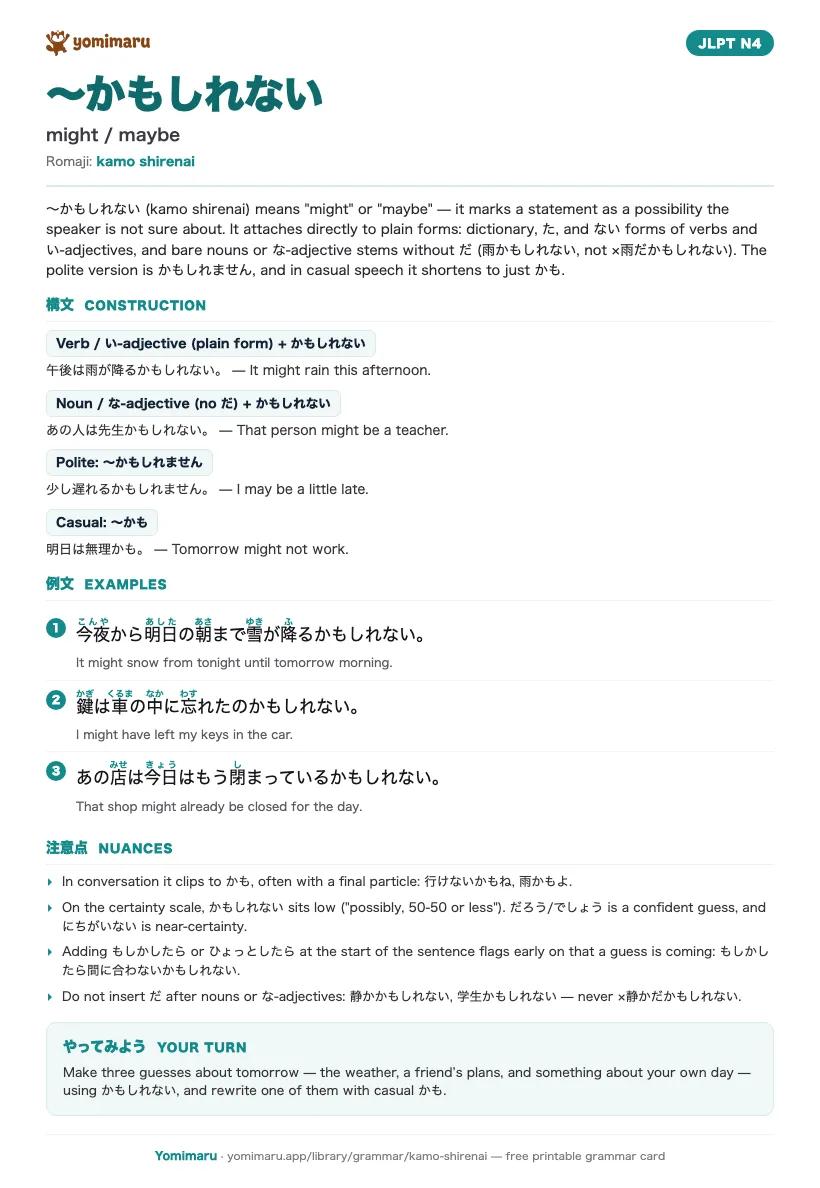
〜かもしれない means “might / maybe”. It is a JLPT N4 pattern: below are its construction, the nuances that trip learners up, and the sentences where real Japanese writers use it.
A free one-page study card for 〜かもしれない (might / maybe), JLPT N4: what it means, how it attaches, 3 example sentences with furigana, and the nuances that trip learners up. Read it right here, or take the PDF or PNG with you. We never ask for an email for this card.
It attaches directly to plain forms: dictionary, た, and ない forms of verbs and い-adjectives, and bare nouns or な-adjective stems without だ (雨かもしれない, not ×雨だかもしれない). The polite version is かもしれません, and in casual speech it shortens to just かも.
構文Construction
Verb / い-adjective (plain form) + かもしれない
午後は雨が降るかもしれない。 — It might rain this afternoon.
Noun / な-adjective (no だ) + かもしれない
あの人は先生かもしれない。 — That person might be a teacher.
Polite: 〜かもしれません
少し遅れるかもしれません。 — I may be a little late.
Casual: 〜かも
明日は無理かも。 — Tomorrow might not work.
例文In a sentence
今夜から明日の朝まで雪が降るかもしれない。
It might snow from tonight until tomorrow morning.
鍵は車の中に忘れたのかもしれない。
I might have left my keys in the car.
あの店は今日はもう閉まっているかもしれない。
That shop might already be closed for the day.
注意点Nuances
On the certainty scale, かもしれない sits low ("possibly, 50-50 or less"). だろう/でしょう is a confident guess, and にちがいない is near-certainty.
Adding もしかしたら or ひょっとしたら at the start of the sentence flags early on that a guess is coming: もしかしたら間に合わないかもしれない.
Do not insert だ after nouns or な-adjectives: 静かかもしれない, 学生かもしれない — never ×静かだかもしれない.
How 〜かもしれない differs from similar patterns
〜に違いない — 〜にちがいない expresses near-certainty ("must be"); かもしれない merely raises a possibility ("might be"). Same slot, opposite ends of the confidence scale.
でしょう — 〜でしょう/だろう states a fairly confident guess ("probably"); かもしれない is weaker and leaves the outcome genuinely open.
練習Your Turn
Tip
Make three guesses about tomorrow — the weather, a friend’s plans, and something about your own day — using かもしれない, and rewrite one of them with casual かも.
〜かもしれない (might / maybe) in real sentences
Each one is quoted from a published Japanese text in this library and links to the story it came from. Some use older spellings, or break off where the sentence carried on. They are transcribed exactly as their authors wrote them.
〜かもしれない sits at JLPT N4 in the 302-point taxonomy every text in this library is tagged against. Each text is read for the patterns it contains, which is what lets this page list every text that uses 〜かもしれない and pull its example sentences out of them.
The example sentences were not written to demonstrate the rule. They are quoted from published Japanese texts in this library (The Leg and One Fire among them), and each one links back to the story it came from, so you can read the sentence where it actually happened.
質問Questions
〜かもしれない: questions & answers
Is かも by itself grammatical?
In casual speech, yes — 行けないかも ("I might not make it") is extremely common. It is a clipped form of かもしれない; in polite conversation or writing, use the full かもしれません or かもしれない.
What is the difference between かもしれない and でしょう?
Certainty. でしょう/だろう is a fairly confident guess ("probably"), while かもしれない genuinely leaves the outcome open ("might — or might not"). You can even stack opposite possibilities: 行くかもしれないし、行かないかもしれない.
Do I need だ before かもしれない after a noun?
No — attach it directly: 学生かもしれない, 静かかもしれない. Inserting だ (×学生だかもしれない) is a common learner error; だ only surfaces in related forms like のだ or だろう.
Is there a printable 〜かもしれない cheat sheet?
Yes. A free one-page 〜かもしれない (might / maybe) study card sits at the top of this page, as both a PDF and a PNG. It carries the JLPT N4 meaning, how the pattern attaches, 3 example sentences with furigana, and the nuances learners get wrong. You do not need an account or an email address to download it.
始めるStart free
Read the grammar you just studied
Yomimaru turns every text in the library into a reading lesson: furigana tuned to your JLPT level, tap-to-look-up on any word, and an English breakdown of the vocabulary and grammar in each sentence. It is all free, and we never ask for a card.


 確認
確認