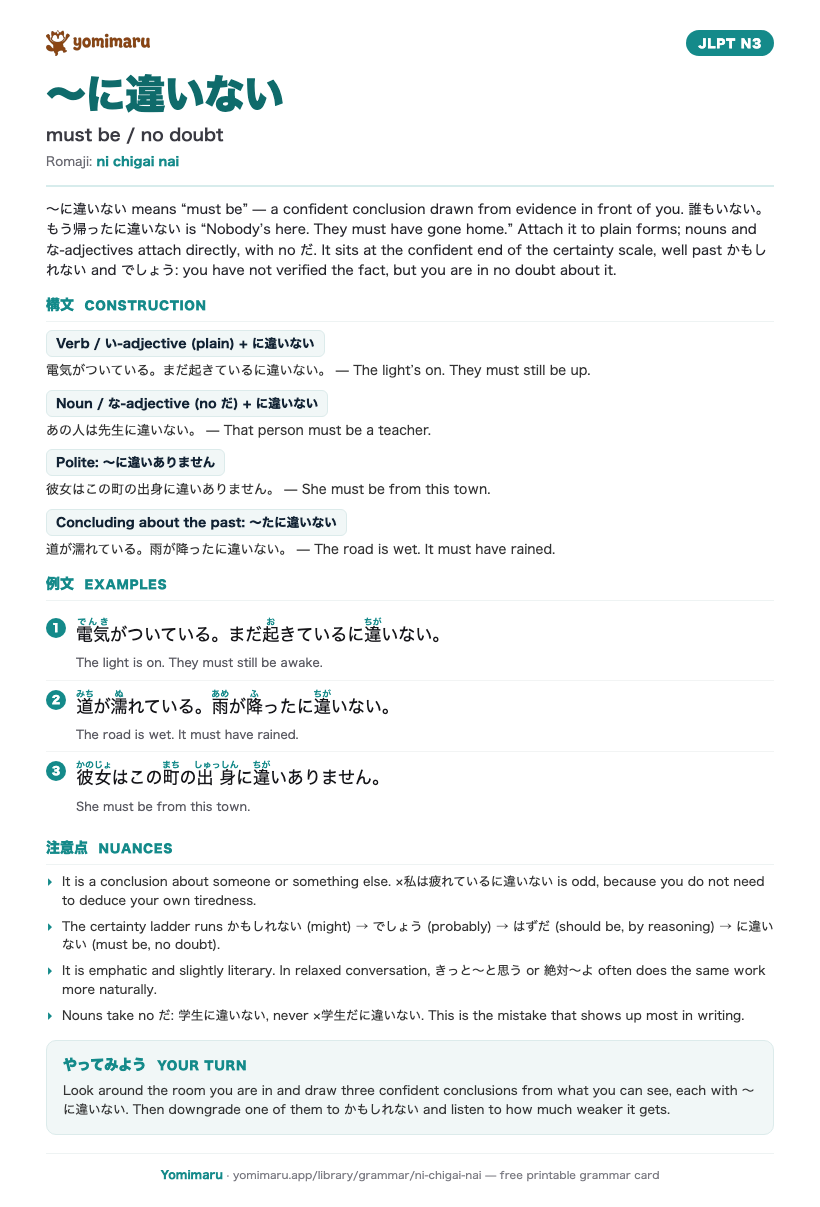
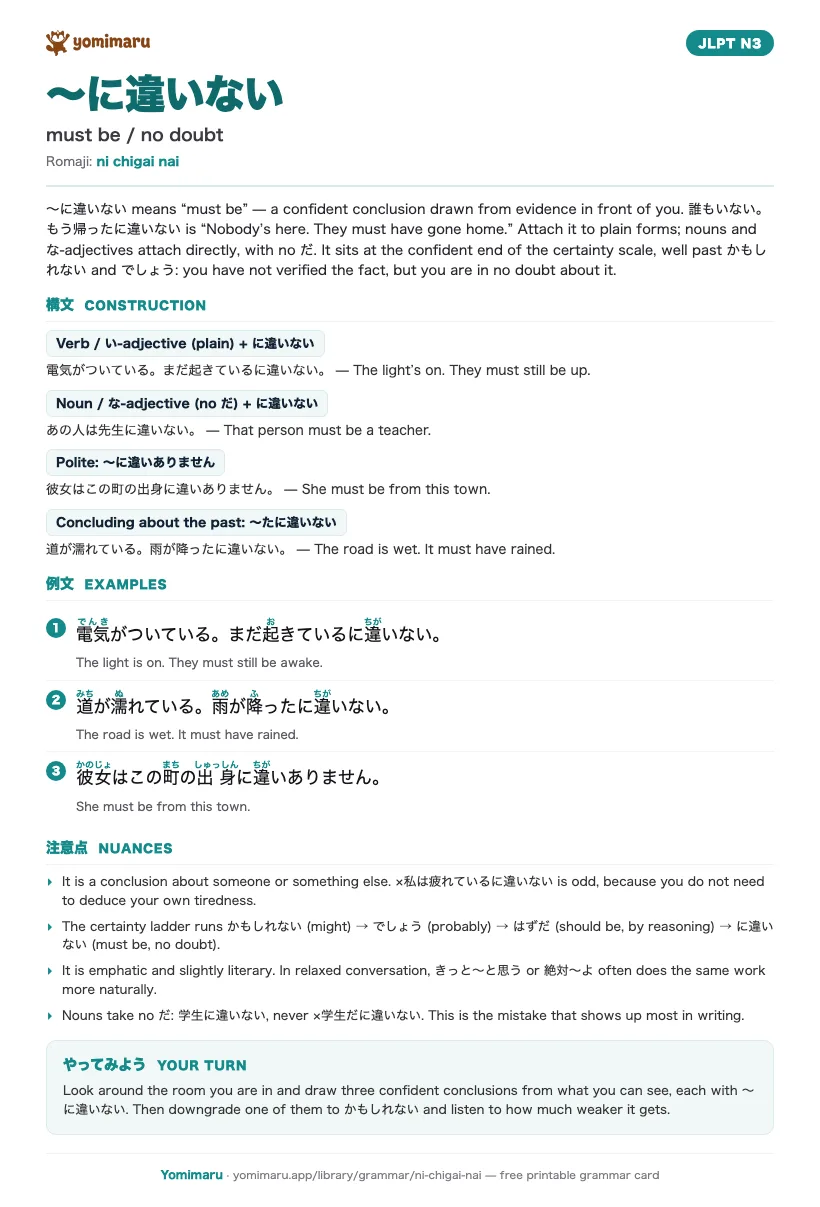
〜に違いない means “must be / no doubt”. It is a JLPT N3 pattern: below are its construction, the nuances that trip learners up, and the sentences where real Japanese writers use it.
A free one-page study card for 〜に違いない (must be / no doubt), JLPT N3: what it means, how it attaches, 3 example sentences with furigana, and the nuances that trip learners up. Read it right here, or take the PDF or PNG with you. We never ask for an email for this card.
誰もいない。もう帰ったに違いない is “Nobody’s here. They must have gone home.” Attach it to plain forms; nouns and な-adjectives attach directly, with no だ. It sits at the confident end of the certainty scale, well past かもしれない and でしょう: you have not verified the fact, but you are in no doubt about it.
構文Construction
Verb / い-adjective (plain) + に違いない
電気がついている。まだ起きているに違いない。 — The light’s on. They must still be up.
Noun / な-adjective (no だ) + に違いない
あの人は先生に違いない。 — That person must be a teacher.
Polite: 〜に違いありません
彼女はこの町の出身に違いありません。 — She must be from this town.
Concluding about the past: 〜たに違いない
道が濡れている。雨が降ったに違いない。 — The road is wet. It must have rained.
例文In a sentence
電気がついている。まだ起きているに違いない。
The light is on. They must still be awake.
道が濡れている。雨が降ったに違いない。
The road is wet. It must have rained.
彼女はこの町の出身に違いありません。
She must be from this town.
注意点Nuances
×私は疲れているに違いない is odd, because you do not need to deduce your own tiredness.
The certainty ladder runs かもしれない (might) → でしょう (probably) → はずだ (should be, by reasoning) → に違いない (must be, no doubt).
It is emphatic and slightly literary. In relaxed conversation, きっと〜と思う or 絶対〜よ often does the same work more naturally.
Nouns take no だ: 学生に違いない, never ×学生だに違いない. This is the mistake that shows up most in writing.
How 〜に違いない differs from similar patterns
〜かもしれない — かもしれない sits at the opposite end of the same scale — a real possibility you are not committing to. に違いない commits fully.
〜はずです — はずだ concludes from a rule, a schedule or an expectation (“it should be, because that’s how it works”); に違いない concludes from evidence and conviction.
〜に相違ない — 〜に相違ない is the formal written twin of this pattern, found in legal and academic prose.
練習Your Turn
Tip
Look around the room you are in and draw three confident conclusions from what you can see, each with 〜に違いない. Then downgrade one of them to かもしれない and listen to how much weaker it gets.
〜に違いない (must be / no doubt) in real sentences
Each one is quoted from a published Japanese text in this library and links to the story it came from. Some use older spellings, or break off where the sentence carried on. They are transcribed exactly as their authors wrote them.
〜に違いない sits at JLPT N3 in the 302-point taxonomy every text in this library is tagged against. Each text is read for the patterns it contains, which is what lets this page list every text that uses 〜に違いない and pull its example sentences out of them.
The example sentences were not written to demonstrate the rule. They are quoted from published Japanese texts in this library (The Role of the Cipher and Ski Diary at Goshiki Hot Springs among them), and each one links back to the story it came from, so you can read the sentence where it actually happened.
質問Questions
〜に違いない: questions & answers
How certain is 〜に違いない?
Very. It means you have no doubt, even though you have not checked. On the scale of Japanese guesses it sits above かもしれない (might), でしょう (probably) and はずだ (should be) — only a plain statement of fact is stronger.
Do I use だ before に違いない?
No. Nouns and な-adjectives attach directly: 学生に違いない, 本当に違いない. Verbs and い-adjectives use their plain form as usual: 行くに違いない, 高いに違いない.
What is the difference between に違いない and はずだ?
はずだ reasons from a rule or an expectation — 三時の便だから、もう着いているはずだ. に違いない reasons from evidence and conviction — 靴がある。まだ家にいるに違いない. はずだ can be wrong without surprise; に違いない sounds shaken if it is.
Is there a printable 〜に違いない cheat sheet?
Yes. A free one-page 〜に違いない (must be / no doubt) study card sits at the top of this page, as both a PDF and a PNG. It carries the JLPT N3 meaning, how the pattern attaches, 3 example sentences with furigana, and the nuances learners get wrong. You do not need an account or an email address to download it.
始めるStart free
Read the grammar you just studied
Yomimaru turns every text in the library into a reading lesson: furigana tuned to your JLPT level, tap-to-look-up on any word, and an English breakdown of the vocabulary and grammar in each sentence. It is all free, and we never ask for a card.


 確認
確認