〜かと思うとjust when / no sooner than: Meaning & Examples
ka to omou to · JLPT N3
JLPT N39 textsQuiz readyStudy card
〜かと思うと means “just when / no sooner than”. It is a JLPT N3 pattern: below are its construction, the nuances that trip learners up, and the sentences where real Japanese writers use it.
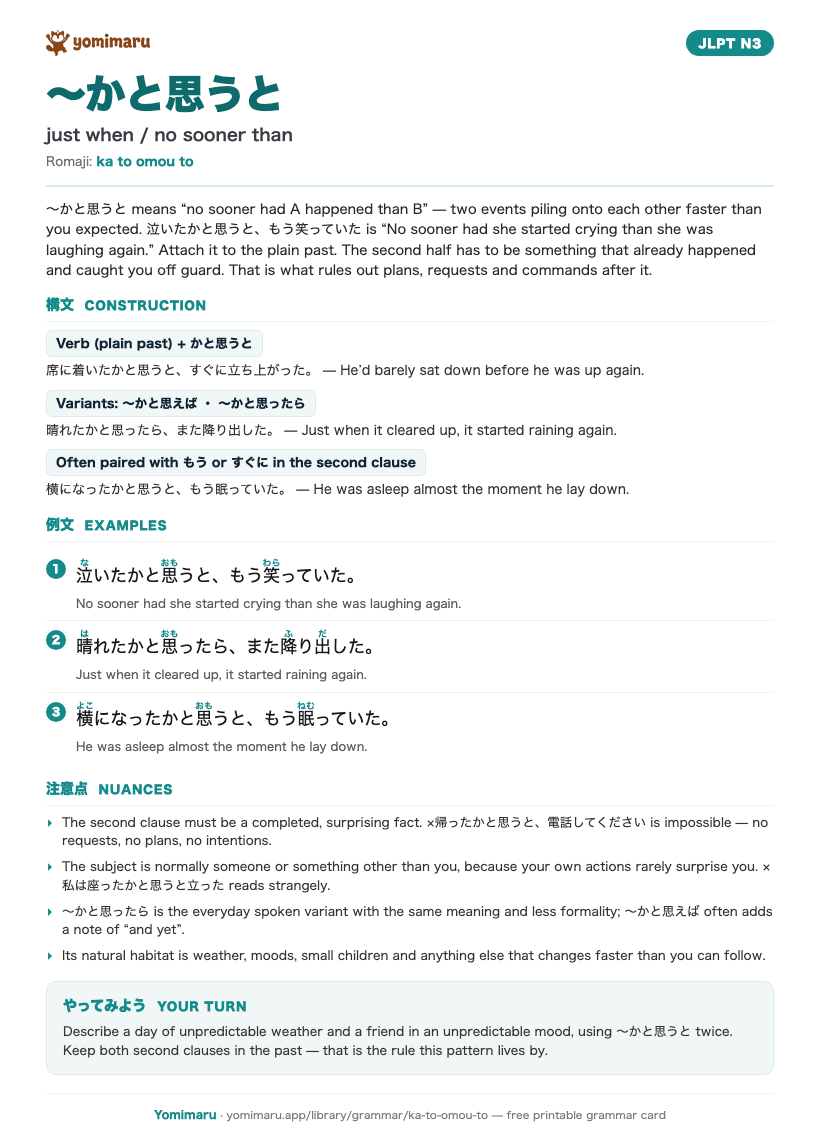
A free one-page study card for 〜かと思うと (just when / no sooner than), JLPT N3: what it means, how it attaches, 3 example sentences with furigana, and the nuances that trip learners up. Read it right here, or take the PDF or PNG with you. We never ask for an email for this card.
泣いたかと思うと、もう笑っていた is “No sooner had she started crying than she was laughing again.” Attach it to the plain past. The second half has to be something that already happened and caught you off guard. That is what rules out plans, requests and commands after it.
構文Construction
Verb (plain past) + かと思うと
席に着いたかと思うと、すぐに立ち上がった。 — He’d barely sat down before he was up again.
Variants: 〜かと思えば ・ 〜かと思ったら
晴れたかと思ったら、また降り出した。 — Just when it cleared up, it started raining again.
Often paired with もう or すぐに in the second clause
横になったかと思うと、もう眠っていた。 — He was asleep almost the moment he lay down.
例文In a sentence
泣いたかと思うと、もう笑っていた。
No sooner had she started crying than she was laughing again.
晴れたかと思ったら、また降り出した。
Just when it cleared up, it started raining again.
横になったかと思うと、もう眠っていた。
He was asleep almost the moment he lay down.
注意点Nuances
×帰ったかと思うと、電話してください is impossible — no requests, no plans, no intentions.
The subject is normally someone or something other than you, because your own actions rarely surprise you. ×私は座ったかと思うと立った reads strangely.
〜かと思ったら is the everyday spoken variant with the same meaning and less formality; 〜かと思えば often adds a note of “and yet”.
Its natural habitat is weather, moods, small children and anything else that changes faster than you can follow.
How 〜かと思うと differs from similar patterns
〜たとたん — 〜たとたん is a neutral “the instant that”; 〜かと思うと adds the speaker’s surprise at how quickly the second thing followed.
〜が早いか — 〜が早いか is the formal, literary way to say the same thing, and belongs to written narration rather than conversation.
〜や否や(いなや) — 〜や否や is another written “the moment that”, stiffer again, and common in news and essays.
練習Your Turn
Tip
Describe a day of unpredictable weather and a friend in an unpredictable mood, using 〜かと思うと twice. Keep both second clauses in the past — that is the rule this pattern lives by.
〜かと思うと (just when / no sooner than) in real sentences
Each one is quoted from a published Japanese text in this library and links to the story it came from. Some use older spellings, or break off where the sentence carried on. They are transcribed exactly as their authors wrote them.
〜かと思うと sits at JLPT N3 in the 302-point taxonomy every text in this library is tagged against. Each text is read for the patterns it contains, which is what lets this page list every text that uses 〜かと思うと and pull its example sentences out of them.
The example sentences were not written to demonstrate the rule. They are quoted from published Japanese texts in this library (April Fool and The Lighthouse Ghost among them), and each one links back to the story it came from, so you can read the sentence where it actually happened.
質問Questions
〜かと思うと: questions & answers
What does 〜かと思うと mean?
It means “no sooner had… than…”. The first clause names something that has just happened, and the second reports what followed immediately and unexpectedly: 出て行ったかと思うと、すぐ戻ってきた.
Why can’t I use a request or a plan after 〜かと思うと?
Because the second clause reports something you observed happening, not something you intend. The pattern exists to express surprise at a completed event, so it only takes past, factual statements.
What is the difference between 〜かと思うと and 〜たとたん?
They both mean “the moment that”, but 〜たとたん is a neutral statement of timing while 〜かと思うと carries the speaker’s astonishment. Use とたん to report, かと思うと to react.
Is there a printable 〜かと思うと cheat sheet?
Yes. A free one-page 〜かと思うと (just when / no sooner than) study card sits at the top of this page, as both a PDF and a PNG. It carries the JLPT N3 meaning, how the pattern attaches, 3 example sentences with furigana, and the nuances learners get wrong. You do not need an account or an email address to download it.
始めるStart free
Read the grammar you just studied
Yomimaru turns every text in the library into a reading lesson: furigana tuned to your JLPT level, tap-to-look-up on any word, and an English breakdown of the vocabulary and grammar in each sentence. It is all free, and we never ask for a card.


 確認
確認