〜ものだshould / used to / general truth: Meaning & Examples
mono da · JLPT N3
JLPT N39 textsStudy card
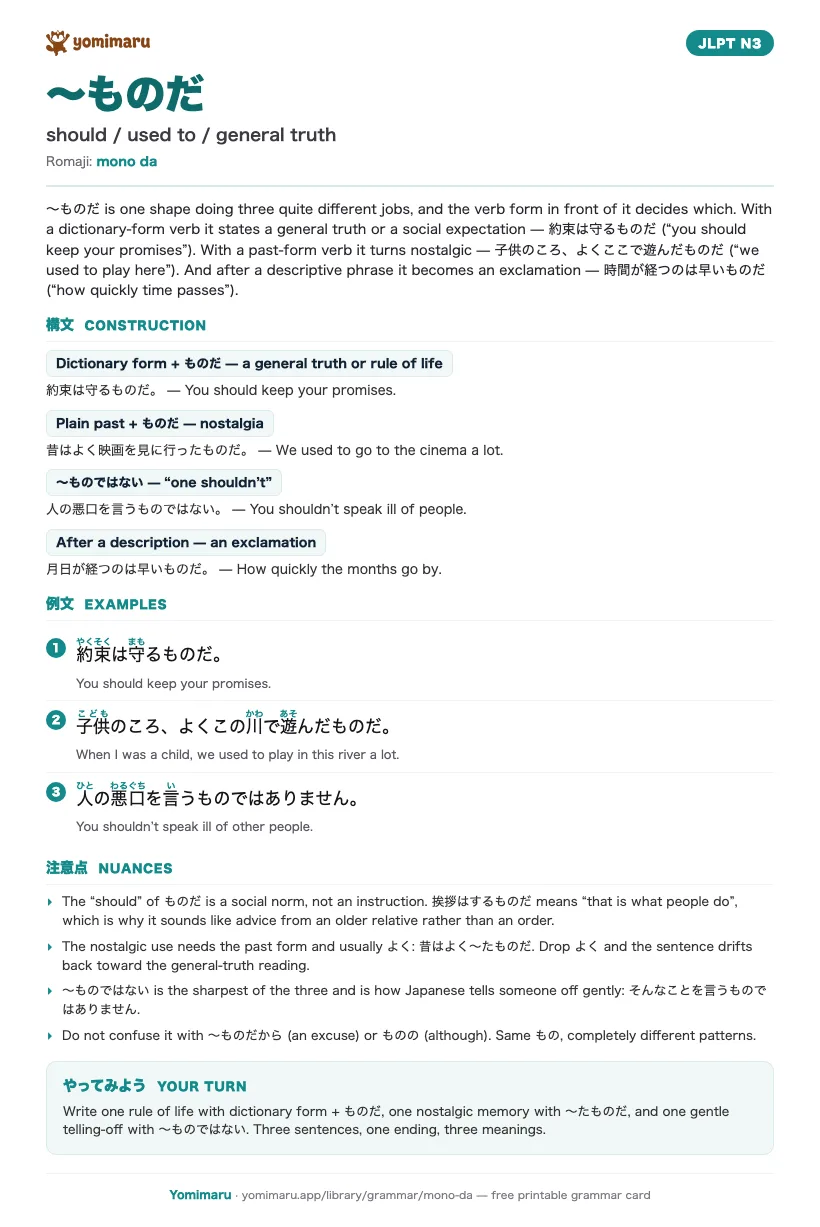
〜ものだ means “should / used to / general truth”. It is a JLPT N3 pattern: below are its construction, the nuances that trip learners up, and the sentences where real Japanese writers use it.
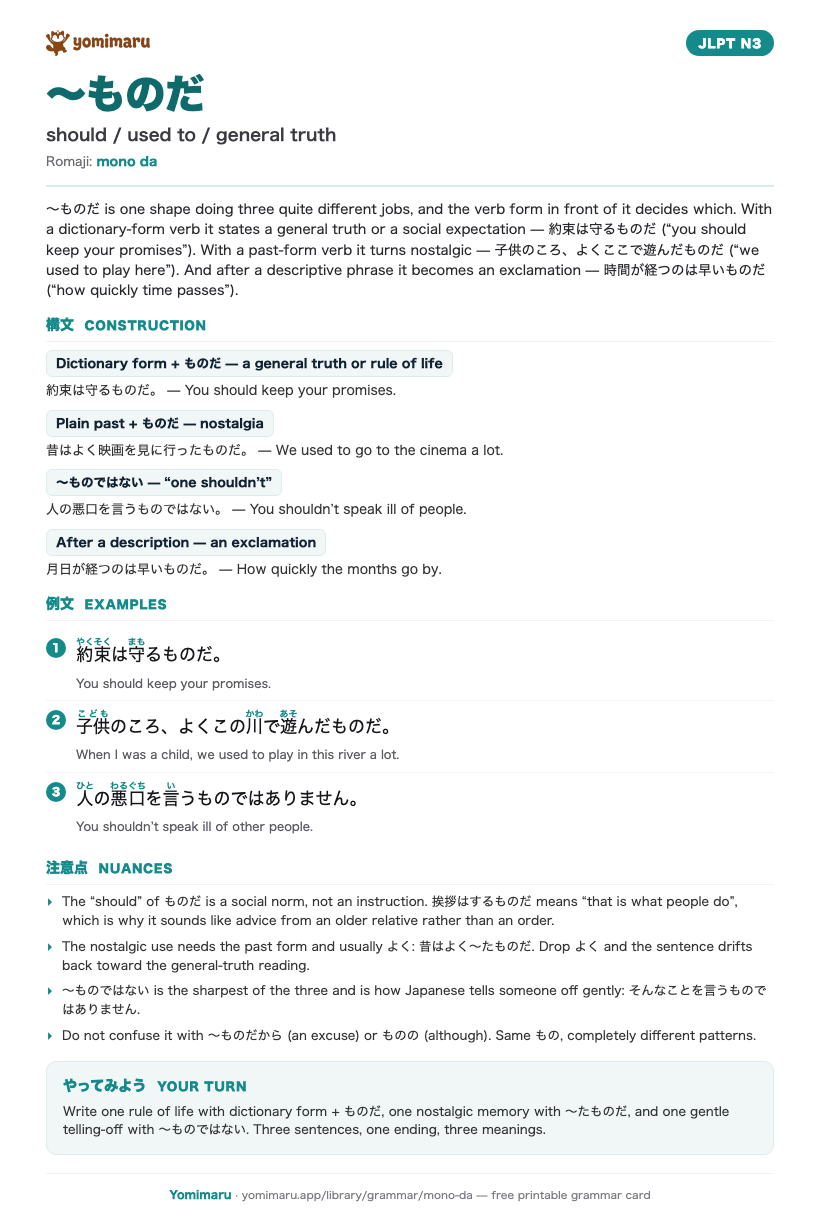
A free one-page study card for 〜ものだ (should / used to / general truth), JLPT N3: what it means, how it attaches, 3 example sentences with furigana, and the nuances that trip learners up. Read it right here, or take the PDF or PNG with you. We never ask for an email for this card.
With a dictionary-form verb it states a general truth or a social expectation — 約束は守るものだ (“you should keep your promises”). With a past-form verb it turns nostalgic — 子供のころ、よくここで遊んだものだ (“we used to play here”). And after a descriptive phrase it becomes an exclamation — 時間が経つのは早いものだ (“how quickly time passes”).
構文Construction
Dictionary form + ものだ — a general truth or rule of life
約束は守るものだ。 — You should keep your promises.
Plain past + ものだ — nostalgia
昔はよく映画を見に行ったものだ。 — We used to go to the cinema a lot.
〜ものではない — “one shouldn’t”
人の悪口を言うものではない。 — You shouldn’t speak ill of people.
After a description — an exclamation
月日が経つのは早いものだ。 — How quickly the months go by.
例文In a sentence
約束は守るものだ。
You should keep your promises.
子供のころ、よくこの川で遊んだものだ。
When I was a child, we used to play in this river a lot.
人の悪口を言うものではありません。
You shouldn’t speak ill of other people.
注意点Nuances
挨拶はするものだ means “that is what people do”, which is why it sounds like advice from an older relative rather than an order.
The nostalgic use needs the past form and usually よく: 昔はよく〜たものだ. Drop よく and the sentence drifts back toward the general-truth reading.
〜ものではない is the sharpest of the three and is how Japanese tells someone off gently: そんなことを言うものではありません.
Do not confuse it with 〜ものだから (an excuse) or ものの (although). Same もの, completely different patterns.
How 〜ものだ differs from similar patterns
〜たものだ — 〜たものだ is the nostalgic branch of this same pattern, listed separately because the past form changes the meaning entirely.
〜ものですから — 〜ものですから offers a reason as an excuse (“it’s just that…”), where ものだ states how things generally are.
〜ほうがいい — 〜ほうがいい advises one person in one situation; ものだ states what people in general are expected to do.
練習Your Turn
Tip
Write one rule of life with dictionary form + ものだ, one nostalgic memory with 〜たものだ, and one gentle telling-off with 〜ものではない. Three sentences, one ending, three meanings.
〜ものだ (should / used to / general truth) in real sentences
Each one is quoted from a published Japanese text in this library and links to the story it came from. Some use older spellings, or break off where the sentence carried on. They are transcribed exactly as their authors wrote them.
〜ものだ sits at JLPT N3 in the 302-point taxonomy every text in this library is tagged against. Each text is read for the patterns it contains, which is what lets this page list every text that uses 〜ものだ and pull its example sentences out of them.
The example sentences were not written to demonstrate the rule. They are quoted from published Japanese texts in this library (Tokyo Bay Monster Tales and A Funny Story among them), and each one links back to the story it came from, so you can read the sentence where it actually happened.
質問Questions
〜ものだ: questions & answers
What are the different meanings of 〜ものだ?
Three, sorted by the form in front of it. Dictionary form gives a general truth or social expectation (人は間違えるものだ). Past form gives nostalgia (よく遊んだものだ). A descriptive phrase gives an exclamation (寒いものだ, 早いものだ).
How is ものだ different from べきだ?
べきだ states a duty and points at the person in front of you: 謝るべきだ (“you ought to apologise”). ものだ states what people in general do, which lands as much softer: 謝るものだ (“apologising is what one does”).
How do I say “used to” with ものだ?
Use the plain past and usually add よく: 学生のころはよく徹夜したものだ (“I used to pull all-nighters as a student”). The nostalgia is part of the meaning — for a neutral past habit, 〜ていました is the better choice.
Is there a printable 〜ものだ cheat sheet?
Yes. A free one-page 〜ものだ (should / used to / general truth) study card sits at the top of this page, as both a PDF and a PNG. It carries the JLPT N3 meaning, how the pattern attaches, 3 example sentences with furigana, and the nuances learners get wrong. You do not need an account or an email address to download it.
始めるStart free
Read the grammar you just studied
Yomimaru turns every text in the library into a reading lesson: furigana tuned to your JLPT level, tap-to-look-up on any word, and an English breakdown of the vocabulary and grammar in each sentence. It is all free, and we never ask for a card.