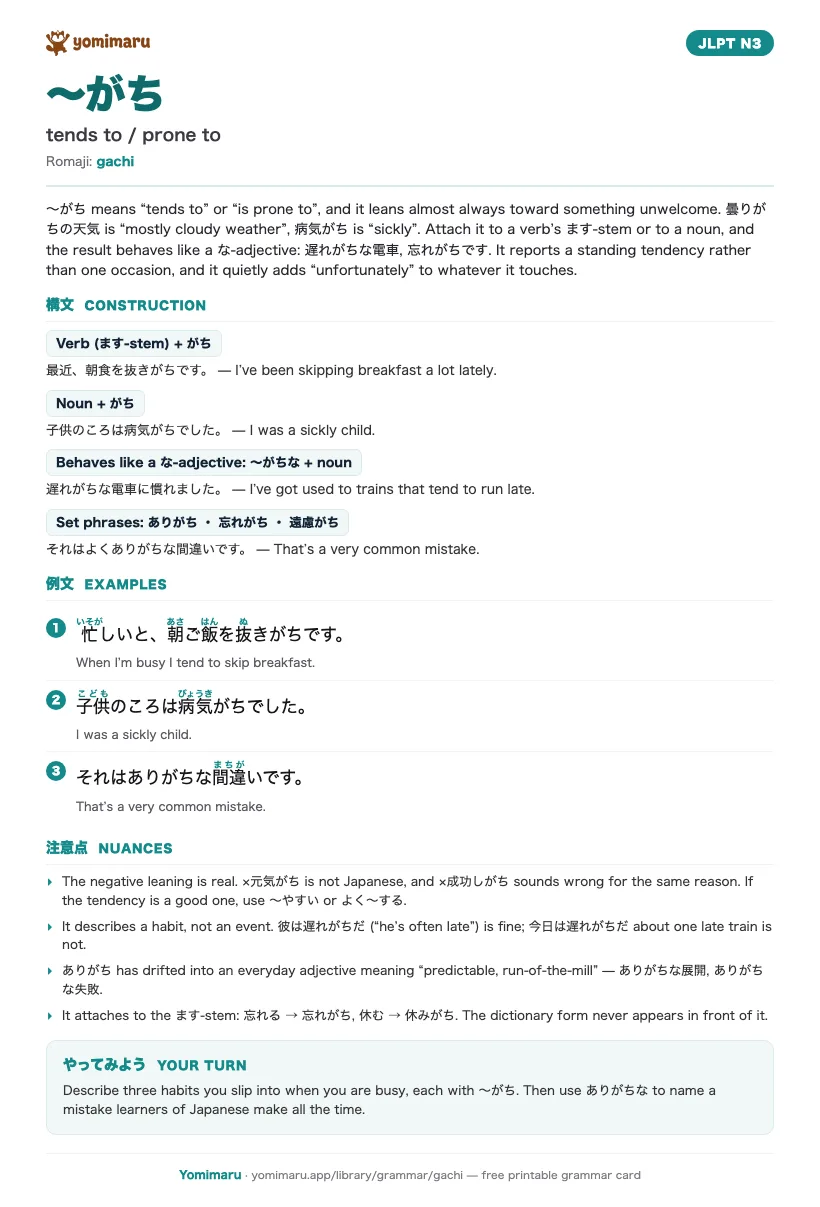
〜がち means “tends to / prone to”. It is a JLPT N3 pattern: below are its construction, the nuances that trip learners up, and the sentences where real Japanese writers use it.
A free one-page study card for 〜がち (tends to / prone to), JLPT N3: what it means, how it attaches, 3 example sentences with furigana, and the nuances that trip learners up. Read it right here, or take the PDF or PNG with you. We never ask for an email for this card.
曇りがちの天気 is “mostly cloudy weather”, 病気がち is “sickly”. Attach it to a verb’s ます-stem or to a noun, and the result behaves like a な-adjective: 遅れがちな電車, 忘れがちです. It reports a standing tendency rather than one occasion, and it quietly adds “unfortunately” to whatever it touches.
構文Construction
Verb (ます-stem) + がち
最近、朝食を抜きがちです。 — I’ve been skipping breakfast a lot lately.
Noun + がち
子供のころは病気がちでした。 — I was a sickly child.
Behaves like a な-adjective: 〜がちな + noun
遅れがちな電車に慣れました。 — I’ve got used to trains that tend to run late.
Set phrases: ありがち ・ 忘れがち ・ 遠慮がち
それはよくありがちな間違いです。 — That’s a very common mistake.
例文In a sentence
忙しいと、朝ご飯を抜きがちです。
When I’m busy I tend to skip breakfast.
子供のころは病気がちでした。
I was a sickly child.
それはありがちな間違いです。
That’s a very common mistake.
注意点Nuances
×元気がち is not Japanese, and ×成功しがち sounds wrong for the same reason. If the tendency is a good one, use 〜やすい or よく〜する.
It describes a habit, not an event. 彼は遅れがちだ (“he’s often late”) is fine; 今日は遅れがちだ about one late train is not.
ありがち has drifted into an everyday adjective meaning “predictable, run-of-the-mill” — ありがちな展開, ありがちな失敗.
It attaches to the ます-stem: 忘れる → 忘れがち, 休む → 休みがち. The dictionary form never appears in front of it.
How 〜がち differs from similar patterns
〜やすい — 〜やすい says something is easy to do or happens readily, with no judgement attached: 割れやすい (“fragile”). がち adds “and that’s a shame”.
〜っぽい — 〜っぽい says what something resembles (子供っぽい, “childish”); がち says what someone repeatedly does.
〜きらいがある — 〜きらいがある is the formal, written relative of this pattern, used for tendencies in people and institutions rather than in weather or health.
練習Your Turn
Tip
Describe three habits you slip into when you are busy, each with 〜がち. Then use ありがちな to name a mistake learners of Japanese make all the time.
〜がち (tends to / prone to) in real sentences
Each one is quoted from a published Japanese text in this library and links to the story it came from. Some use older spellings, or break off where the sentence carried on. They are transcribed exactly as their authors wrote them.
〜がち sits at JLPT N3 in the 302-point taxonomy every text in this library is tagged against. Each text is read for the patterns it contains, which is what lets this page list every text that uses 〜がち and pull its example sentences out of them.
The example sentences were not written to demonstrate the rule. They are quoted from published Japanese texts in this library (On a Certain Trend and Lecture Campaign Record among them), and each one links back to the story it came from, so you can read the sentence where it actually happened.
質問Questions
〜がち: questions & answers
What does 〜がち mean?
It marks a tendency: something that happens often and is usually unwelcome. 曇りがち is “tending to be cloudy”, 遅れがち is “often late”, 忘れがち is “easy to forget”.
Can 〜がち be used for good things?
Rarely, and it sounds odd when you try. The pattern carries a shade of regret, so for positive tendencies Japanese uses 〜やすい (覚えやすい) or simply よく〜する (よく笑う).
What form does the verb take before がち?
The ます-stem: 忘れる → 忘れがち, 休む → 休みがち, 遅れる → 遅れがち. Nouns attach directly (病気がち, 曇りがち), and the whole thing then behaves like a な-adjective.
Is there a printable 〜がち cheat sheet?
Yes. A free one-page 〜がち (tends to / prone to) study card sits at the top of this page, as both a PDF and a PNG. It carries the JLPT N3 meaning, how the pattern attaches, 3 example sentences with furigana, and the nuances learners get wrong. You do not need an account or an email address to download it.
始めるStart free
Read the grammar you just studied
Yomimaru turns every text in the library into a reading lesson: furigana tuned to your JLPT level, tap-to-look-up on any word, and an English breakdown of the vocabulary and grammar in each sentence. It is all free, and we never ask for a card.