ように means “so that / in order to”. It is a JLPT N3 pattern: below are its construction, the nuances that trip learners up, and the sentences where real Japanese writers use it.
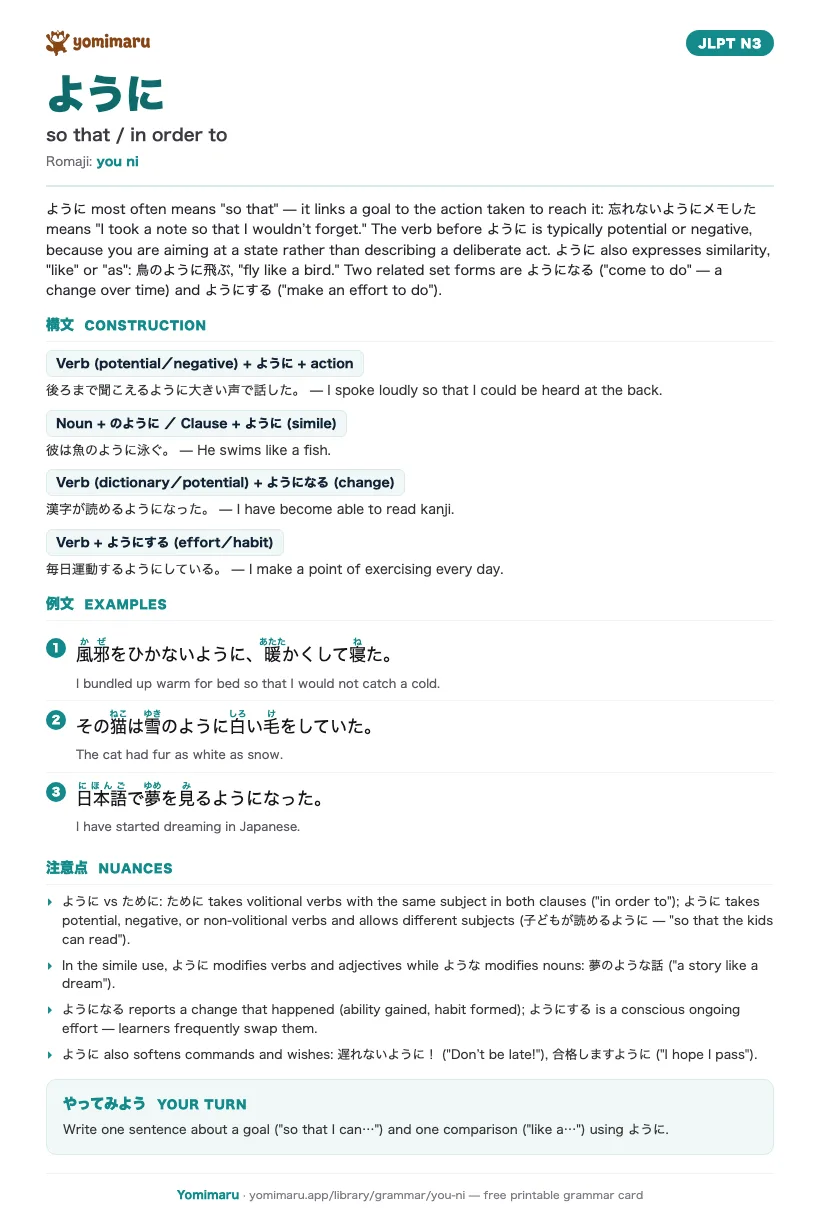
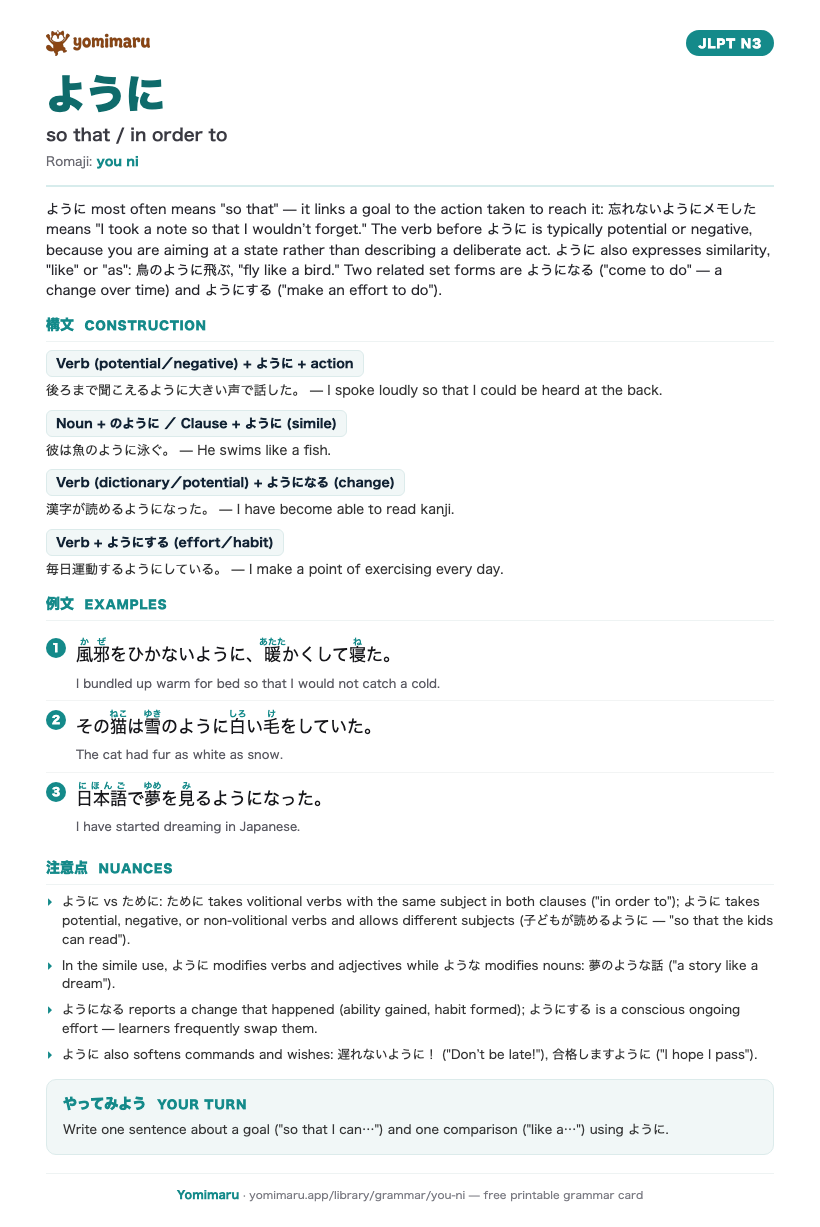
A free one-page study card for ように (so that / in order to), JLPT N3: what it means, how it attaches, 3 example sentences with furigana, and the nuances that trip learners up. Read it right here, or take the PDF or PNG with you. We never ask for an email for this card.
ように also expresses similarity, "like" or "as": 鳥のように飛ぶ, "fly like a bird." Two related set forms are ようになる ("come to do" — a change over time) and ようにする ("make an effort to do").
構文Construction
Verb (potential/negative) + ように + action
後ろまで聞こえるように大きい声で話した。 — I spoke loudly so that I could be heard at the back.
Noun + のように / Clause + ように (simile)
彼は魚のように泳ぐ。 — He swims like a fish.
Verb (dictionary/potential) + ようになる (change)
漢字が読めるようになった。 — I have become able to read kanji.
Verb + ようにする (effort/habit)
毎日運動するようにしている。 — I make a point of exercising every day.
例文In a sentence
風邪をひかないように、暖かくして寝た。
I bundled up warm for bed so that I would not catch a cold.
その猫は雪のように白い毛をしていた。
The cat had fur as white as snow.
日本語で夢を見るようになった。
I have started dreaming in Japanese.
注意点Nuances
In the simile use, ように modifies verbs and adjectives while ような modifies nouns: 夢のような話 ("a story like a dream").
ようになる reports a change that happened (ability gained, habit formed); ようにする is a conscious ongoing effort — learners frequently swap them.
ように also softens commands and wishes: 遅れないように! ("Don’t be late!"), 合格しますように ("I hope I pass").
How ように differs from similar patterns
〜ために — 〜ために is "in order to" with volitional verbs and one subject doing both actions; ように is "so that" with potential or negative verbs, and the subjects may differ.
〜ようとする — 〜ようとする means "try to / be about to do" at a specific moment; ようにする is a sustained effort or habit. One is an attempt, the other a policy.
練習Your Turn
Tip
Write one sentence about a goal ("so that I can…") and one comparison ("like a…") using ように.
ように (so that / in order to) in real sentences
Each one is quoted from a published Japanese text in this library and links to the story it came from. Some use older spellings, or break off where the sentence carried on. They are transcribed exactly as their authors wrote them.
ように sits at JLPT N3 in the 302-point taxonomy every text in this library is tagged against. Each text is read for the patterns it contains, which is what lets this page list every text that uses ように and pull its example sentences out of them.
The example sentences were not written to demonstrate the rule. They are quoted from published Japanese texts in this library (Excellent English and American Jokes and The Lotus Princess among them), and each one links back to the story it came from, so you can read the sentence where it actually happened.
質問Questions
ように: questions & answers
How do I choose between ように and ために for "in order to"?
Use ために when one subject deliberately does both actions: 日本へ行くために貯金している ("I’m saving up in order to go to Japan"). Use ように when the verb before it is potential, negative, or otherwise outside direct control (読めるように, 忘れないように), or when the two clauses have different subjects.
What is the difference between ようになる and ようにする?
ようになる describes a change that took place: 話せるようになった ("I became able to speak"). ようにする is a deliberate effort or habit: 毎日話すようにしている ("I make a point of speaking every day"). One reports a change; the other reports trying.
How can ように mean both "so that" and "like"?
What comes before it decides. After a potential or negative verb followed by an action, it marks purpose: 聞こえるように大声で話す ("speak loudly so as to be heard"). After Noun + の or a clause describing manner, it is a comparison: 氷のように冷たい ("cold as ice").
Is there a printable ように cheat sheet?
Yes. A free one-page ように (so that / in order to) study card sits at the top of this page, as both a PDF and a PNG. It carries the JLPT N3 meaning, how the pattern attaches, 3 example sentences with furigana, and the nuances learners get wrong. You do not need an account or an email address to download it.
始めるStart free
Read the grammar you just studied
Yomimaru turns every text in the library into a reading lesson: furigana tuned to your JLPT level, tap-to-look-up on any word, and an English breakdown of the vocabulary and grammar in each sentence. It is all free, and we never ask for a card.