〜てたまらないunbearably / can't stand it: Meaning & Examples
te tamaranai · JLPT N3
JLPT N35 textsStudy card
〜てたまらない means “unbearably / can't stand it”. It is a JLPT N3 pattern: below are its construction, the nuances that trip learners up, and the sentences where real Japanese writers use it.
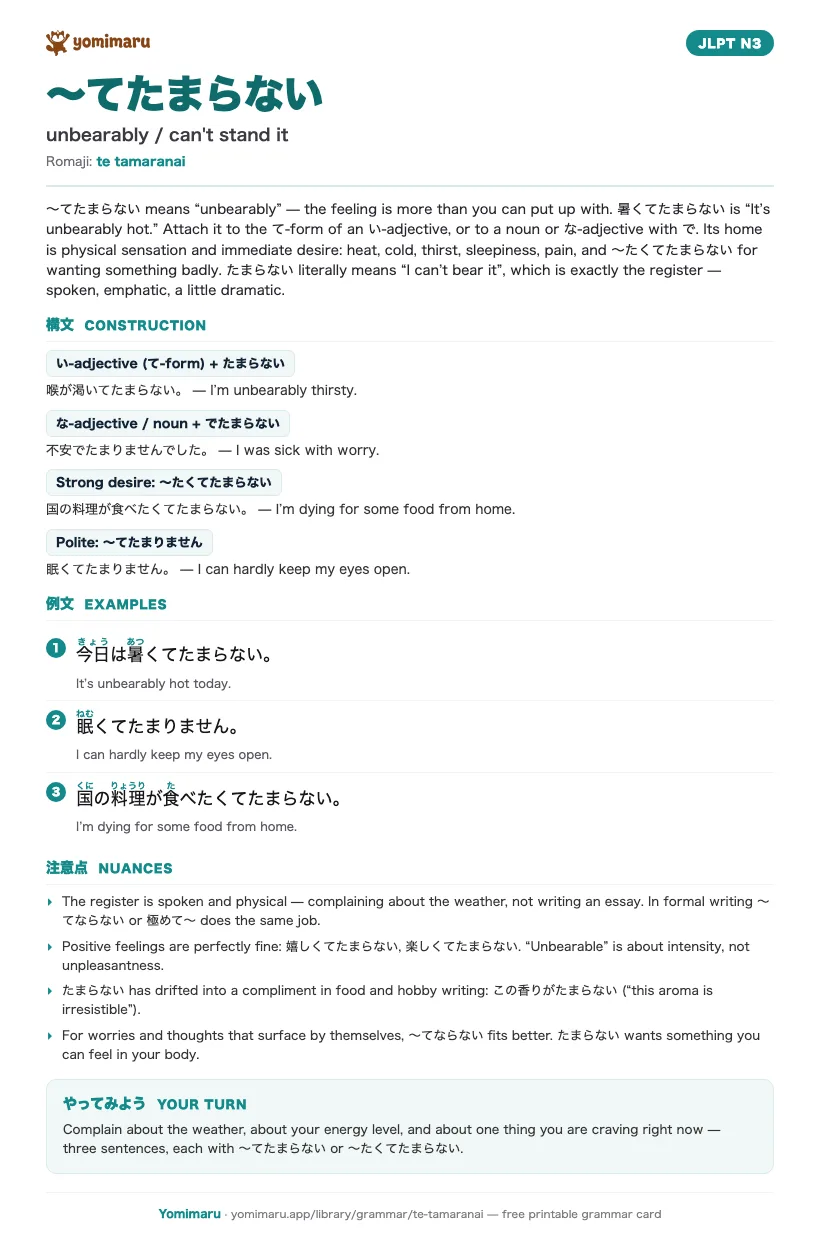
A free one-page study card for 〜てたまらない (unbearably / can't stand it), JLPT N3: what it means, how it attaches, 3 example sentences with furigana, and the nuances that trip learners up. Read it right here, or take the PDF or PNG with you. We never ask for an email for this card.
暑くてたまらない is “It’s unbearably hot.” Attach it to the て-form of an い-adjective, or to a noun or な-adjective with で. Its home is physical sensation and immediate desire: heat, cold, thirst, sleepiness, pain, and 〜たくてたまらない for wanting something badly. たまらない literally means “I can’t bear it”, which is exactly the register — spoken, emphatic, a little dramatic.
構文Construction
い-adjective (て-form) + たまらない
喉が渇いてたまらない。 — I’m unbearably thirsty.
な-adjective / noun + でたまらない
不安でたまりませんでした。 — I was sick with worry.
Strong desire: 〜たくてたまらない
国の料理が食べたくてたまらない。 — I’m dying for some food from home.
Polite: 〜てたまりません
眠くてたまりません。 — I can hardly keep my eyes open.
例文In a sentence
今日は暑くてたまらない。
It’s unbearably hot today.
眠くてたまりません。
I can hardly keep my eyes open.
国の料理が食べたくてたまらない。
I’m dying for some food from home.
注意点Nuances
In formal writing 〜てならない or 極めて〜 does the same job.
Positive feelings are perfectly fine: 嬉しくてたまらない, 楽しくてたまらない. “Unbearable” is about intensity, not unpleasantness.
たまらない has drifted into a compliment in food and hobby writing: この香りがたまらない (“this aroma is irresistible”).
For worries and thoughts that surface by themselves, 〜てならない fits better. たまらない wants something you can feel in your body.
How 〜てたまらない differs from similar patterns
〜てならない — 〜てならない covers feelings and thoughts that well up unbidden; 〜てたまらない covers sensations and cravings you can physically feel.
〜てしかたがない — 〜てしかたがない is the most conversational of the three and works for either kind of feeling.
〜すぎる — 〜すぎる says something exceeds a reasonable amount (暑すぎる, “too hot”); 〜てたまらない says you personally cannot stand it.
練習Your Turn
Tip
Complain about the weather, about your energy level, and about one thing you are craving right now — three sentences, each with 〜てたまらない or 〜たくてたまらない.
〜てたまらない (unbearably / can't stand it) in real sentences
Each one is quoted from a published Japanese text in this library and links to the story it came from. Some use older spellings, or break off where the sentence carried on. They are transcribed exactly as their authors wrote them.
〜てたまらない sits at JLPT N3 in the 302-point taxonomy every text in this library is tagged against. Each text is read for the patterns it contains, which is what lets this page list every text that uses 〜てたまらない and pull its example sentences out of them.
The example sentences were not written to demonstrate the rule. They are quoted from published Japanese texts in this library (The Daughter's Living Ghost and The Sound of a Drum among them), and each one links back to the story it came from, so you can read the sentence where it actually happened.
質問Questions
〜てたまらない: questions & answers
What does 〜てたまらない mean?
It means the feeling is unbearable — more than you can put up with. 寒くてたまらない is “I’m freezing”, 会いたくてたまらない is “I’m desperate to see you”. The pattern intensifies whatever adjective it attaches to.
Can 〜てたまらない be used for good feelings?
Yes. 嬉しくてたまらない (“I’m over the moon”) and 楽しくてたまらない (“I’m having the time of my life”) are completely natural. The “unbearable” part is about intensity, not about the feeling being bad.
What is the difference between 〜てたまらない and 〜てならない?
〜てたまらない is physical and immediate — heat, hunger, sleepiness, cravings. 〜てならない is emotional and reflective — worry, nostalgia, a nagging suspicion. 心配でならない and 心配でたまらない are both possible, but the first sounds more considered.
Is there a printable 〜てたまらない cheat sheet?
Yes. A free one-page 〜てたまらない (unbearably / can't stand it) study card sits at the top of this page, as both a PDF and a PNG. It carries the JLPT N3 meaning, how the pattern attaches, 3 example sentences with furigana, and the nuances learners get wrong. You do not need an account or an email address to download it.
始めるStart free
Read the grammar you just studied
Yomimaru turns every text in the library into a reading lesson: furigana tuned to your JLPT level, tap-to-look-up on any word, and an English breakdown of the vocabulary and grammar in each sentence. It is all free, and we never ask for a card.