〜たばかり means “just did”. It is a JLPT N3 pattern: below are its construction, the nuances that trip learners up, and the sentences where real Japanese writers use it.
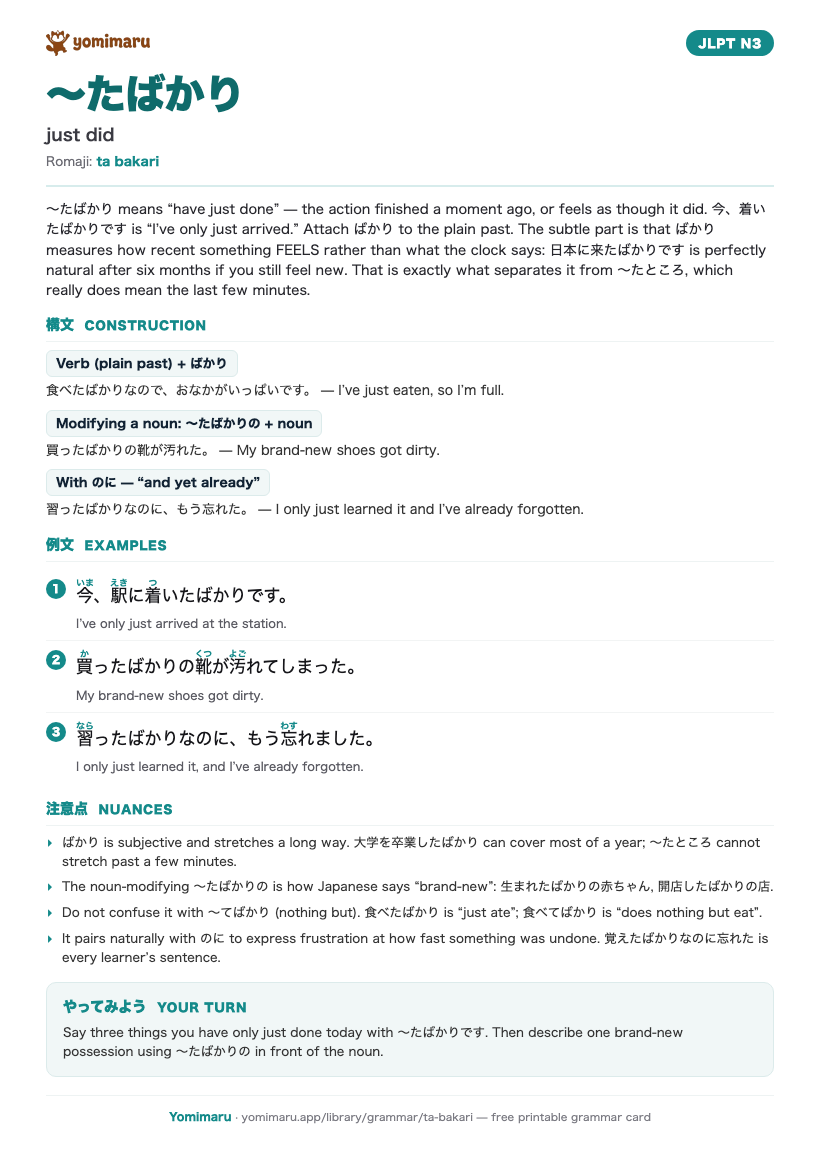
A free one-page study card for 〜たばかり (just did), JLPT N3: what it means, how it attaches, 3 example sentences with furigana, and the nuances that trip learners up. Read it right here, or take the PDF or PNG with you. We never ask for an email for this card.
今、着いたばかりです is “I’ve only just arrived.” Attach ばかり to the plain past. The subtle part is that ばかり measures how recent something FEELS rather than what the clock says: 日本に来たばかりです is perfectly natural after six months if you still feel new. That is exactly what separates it from 〜たところ, which really does mean the last few minutes.
構文Construction
Verb (plain past) + ばかり
食べたばかりなので、おなかがいっぱいです。 — I’ve just eaten, so I’m full.
Modifying a noun: 〜たばかりの + noun
買ったばかりの靴が汚れた。 — My brand-new shoes got dirty.
With のに — “and yet already”
習ったばかりなのに、もう忘れた。 — I only just learned it and I’ve already forgotten.
例文In a sentence
今、駅に着いたばかりです。
I’ve only just arrived at the station.
買ったばかりの靴が汚れてしまった。
My brand-new shoes got dirty.
習ったばかりなのに、もう忘れました。
I only just learned it, and I’ve already forgotten.
注意点Nuances
大学を卒業したばかり can cover most of a year; 〜たところ cannot stretch past a few minutes.
The noun-modifying 〜たばかりの is how Japanese says “brand-new”: 生まれたばかりの赤ちゃん, 開店したばかりの店.
Do not confuse it with 〜てばかり (nothing but). 食べたばかり is “just ate”; 食べてばかり is “does nothing but eat”.
It pairs naturally with のに to express frustration at how fast something was undone. 覚えたばかりなのに忘れた is every learner’s sentence.
How 〜たばかり differs from similar patterns
〜ばかり — 〜ばかり without the た means “nothing but” and usually complains. The た in front is the only signal that you are in this pattern instead.
〜てから — 〜てから orders two actions (“after doing X, Y”); 〜たばかり says how recently one action finished, with nothing following.
〜たとたん — 〜たとたん marks the instant something happened and always has a second event attached; 〜たばかり can stand alone as a complete statement.
練習Your Turn
Tip
Say three things you have only just done today with 〜たばかりです. Then describe one brand-new possession using 〜たばかりの in front of the noun.
〜たばかり (just did) in real sentences
Each one is quoted from a published Japanese text in this library and links to the story it came from. Some use older spellings, or break off where the sentence carried on. They are transcribed exactly as their authors wrote them.
〜たばかり sits at JLPT N3 in the 302-point taxonomy every text in this library is tagged against. Each text is read for the patterns it contains, which is what lets this page list every text that uses 〜たばかり and pull its example sentences out of them.
The example sentences were not written to demonstrate the rule. They are quoted from published Japanese texts in this library (The First Graders and the Ducklings and Little Brother Ryo-chan among them), and each one links back to the story it came from, so you can read the sentence where it actually happened.
質問Questions
〜たばかり: questions & answers
What is the difference between 〜たばかり and 〜たところ?
〜たところ is literal: the action finished moments ago (今、終わったところです). 〜たばかり is psychological and stretches — 引っ越したばかり can mean weeks ago, as long as it still feels recent to you.
How do I use 〜たばかりの before a noun?
Add の and put it straight in front of the noun: 焼いたばかりのパン (“bread just out of the oven”), 生まれたばかりの子猫 (“a newborn kitten”), 開店したばかりの店 (“a shop that has only just opened”). It is the everyday way to say something is brand new.
How is 〜たばかり different from 〜てばかり?
Completely. 〜たばかり (past form) means “just did it once”; 〜てばかり (て-form) means “does nothing but”. 飲んだばかり is “just had a drink”, 飲んでばかり is “always drinking”.
Is there a printable 〜たばかり cheat sheet?
Yes. A free one-page 〜たばかり (just did) study card sits at the top of this page, as both a PDF and a PNG. It carries the JLPT N3 meaning, how the pattern attaches, 3 example sentences with furigana, and the nuances learners get wrong. You do not need an account or an email address to download it.
始めるStart free
Read the grammar you just studied
Yomimaru turns every text in the library into a reading lesson: furigana tuned to your JLPT level, tap-to-look-up on any word, and an English breakdown of the vocabulary and grammar in each sentence. It is all free, and we never ask for a card.


 確認
確認