〜ばかり means “nothing but / only”. It is a JLPT N3 pattern: below are its construction, the nuances that trip learners up, and the sentences where real Japanese writers use it.
A free one-page study card for 〜ばかり (nothing but / only), JLPT N3: what it means, how it attaches, 3 example sentences with furigana, and the nuances that trip learners up. Read it right here, or take the PDF or PNG with you. We never ask for an email for this card.
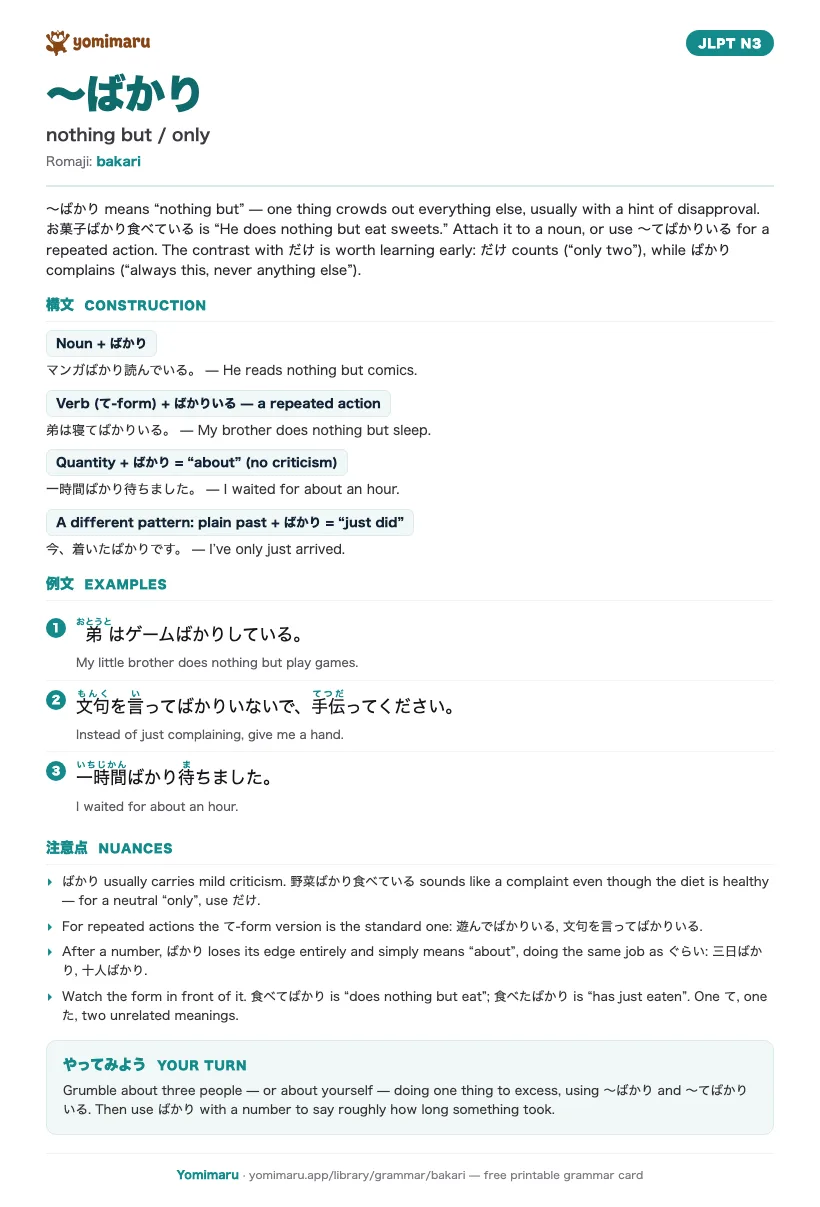
お菓子ばかり食べている is “He does nothing but eat sweets.” Attach it to a noun, or use 〜てばかりいる for a repeated action. The contrast with だけ is worth learning early: だけ counts (“only two”), while ばかり complains (“always this, never anything else”).
構文Construction
Noun + ばかり
マンガばかり読んでいる。 — He reads nothing but comics.
Verb (て-form) + ばかりいる — a repeated action
弟は寝てばかりいる。 — My brother does nothing but sleep.
Quantity + ばかり = “about” (no criticism)
一時間ばかり待ちました。 — I waited for about an hour.
A different pattern: plain past + ばかり = “just did”
今、着いたばかりです。 — I’ve only just arrived.
例文In a sentence
弟はゲームばかりしている。
My little brother does nothing but play games.
文句を言ってばかりいないで、手伝ってください。
Instead of just complaining, give me a hand.
一時間ばかり待ちました。
I waited for about an hour.
注意点Nuances
野菜ばかり食べている sounds like a complaint even though the diet is healthy — for a neutral “only”, use だけ.
For repeated actions the て-form version is the standard one: 遊んでばかりいる, 文句を言ってばかりいる.
After a number, ばかり loses its edge entirely and simply means “about”, doing the same job as ぐらい: 三日ばかり, 十人ばかり.
Watch the form in front of it. 食べてばかり is “does nothing but eat”; 食べたばかり is “has just eaten”. One て, one た, two unrelated meanings.
How 〜ばかり differs from similar patterns
〜たばかり — 〜たばかり attaches to the plain past and means “only just did”. Same word, and the た is the only thing telling you which pattern you are in.
しか〜ない — しか〜ない says everything else is missing (二人しか来なかった); ばかり says one thing keeps happening (文句ばかり言う).
〜がち — 〜がち reports a tendency someone has; ばかり reports what they are actually doing, over and over, right now.
練習Your Turn
Tip
Grumble about three people — or about yourself — doing one thing to excess, using 〜ばかり and 〜てばかりいる. Then use ばかり with a number to say roughly how long something took.
〜ばかり (nothing but / only) in real sentences
Each one is quoted from a published Japanese text in this library and links to the story it came from. Some use older spellings, or break off where the sentence carried on. They are transcribed exactly as their authors wrote them.
〜ばかり sits at JLPT N3 in the 302-point taxonomy every text in this library is tagged against. Each text is read for the patterns it contains, which is what lets this page list every text that uses 〜ばかり and pull its example sentences out of them.
The example sentences were not written to demonstrate the rule. They are quoted from published Japanese texts in this library (Red Candle and Group Blind Date among them), and each one links back to the story it came from, so you can read the sentence where it actually happened.
質問Questions
〜ばかり: questions & answers
What is the difference between ばかり and だけ?
だけ states an amount neutrally — 二人だけ来た (“only two people came”). ばかり says one thing dominates and usually implies you disapprove — 文句ばかり言う (“all he does is complain”).
What does 〜てばかりいる mean?
It marks an action someone does to the exclusion of everything else: 遊んでばかりいる (“all they do is play”). The いる is what makes it an ongoing state rather than a single occasion.
Does ばかり always sound negative?
No. After a number it simply means “about” — 五分ばかり待って (“wait about five minutes”) — with no criticism at all. The disapproving flavour belongs to the noun and て-form uses.
Is there a printable 〜ばかり cheat sheet?
Yes. A free one-page 〜ばかり (nothing but / only) study card sits at the top of this page, as both a PDF and a PNG. It carries the JLPT N3 meaning, how the pattern attaches, 3 example sentences with furigana, and the nuances learners get wrong. You do not need an account or an email address to download it.
始めるStart free
Read the grammar you just studied
Yomimaru turns every text in the library into a reading lesson: furigana tuned to your JLPT level, tap-to-look-up on any word, and an English breakdown of the vocabulary and grammar in each sentence. It is all free, and we never ask for a card.