〜ず means “without / not (literary)”. It is a JLPT N3 pattern: below are its construction, the nuances that trip learners up, and the sentences where real Japanese writers use it.
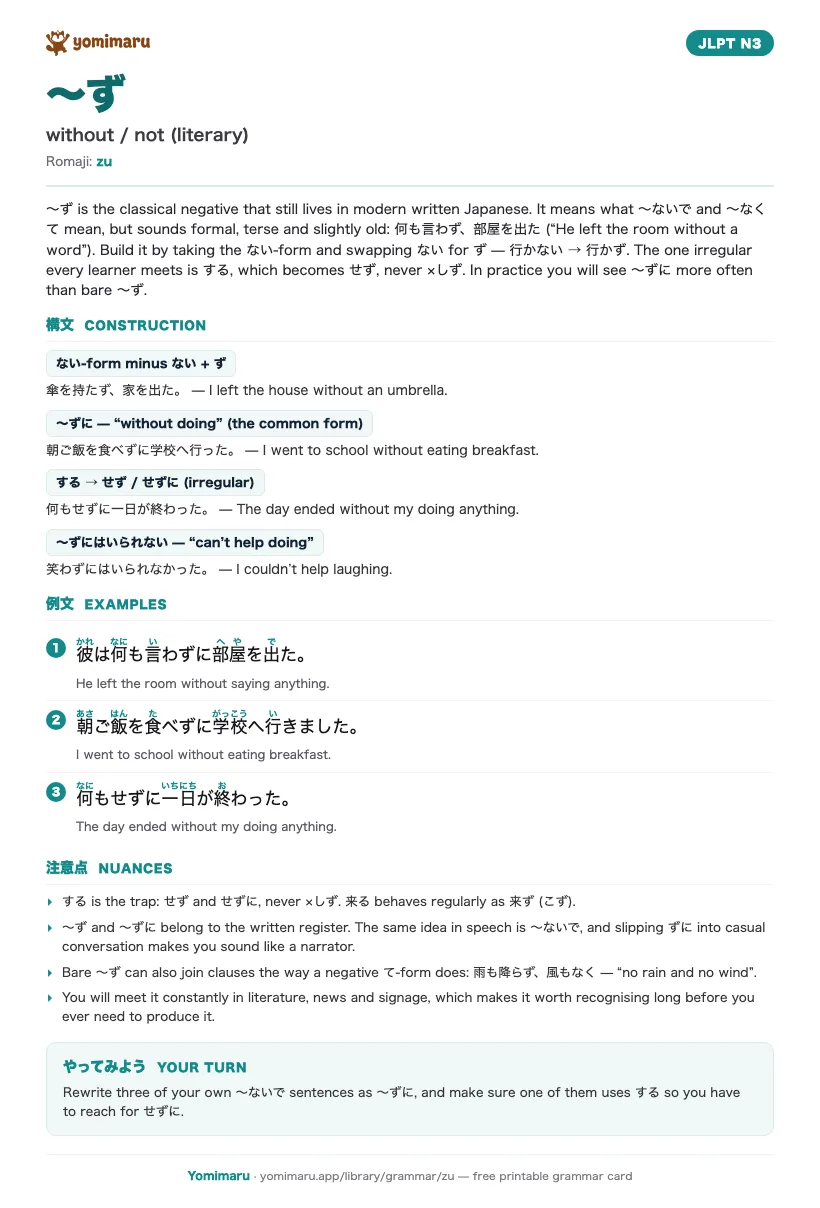
A free one-page study card for 〜ず (without / not (literary)), JLPT N3: what it means, how it attaches, 3 example sentences with furigana, and the nuances that trip learners up. Read it right here, or take the PDF or PNG with you. We never ask for an email for this card.
It means what 〜ないで and 〜なくて mean, but sounds formal, terse and slightly old: 何も言わず、部屋を出た (“He left the room without a word”). Build it by taking the ない-form and swapping ない for ず — 行かない → 行かず. The one irregular every learner meets is する, which becomes せず, never ×しず. In practice you will see 〜ずに more often than bare 〜ず.
構文Construction
ない-form minus ない + ず
傘を持たず、家を出た。 — I left the house without an umbrella.
〜ずに — “without doing” (the common form)
朝ご飯を食べずに学校へ行った。 — I went to school without eating breakfast.
する → せず / せずに (irregular)
何もせずに一日が終わった。 — The day ended without my doing anything.
〜ずにはいられない — “can’t help doing”
笑わずにはいられなかった。 — I couldn’t help laughing.
例文In a sentence
彼は何も言わずに部屋を出た。
He left the room without saying anything.
朝ご飯を食べずに学校へ行きました。
I went to school without eating breakfast.
何もせずに一日が終わった。
The day ended without my doing anything.
注意点Nuances
来る behaves regularly as 来ず (こず).
〜ず and 〜ずに belong to the written register. The same idea in speech is 〜ないで, and slipping ずに into casual conversation makes you sound like a narrator.
Bare 〜ず can also join clauses the way a negative て-form does: 雨も降らず、風もなく — “no rain and no wind”.
You will meet it constantly in literature, news and signage, which makes it worth recognising long before you ever need to produce it.
How 〜ず differs from similar patterns
〜ないで — 〜ないで is the everyday spoken equivalent. 食べないで and 食べずに mean the same thing; only the register differs.
〜ぬ — 〜ぬ is the other surviving classical negative, and it works as a modifier or sentence ending (知らぬ人) where ず links clauses.
〜なしに — 〜なしに attaches to nouns (許可なしに, “without permission”); 〜ずに attaches to verbs.
練習Your Turn
Tip
Rewrite three of your own 〜ないで sentences as 〜ずに, and make sure one of them uses する so you have to reach for せずに.
〜ず (without / not (literary)) in real sentences
Each one is quoted from a published Japanese text in this library and links to the story it came from. Some use older spellings, or break off where the sentence carried on. They are transcribed exactly as their authors wrote them.
〜ず sits at JLPT N3 in the 302-point taxonomy every text in this library is tagged against. Each text is read for the patterns it contains, which is what lets this page list every text that uses 〜ず and pull its example sentences out of them.
The example sentences were not written to demonstrate the rule. They are quoted from published Japanese texts in this library (The Ghost's Foot and The Disappearance of the Express Train among them), and each one links back to the story it came from, so you can read the sentence where it actually happened.
質問Questions
〜ず: questions & answers
What is the difference between 〜ず and 〜ない?
They mean the same thing; the difference is register. 〜ない is ordinary modern Japanese, while 〜ず is a classical form kept alive in writing, signage and formal speech. 知らずに and 知らないで are both “without knowing”.
Why is it せずに and not しずに?
Because 〜ず attaches to an older stem of する than the modern し. The classical negative of する was せず, and that form survived intact. 勉強せずに, 気にせずに and 何もせずに are all built on it.
What does 〜ずにはいられない mean?
It means “can’t help doing” — the action is impossible to hold back: 笑わずにはいられない (“I can’t help laughing”), 考えずにはいられない (“I can’t stop thinking about it”). It is the literary counterpart of 〜てしまう’s involuntary sense.
Is there a printable 〜ず cheat sheet?
Yes. A free one-page 〜ず (without / not (literary)) study card sits at the top of this page, as both a PDF and a PNG. It carries the JLPT N3 meaning, how the pattern attaches, 3 example sentences with furigana, and the nuances learners get wrong. You do not need an account or an email address to download it.
始めるStart free
Read the grammar you just studied
Yomimaru turns every text in the library into a reading lesson: furigana tuned to your JLPT level, tap-to-look-up on any word, and an English breakdown of the vocabulary and grammar in each sentence. It is all free, and we never ask for a card.