〜てならない means “can't help feeling”. It is a JLPT N3 pattern: below are its construction, the nuances that trip learners up, and the sentences where real Japanese writers use it.
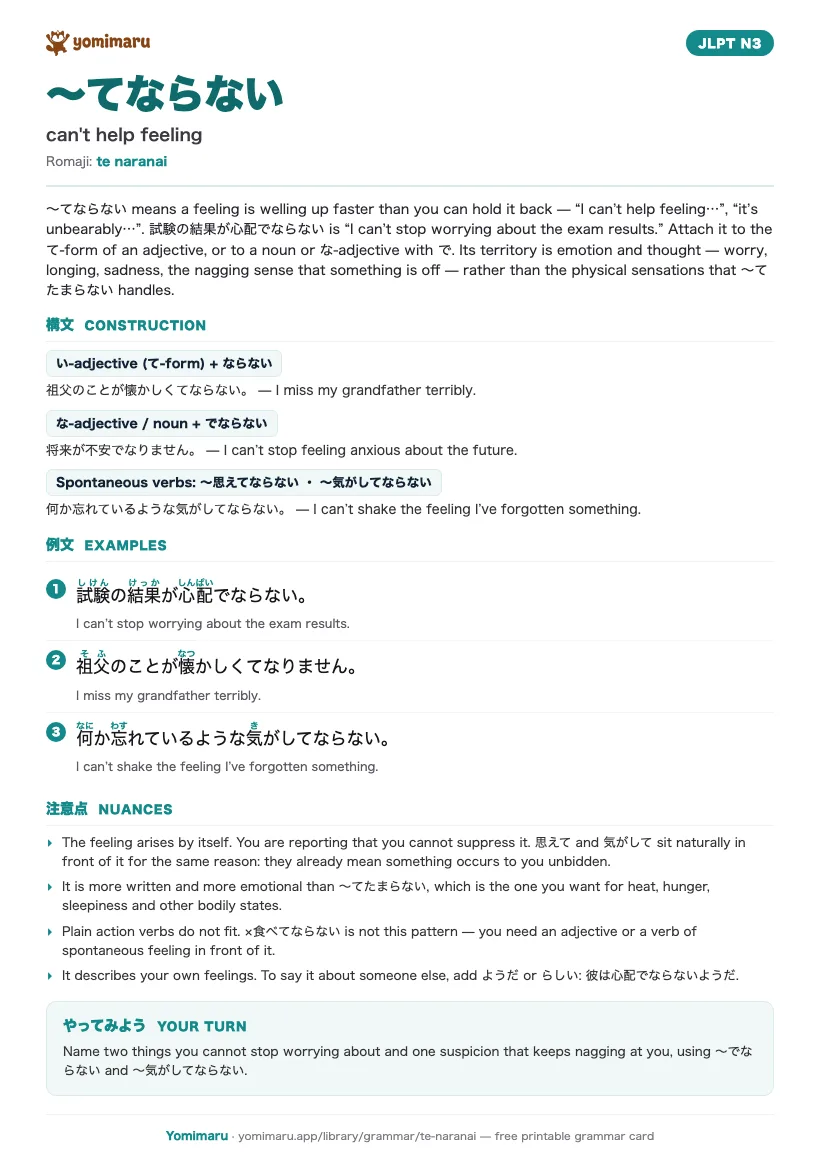
A free one-page study card for 〜てならない (can't help feeling), JLPT N3: what it means, how it attaches, 3 example sentences with furigana, and the nuances that trip learners up. Read it right here, or take the PDF or PNG with you. We never ask for an email for this card.
試験の結果が心配でならない is “I can’t stop worrying about the exam results.” Attach it to the て-form of an adjective, or to a noun or な-adjective with で. Its territory is emotion and thought — worry, longing, sadness, the nagging sense that something is off — rather than the physical sensations that 〜てたまらない handles.
構文Construction
い-adjective (て-form) + ならない
祖父のことが懐かしくてならない。 — I miss my grandfather terribly.
な-adjective / noun + でならない
将来が不安でなりません。 — I can’t stop feeling anxious about the future.
Spontaneous verbs: 〜思えてならない ・ 〜気がしてならない
何か忘れているような気がしてならない。 — I can’t shake the feeling I’ve forgotten something.
例文In a sentence
試験の結果が心配でならない。
I can’t stop worrying about the exam results.
祖父のことが懐かしくてなりません。
I miss my grandfather terribly.
何か忘れているような気がしてならない。
I can’t shake the feeling I’ve forgotten something.
注意点Nuances
You are reporting that you cannot suppress it. 思えて and 気がして sit naturally in front of it for the same reason: they already mean something occurs to you unbidden.
It is more written and more emotional than 〜てたまらない, which is the one you want for heat, hunger, sleepiness and other bodily states.
Plain action verbs do not fit. ×食べてならない is not this pattern — you need an adjective or a verb of spontaneous feeling in front of it.
It describes your own feelings. To say it about someone else, add ようだ or らしい: 彼は心配でならないようだ.
How 〜てならない differs from similar patterns
〜てたまらない — 〜てたまらない is the physical twin — heat, thirst, sleepiness, cravings. 〜てならない handles feelings and thoughts that surface on their own.
〜てしかたがない — 〜てしかたがない sits between the two and works for both kinds of feeling; it is also the most conversational of the three.
〜がする — 気がする reports a feeling neutrally; 気がしてならない says the same feeling will not leave you alone.
練習Your Turn
Tip
Name two things you cannot stop worrying about and one suspicion that keeps nagging at you, using 〜でならない and 〜気がしてならない.
〜てならない (can't help feeling) in real sentences
Each one is quoted from a published Japanese text in this library and links to the story it came from. Some use older spellings, or break off where the sentence carried on. They are transcribed exactly as their authors wrote them.
〜てならない sits at JLPT N3 in the 302-point taxonomy every text in this library is tagged against. Each text is read for the patterns it contains, which is what lets this page list every text that uses 〜てならない and pull its example sentences out of them.
The example sentences were not written to demonstrate the rule. They are quoted from published Japanese texts in this library (Murder Maze and Little Brother Ryo-chan among them), and each one links back to the story it came from, so you can read the sentence where it actually happened.
質問Questions
〜てならない: questions & answers
What is the difference between 〜てならない and 〜てたまらない?
〜てならない is for feelings and thoughts that rise up on their own — 心配でならない, 気がしてならない. 〜てたまらない is for physical sensations and cravings — 暑くてたまらない, 食べたくてたまらない.
What kinds of words can go before 〜てならない?
Adjectives in て-form (懐かしくて, 悲しくて), nouns and な-adjectives with で (心配で, 残念で), and verbs of spontaneous feeling (思えて, 気がして). Ordinary action verbs do not work.
Can I use 〜てならない about someone else?
Not directly, because you cannot feel another person’s feelings. Add a hedge instead: 彼は不安でならないようだ or 心配でならないらしい. The same restriction applies to most Japanese emotion patterns.
Is there a printable 〜てならない cheat sheet?
Yes. A free one-page 〜てならない (can't help feeling) study card sits at the top of this page, as both a PDF and a PNG. It carries the JLPT N3 meaning, how the pattern attaches, 3 example sentences with furigana, and the nuances learners get wrong. You do not need an account or an email address to download it.
始めるStart free
Read the grammar you just studied
Yomimaru turns every text in the library into a reading lesson: furigana tuned to your JLPT level, tap-to-look-up on any word, and an English breakdown of the vocabulary and grammar in each sentence. It is all free, and we never ask for a card.