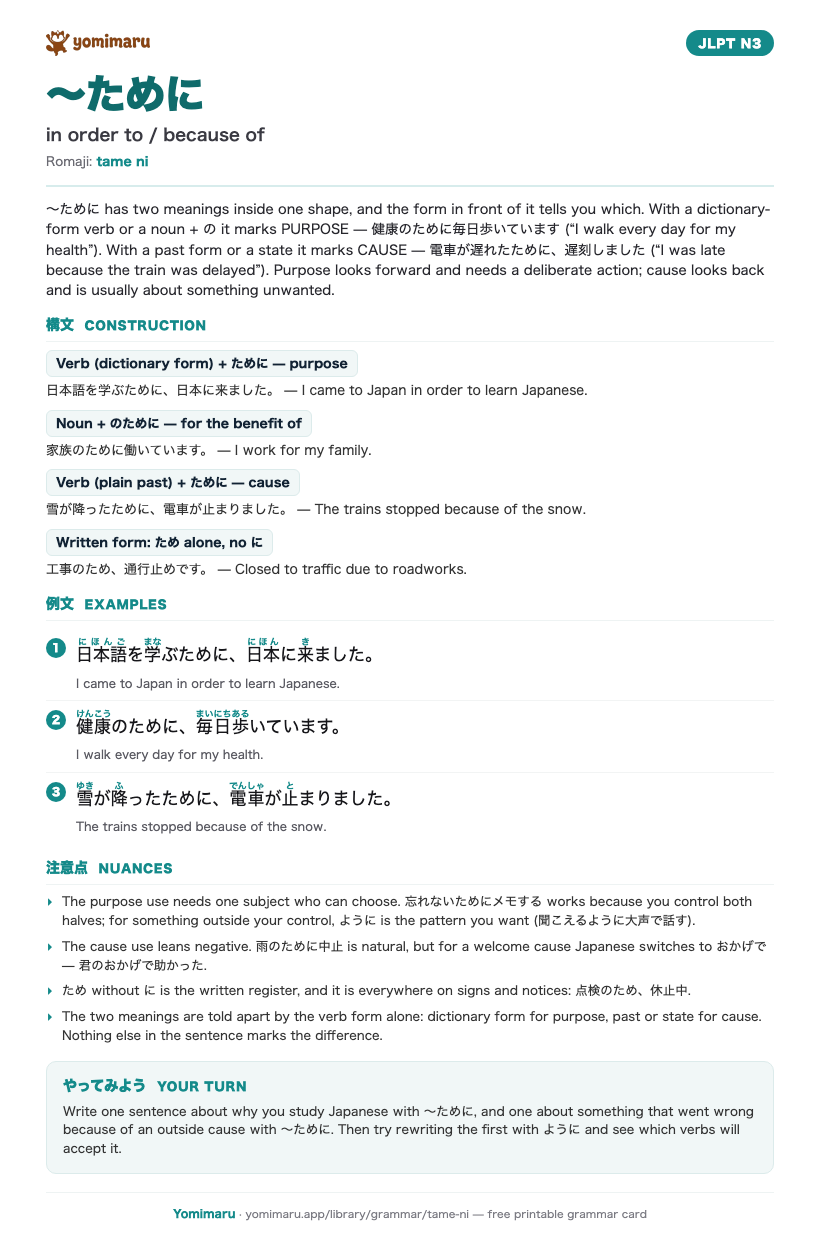
〜ために means “in order to / because of”. It is a JLPT N3 pattern: below are its construction, the nuances that trip learners up, and the sentences where real Japanese writers use it.
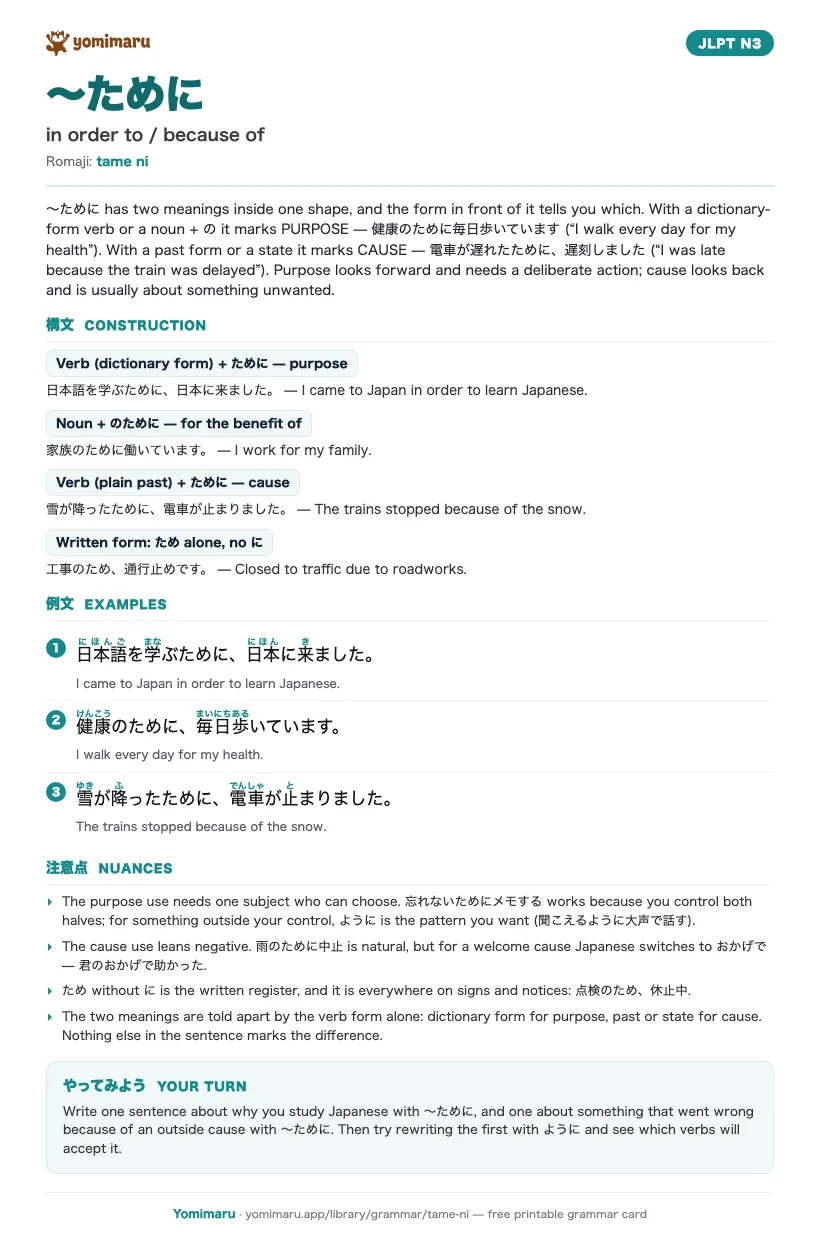
A free one-page study card for 〜ために (in order to / because of), JLPT N3: what it means, how it attaches, 3 example sentences with furigana, and the nuances that trip learners up. Read it right here, or take the PDF or PNG with you. We never ask for an email for this card.
With a dictionary-form verb or a noun + の it marks PURPOSE — 健康のために毎日歩いています (“I walk every day for my health”). With a past form or a state it marks CAUSE — 電車が遅れたために、遅刻しました (“I was late because the train was delayed”). Purpose looks forward and needs a deliberate action; cause looks back and is usually about something unwanted.
構文Construction
Verb (dictionary form) + ために — purpose
日本語を学ぶために、日本に来ました。 — I came to Japan in order to learn Japanese.
Noun + のために — for the benefit of
家族のために働いています。 — I work for my family.
Verb (plain past) + ために — cause
雪が降ったために、電車が止まりました。 — The trains stopped because of the snow.
Written form: ため alone, no に
工事のため、通行止めです。 — Closed to traffic due to roadworks.
例文In a sentence
日本語を学ぶために、日本に来ました。
I came to Japan in order to learn Japanese.
健康のために、毎日歩いています。
I walk every day for my health.
雪が降ったために、電車が止まりました。
The trains stopped because of the snow.
注意点Nuances
忘れないためにメモする works because you control both halves; for something outside your control, ように is the pattern you want (聞こえるように大声で話す).
The cause use leans negative. 雨のために中止 is natural, but for a welcome cause Japanese switches to おかげで — 君のおかげで助かった.
ため without に is the written register, and it is everywhere on signs and notices: 点検のため、休止中.
The two meanings are told apart by the verb form alone: dictionary form for purpose, past or state for cause. Nothing else in the sentence marks the difference.
How 〜ために differs from similar patterns
ように — ように is the purpose partner for verbs outside your direct control — potentials, negatives, and clauses with a different subject. ために needs deliberate, controllable action.
ので — ので gives an ordinary spoken reason; ために as a cause is heavier and more written, and belongs to announcements and reports.
おかげで — おかげで credits a positive cause (“thanks to”), which is the one job the cause-marking ために does badly.
練習Your Turn
Tip
Write one sentence about why you study Japanese with 〜ために, and one about something that went wrong because of an outside cause with 〜ために. Then try rewriting the first with ように and see which verbs will accept it.
〜ために (in order to / because of) in real sentences
Each one is quoted from a published Japanese text in this library and links to the story it came from. Some use older spellings, or break off where the sentence carried on. They are transcribed exactly as their authors wrote them.
〜ために sits at JLPT N3 in the 302-point taxonomy every text in this library is tagged against. Each text is read for the patterns it contains, which is what lets this page list every text that uses 〜ために and pull its example sentences out of them.
The example sentences were not written to demonstrate the rule. They are quoted from published Japanese texts in this library (The Hermit and The Shamisen Body among them), and each one links back to the story it came from, so you can read the sentence where it actually happened.
質問Questions
〜ために: questions & answers
Does ために mean “in order to” or “because”?
Both, and the verb form decides. Dictionary form before it gives purpose (会うために来た, “I came in order to meet you”). Past form or a state before it gives cause (事故があったために遅れた, “I was late because there was an accident”).
What is the difference between ために and ように?
ために needs a deliberate action you control, with the same subject in both halves: 合格するために勉強する. ように is for things outside direct control — potentials, negatives, or a different subject: 合格できるように祈る, 忘れないようにメモする.
When do I use のために?
After a noun. For purpose or benefit it is 試験のために勉強する, 家族のために働く. For cause it is 台風のために中止 — and there the tone is negative, so for something you are grateful for use おかげで instead.
Is there a printable 〜ために cheat sheet?
Yes. A free one-page 〜ために (in order to / because of) study card sits at the top of this page, as both a PDF and a PNG. It carries the JLPT N3 meaning, how the pattern attaches, 3 example sentences with furigana, and the nuances learners get wrong. You do not need an account or an email address to download it.
始めるStart free
Read the grammar you just studied
Yomimaru turns every text in the library into a reading lesson: furigana tuned to your JLPT level, tap-to-look-up on any word, and an English breakdown of the vocabulary and grammar in each sentence. It is all free, and we never ask for a card.


 確認
確認