〜ようとする means “try to / be about to”. It is a JLPT N4 pattern: below are its construction, the nuances that trip learners up, and the sentences where real Japanese writers use it.
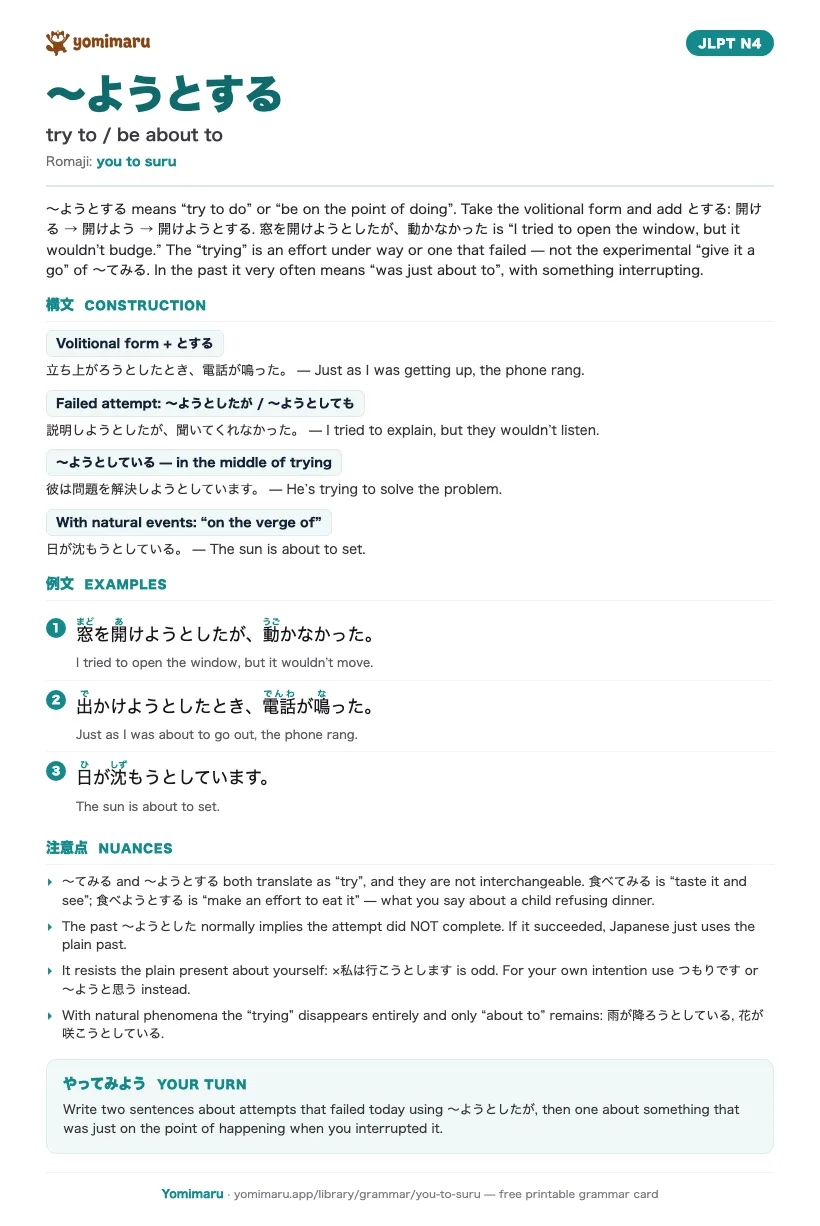
A free one-page study card for 〜ようとする (try to / be about to), JLPT N4: what it means, how it attaches, 3 example sentences with furigana, and the nuances that trip learners up. Read it right here, or take the PDF or PNG with you. We never ask for an email for this card.
Take the volitional form and add とする: 開ける → 開けよう → 開けようとする. 窓を開けようとしたが、動かなかった is “I tried to open the window, but it wouldn’t budge.” The “trying” is an effort under way or one that failed — not the experimental “give it a go” of 〜てみる. In the past it very often means “was just about to”, with something interrupting.
構文Construction
Volitional form + とする
立ち上がろうとしたとき、電話が鳴った。 — Just as I was getting up, the phone rang.
Failed attempt: 〜ようとしたが / 〜ようとしても
説明しようとしたが、聞いてくれなかった。 — I tried to explain, but they wouldn’t listen.
〜ようとしている — in the middle of trying
彼は問題を解決しようとしています。 — He’s trying to solve the problem.
With natural events: “on the verge of”
日が沈もうとしている。 — The sun is about to set.
例文In a sentence
窓を開けようとしたが、動かなかった。
I tried to open the window, but it wouldn’t move.
出かけようとしたとき、電話が鳴った。
Just as I was about to go out, the phone rang.
日が沈もうとしています。
The sun is about to set.
注意点Nuances
食べてみる is “taste it and see”; 食べようとする is “make an effort to eat it” — what you say about a child refusing dinner.
The past 〜ようとした normally implies the attempt did NOT complete. If it succeeded, Japanese just uses the plain past.
It resists the plain present about yourself: ×私は行こうとします is odd. For your own intention use つもりです or 〜ようと思う instead.
With natural phenomena the “trying” disappears entirely and only “about to” remains: 雨が降ろうとしている, 花が咲こうとしている.
How 〜ようとする differs from similar patterns
てみる — 〜てみる is trying something out to see how it turns out; 〜ようとする is straining toward something you already want to achieve.
〜ことにする — 〜ことにする is the decision made before any attempt; 〜ようとする is the attempt itself, often the one that failed.
つもりです — つもりです states a plan you are holding, which is what to use for your own future intentions where 〜ようとする sounds wrong.
練習Your Turn
Tip
Write two sentences about attempts that failed today using 〜ようとしたが, then one about something that was just on the point of happening when you interrupted it.
〜ようとする (try to / be about to) in real sentences
Each one is quoted from a published Japanese text in this library and links to the story it came from. Some use older spellings, or break off where the sentence carried on. They are transcribed exactly as their authors wrote them.
〜ようとする sits at JLPT N4 in the 302-point taxonomy every text in this library is tagged against. Each text is read for the patterns it contains, which is what lets this page list every text that uses 〜ようとする and pull its example sentences out of them.
The example sentences were not written to demonstrate the rule. They are quoted from published Japanese texts in this library (Hint and The Pot, the Plate, and the Curtain among them), and each one links back to the story it came from, so you can read the sentence where it actually happened.
質問Questions
〜ようとする: questions & answers
What is the difference between 〜ようとする and 〜てみる?
Both mean “try”, but 〜てみる is experimental — do it and see what happens (食べてみる, “taste it”). 〜ようとする is effortful — strain toward something that may not work (立とうとする, “try to stand up”).
Why does 〜ようとした often mean “was about to”?
Because an attempt that has begun but not finished is exactly the moment before the action. 出かけようとした captures you at the door, which is why an interruption almost always follows in the second half of the sentence.
How do I make the volitional form for this pattern?
る-verbs drop る and add よう (見る → 見よう). う-verbs shift the final vowel to the お-row and add う (書く → 書こう, 待つ → 待とう). する becomes しよう and 来る becomes 来よう. Then add とする.
Is there a printable 〜ようとする cheat sheet?
Yes. A free one-page 〜ようとする (try to / be about to) study card sits at the top of this page, as both a PDF and a PNG. It carries the JLPT N4 meaning, how the pattern attaches, 3 example sentences with furigana, and the nuances learners get wrong. You do not need an account or an email address to download it.
始めるStart free
Read the grammar you just studied
Yomimaru turns every text in the library into a reading lesson: furigana tuned to your JLPT level, tap-to-look-up on any word, and an English breakdown of the vocabulary and grammar in each sentence. It is all free, and we never ask for a card.