てみる means “try doing”. It is a JLPT N4 pattern: below are its construction, the nuances that trip learners up, and the sentences where real Japanese writers use it.
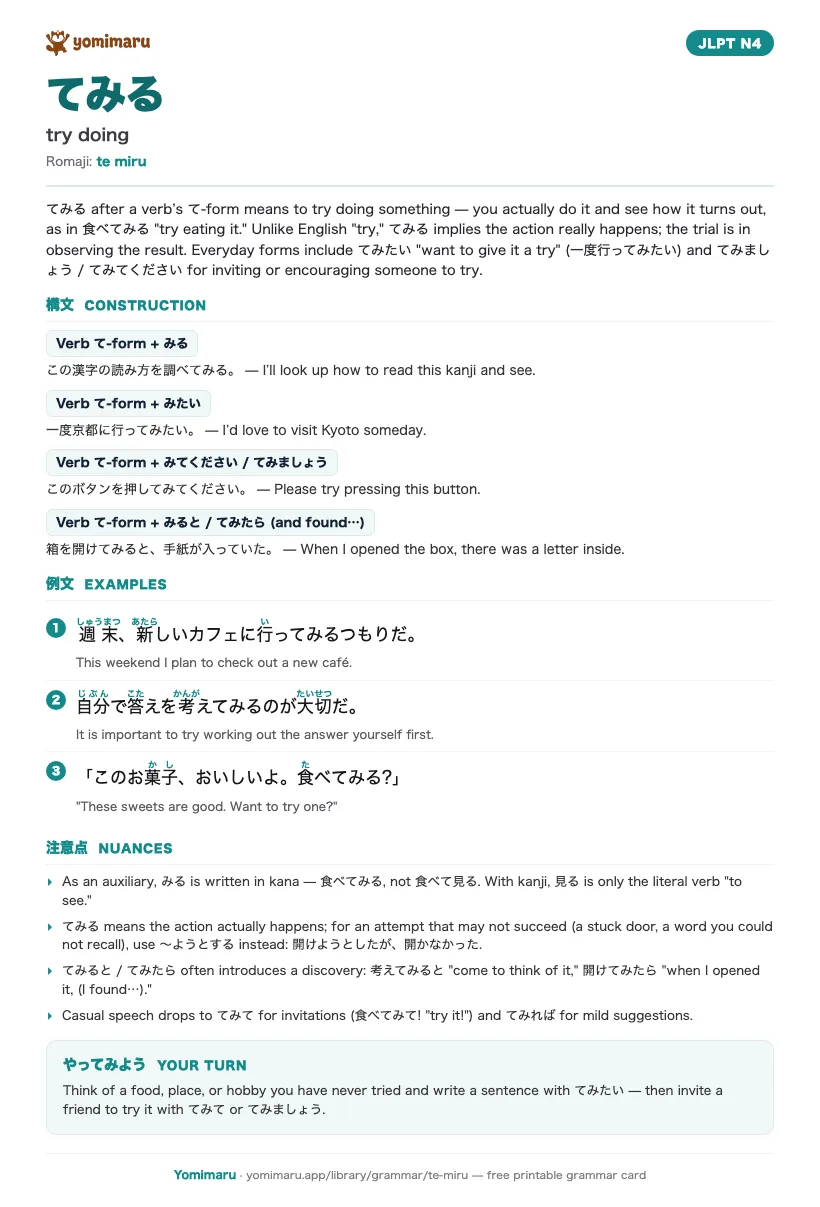
A free one-page study card for てみる (try doing), JLPT N4: what it means, how it attaches, 3 example sentences with furigana, and the nuances that trip learners up. Read it right here, or take the PDF or PNG with you. We never ask for an email for this card.
Everyday forms include てみたい "want to give it a try" (一度行ってみたい) and てみましょう / てみてください for inviting or encouraging someone to try.
構文Construction
Verb て-form + みる
この漢字の読み方を調べてみる。 — I’ll look up how to read this kanji and see.
Verb て-form + みたい
一度京都に行ってみたい。 — I’d love to visit Kyoto someday.
Verb て-form + みてください / てみましょう
このボタンを押してみてください。 — Please try pressing this button.
Verb て-form + みると / てみたら (and found…)
箱を開けてみると、手紙が入っていた。 — When I opened the box, there was a letter inside.
例文In a sentence
週末、新しいカフェに行ってみるつもりだ。
This weekend I plan to check out a new café.
自分で答えを考えてみるのが大切だ。
It is important to try working out the answer yourself first.
「このお菓子、おいしいよ。食べてみる?」
"These sweets are good. Want to try one?"
注意点Nuances
With kanji, 見る is only the literal verb "to see."
てみる means the action actually happens; for an attempt that may not succeed (a stuck door, a word you could not recall), use 〜ようとする instead: 開けようとしたが、開かなかった.
てみると / てみたら often introduces a discovery: 考えてみると "come to think of it," 開けてみたら "when I opened it, (I found…)."
Casual speech drops to てみて for invitations (食べてみて! "try it!") and てみれば for mild suggestions.
How てみる differs from similar patterns
〜ようとする — 〜ようとする is an attempt that may not come off (開けようとした = "tried to open it, but…"); てみる means you actually do it to see the result (開けてみた = "opened it and saw").
〜ておく — ておく does something in advance so you are ready later (調べておく = "look it up beforehand"); てみる does something as an experiment to see how it goes (調べてみる = "look it up and see").
練習Your Turn
Tip
Think of a food, place, or hobby you have never tried and write a sentence with てみたい — then invite a friend to try it with てみて or てみましょう.
てみる (try doing) in real sentences
Each one is quoted from a published Japanese text in this library and links to the story it came from. Some use older spellings, or break off where the sentence carried on. They are transcribed exactly as their authors wrote them.
てみる sits at JLPT N4 in the 302-point taxonomy every text in this library is tagged against. Each text is read for the patterns it contains, which is what lets this page list every text that uses てみる and pull its example sentences out of them.
The example sentences were not written to demonstrate the rule. They are quoted from published Japanese texts in this library (The Spirit Possessing the Mother and The Ghost's Foot among them), and each one links back to the story it came from, so you can read the sentence where it actually happened.
質問Questions
てみる: questions & answers
What is the difference between てみる and 〜ようとする for "try"?
てみる means you actually do the action and see what happens: 開けてみた = you opened it and looked. 〜ようとする is the attempt itself, which may fail: 開けようとした = you tried to open it (and maybe could not). If the action definitely happened, use てみる.
How do I say "I want to try…" in Japanese?
Use the て-form + みたい: 行ってみたい "I want to try going," 食べてみたい "I want to try eating it." To encourage someone else instead, use てみてください, or casual てみて.
Is てみる written with the kanji 見る?
Writing てみる in kana is the standard convention: 食べてみる, やってみた. 〜て見る appears in older texts, but the kanji reads as literal seeing, so learners should stick with kana. You will meet てみると and てみたら constantly in stories, so spotting them mid-sentence is great practice while reading on Yomimaru.
Is there a printable てみる cheat sheet?
Yes. A free one-page てみる (try doing) study card sits at the top of this page, as both a PDF and a PNG. It carries the JLPT N4 meaning, how the pattern attaches, 3 example sentences with furigana, and the nuances learners get wrong. You do not need an account or an email address to download it.
始めるStart free
Read the grammar you just studied
Yomimaru turns every text in the library into a reading lesson: furigana tuned to your JLPT level, tap-to-look-up on any word, and an English breakdown of the vocabulary and grammar in each sentence. It is all free, and we never ask for a card.