〜てくるcome to / start to (toward speaker): Meaning & Examples
te kuru · JLPT N4
JLPT N423 textsStudy card
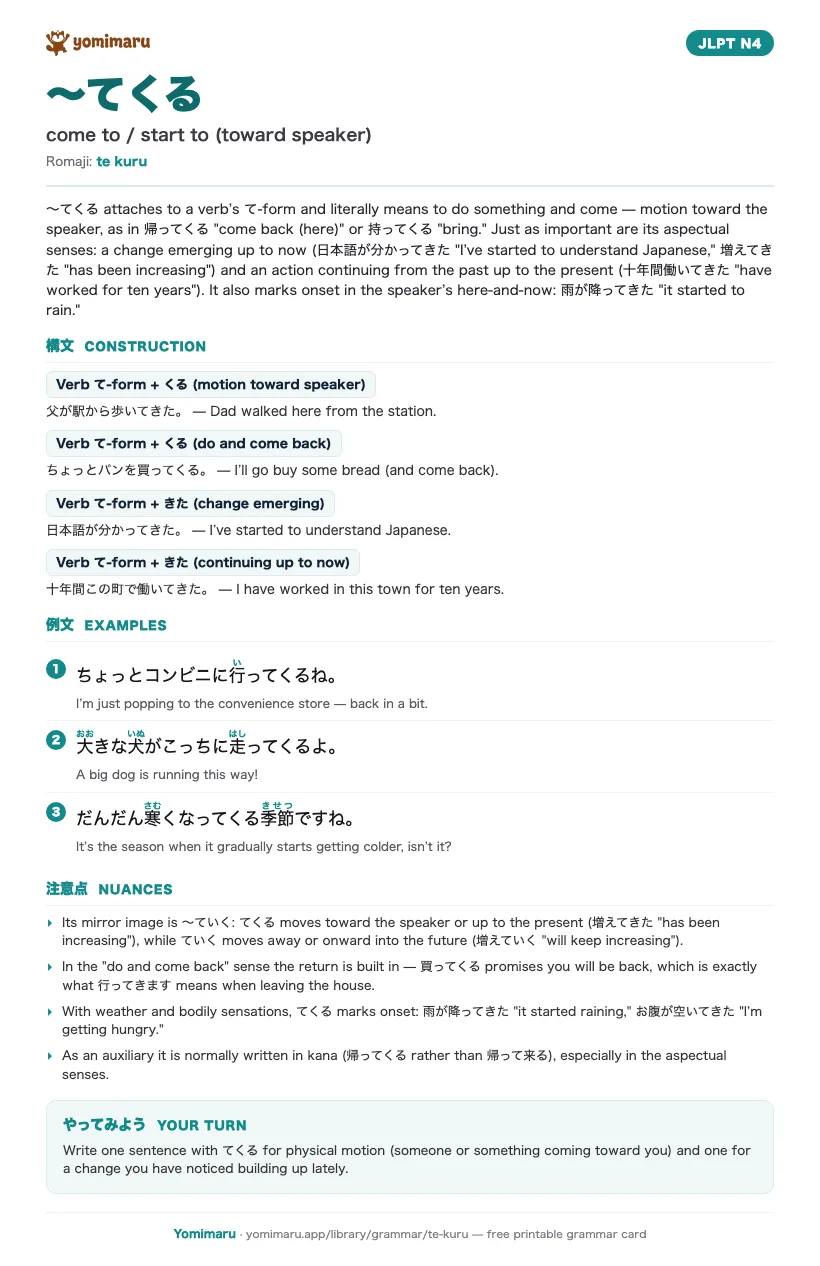
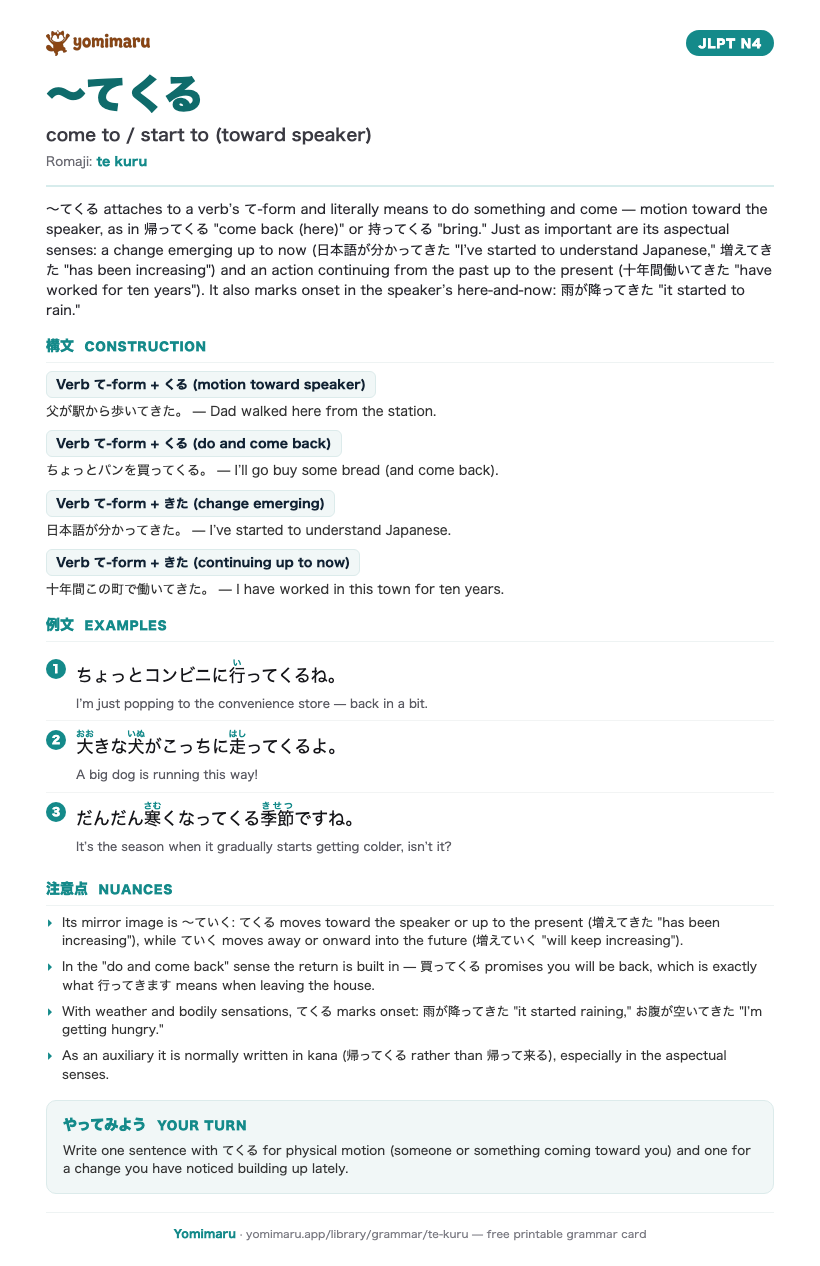
〜てくる means “come to / start to (toward speaker)”. It is a JLPT N4 pattern: below are its construction, the nuances that trip learners up, and the sentences where real Japanese writers use it.
A free one-page study card for 〜てくる (come to / start to (toward speaker)), JLPT N4: what it means, how it attaches, 3 example sentences with furigana, and the nuances that trip learners up. Read it right here, or take the PDF or PNG with you. We never ask for an email for this card.
It also marks onset in the speaker’s here-and-now: 雨が降ってきた "it started to rain."
構文Construction
Verb て-form + くる (motion toward speaker)
父が駅から歩いてきた。 — Dad walked here from the station.
Verb て-form + くる (do and come back)
ちょっとパンを買ってくる。 — I’ll go buy some bread (and come back).
Verb て-form + きた (change emerging)
日本語が分かってきた。 — I’ve started to understand Japanese.
Verb て-form + きた (continuing up to now)
十年間この町で働いてきた。 — I have worked in this town for ten years.
例文In a sentence
ちょっとコンビニに行ってくるね。
I’m just popping to the convenience store — back in a bit.
大きな犬がこっちに走ってくるよ。
A big dog is running this way!
だんだん寒くなってくる季節ですね。
It’s the season when it gradually starts getting colder, isn’t it?
注意点Nuances
In the "do and come back" sense the return is built in — 買ってくる promises you will be back, which is exactly what 行ってきます means when leaving the house.
With weather and bodily sensations, てくる marks onset: 雨が降ってきた "it started raining," お腹が空いてきた "I’m getting hungry."
As an auxiliary it is normally written in kana (帰ってくる rather than 帰って来る), especially in the aspectual senses.
How 〜てくる differs from similar patterns
〜ていく — The directional pair: 〜てくる comes toward the speaker or the present (持ってくる "bring," 増えてきた), while 〜ていく goes away or into the future (持っていく "take," 増えていく).
〜ている — 増えている states the current ongoing situation ("is increasing / has increased"); 増えてきた highlights the change as something that has been arriving over time, up to now.
練習Your Turn
Tip
Write one sentence with てくる for physical motion (someone or something coming toward you) and one for a change you have noticed building up lately.
〜てくる (come to / start to (toward speaker)) in real sentences
Each one is quoted from a published Japanese text in this library and links to the story it came from. Some use older spellings, or break off where the sentence carried on. They are transcribed exactly as their authors wrote them.
〜てくる sits at JLPT N4 in the 302-point taxonomy every text in this library is tagged against. Each text is read for the patterns it contains, which is what lets this page list every text that uses 〜てくる and pull its example sentences out of them.
The example sentences were not written to demonstrate the rule. They are quoted from published Japanese texts in this library (The Buzzing Belt and Our Cat's Secret among them), and each one links back to the story it came from, so you can read the sentence where it actually happened.
質問Questions
〜てくる: questions & answers
What is the difference between 〜てくる and 〜ていく?
They are directional mirrors. In space, てくる moves toward the speaker (持ってくる "bring") and ていく moves away (持っていく "take"). In time, 増えてきた views a change from the past up to now, while 増えていく projects it from now into the future.
Why does 行ってきます mean "I’m off"?
Literally it is "I will go and come (back)." The きます half builds the return into the phrase — you are not just leaving, you are promising to come back, which is why the set reply is いってらっしゃい.
Does 雨が降ってきた mean the rain physically came from somewhere?
Not literally — this is the onset sense: "it started to rain (here, on us)." てくる frames a change as arriving in the speaker’s here-and-now, so it pairs naturally with weather, feelings, and gradual changes like 眠くなってきた "I’m getting sleepy."
Is there a printable 〜てくる cheat sheet?
Yes. A free one-page 〜てくる (come to / start to (toward speaker)) study card sits at the top of this page, as both a PDF and a PNG. It carries the JLPT N4 meaning, how the pattern attaches, 3 example sentences with furigana, and the nuances learners get wrong. You do not need an account or an email address to download it.
始めるStart free
Read the grammar you just studied
Yomimaru turns every text in the library into a reading lesson: furigana tuned to your JLPT level, tap-to-look-up on any word, and an English breakdown of the vocabulary and grammar in each sentence. It is all free, and we never ask for a card.