〜てくれる means “do for me (favour)”. It is a JLPT N4 pattern: below are its construction, the nuances that trip learners up, and the sentences where real Japanese writers use it.
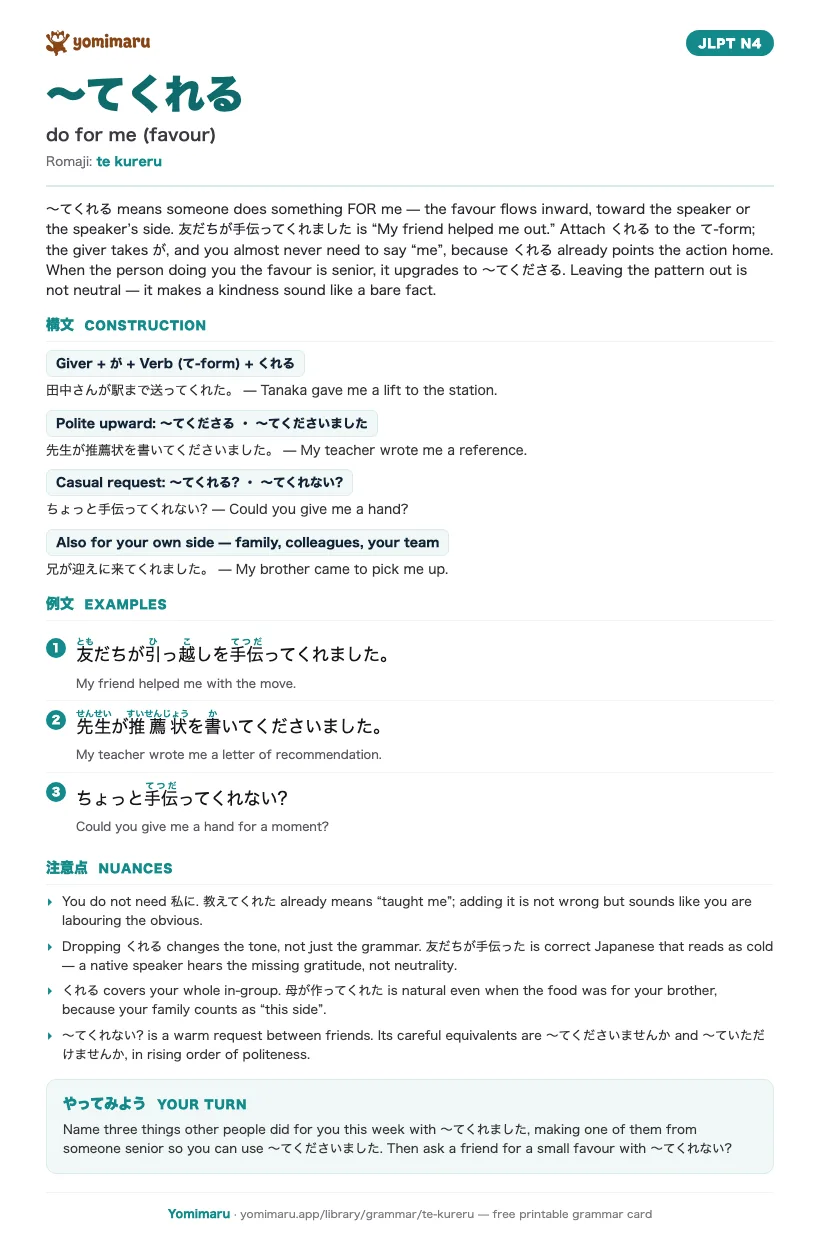
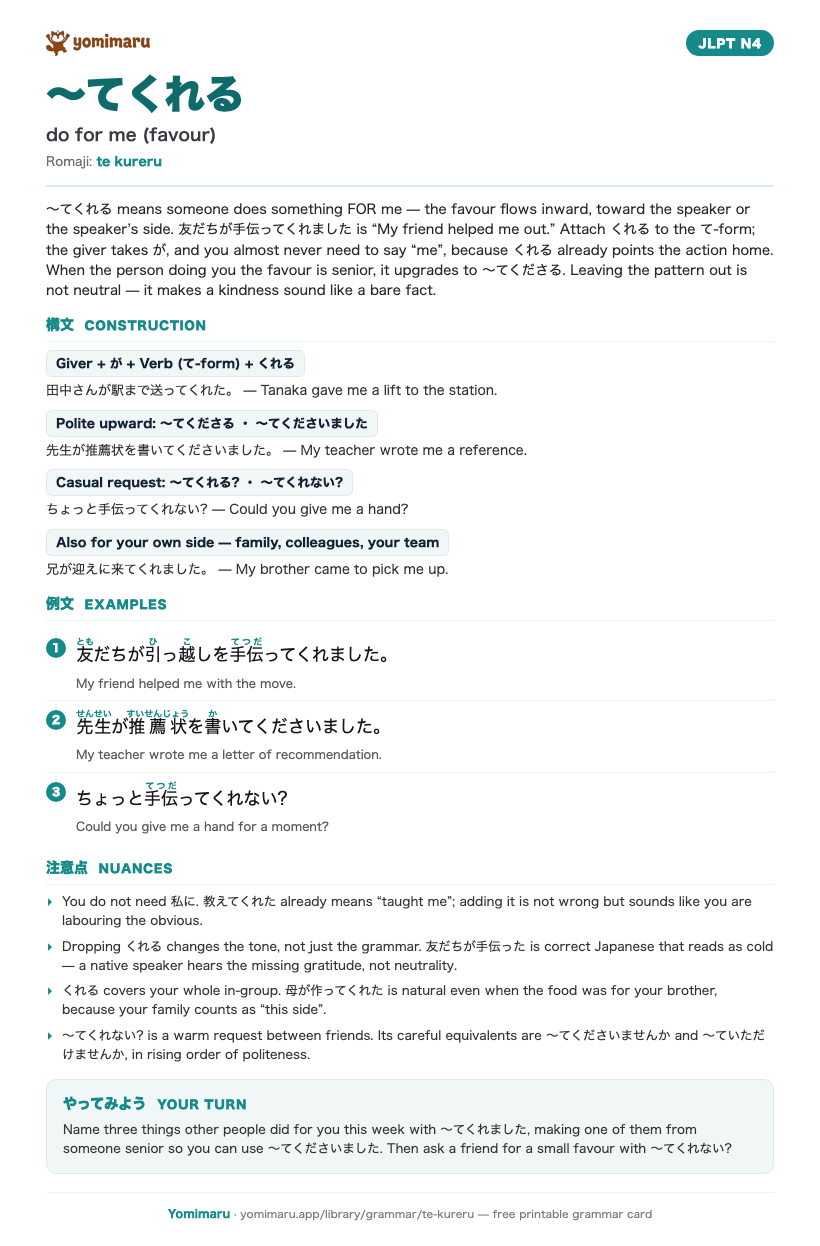
A free one-page study card for 〜てくれる (do for me (favour)), JLPT N4: what it means, how it attaches, 3 example sentences with furigana, and the nuances that trip learners up. Read it right here, or take the PDF or PNG with you. We never ask for an email for this card.
友だちが手伝ってくれました is “My friend helped me out.” Attach くれる to the て-form; the giver takes が, and you almost never need to say “me”, because くれる already points the action home. When the person doing you the favour is senior, it upgrades to 〜てくださる. Leaving the pattern out is not neutral — it makes a kindness sound like a bare fact.
構文Construction
Giver + が + Verb (て-form) + くれる
田中さんが駅まで送ってくれた。 — Tanaka gave me a lift to the station.
Polite upward: 〜てくださる ・ 〜てくださいました
先生が推薦状を書いてくださいました。 — My teacher wrote me a reference.
Casual request: 〜てくれる? ・ 〜てくれない?
ちょっと手伝ってくれない? — Could you give me a hand?
Also for your own side — family, colleagues, your team
兄が迎えに来てくれました。 — My brother came to pick me up.
例文In a sentence
友だちが引っ越しを手伝ってくれました。
My friend helped me with the move.
先生が推薦状を書いてくださいました。
My teacher wrote me a letter of recommendation.
ちょっと手伝ってくれない?
Could you give me a hand for a moment?
注意点Nuances
教えてくれた already means “taught me”; adding it is not wrong but sounds like you are labouring the obvious.
Dropping くれる changes the tone, not just the grammar. 友だちが手伝った is correct Japanese that reads as cold — a native speaker hears the missing gratitude, not neutrality.
くれる covers your whole in-group. 母が作ってくれた is natural even when the food was for your brother, because your family counts as “this side”.
〜てくれない? is a warm request between friends. Its careful equivalents are 〜てくださいませんか and 〜ていただけませんか, in rising order of politeness.
How 〜てくれる differs from similar patterns
〜てあげる — Same favour, opposite direction: 教えてあげた means I taught them, 教えてくれた means they taught me. Getting these backwards is one of the most audible learner slips.
〜てもらう — 〜てもらう describes the same event from the receiving end, with you as the subject: 教えてもらった (“I had them teach me”) rather than 教えてくれた (“they taught me”).
〜てください — 〜てください is a direct request built from this same くれる; 〜てくれる reports a favour that has already happened.
練習Your Turn
Tip
Name three things other people did for you this week with 〜てくれました, making one of them from someone senior so you can use 〜てくださいました. Then ask a friend for a small favour with 〜てくれない?
〜てくれる (do for me (favour)) in real sentences
Each one is quoted from a published Japanese text in this library and links to the story it came from. Some use older spellings, or break off where the sentence carried on. They are transcribed exactly as their authors wrote them.
〜てくれる sits at JLPT N4 in the 302-point taxonomy every text in this library is tagged against. Each text is read for the patterns it contains, which is what lets this page list every text that uses 〜てくれる and pull its example sentences out of them.
The example sentences were not written to demonstrate the rule. They are quoted from published Japanese texts in this library (A Rainy Day and The Long Name among them), and each one links back to the story it came from, so you can read the sentence where it actually happened.
質問Questions
〜てくれる: questions & answers
What is the difference between 〜てくれる and 〜てあげる?
Direction of the favour. 〜てくれる means someone does something for you or your side; 〜てあげる means you do something for someone else. 貸してくれた is “they lent it to me”, 貸してあげた is “I lent it to them”.
Do I have to say 私に with 〜てくれる?
No — くれる already means the action came toward you, so the “me” is built in. 手伝ってくれてありがとう needs no pronoun at all, and adding 私を or 私に usually sounds heavy.
What is 〜てくださる?
It is the respectful form of 〜てくれる, for favours from someone above you: 先生が説明してくださいました. The imperative 〜てください that you learned early on is the same verb, which is why every request in Japanese is literally “give me this action”.
Is there a printable 〜てくれる cheat sheet?
Yes. A free one-page 〜てくれる (do for me (favour)) study card sits at the top of this page, as both a PDF and a PNG. It carries the JLPT N4 meaning, how the pattern attaches, 3 example sentences with furigana, and the nuances learners get wrong. You do not need an account or an email address to download it.
始めるStart free
Read the grammar you just studied
Yomimaru turns every text in the library into a reading lesson: furigana tuned to your JLPT level, tap-to-look-up on any word, and an English breakdown of the vocabulary and grammar in each sentence. It is all free, and we never ask for a card.