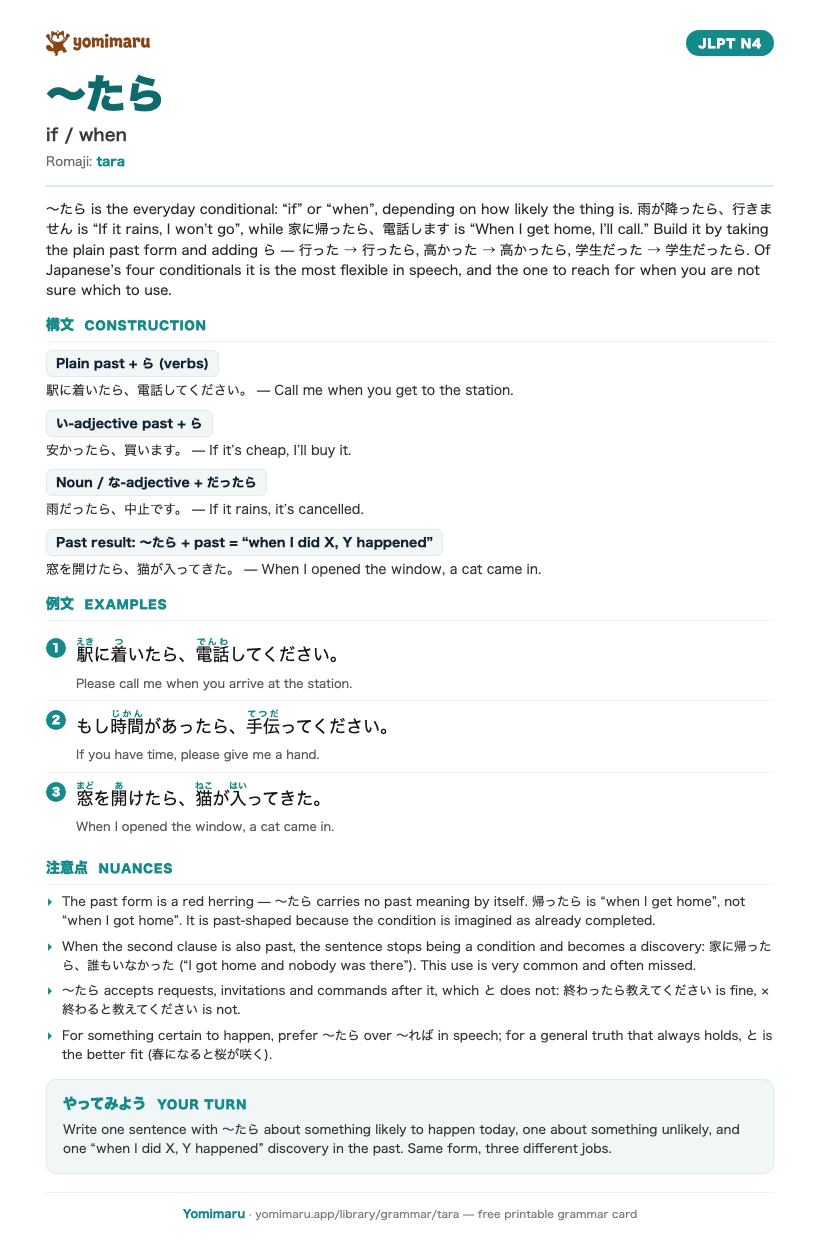
〜たら means “if / when”. It is a JLPT N4 pattern: below are its construction, the nuances that trip learners up, and the sentences where real Japanese writers use it.
A free one-page study card for 〜たら (if / when), JLPT N4: what it means, how it attaches, 3 example sentences with furigana, and the nuances that trip learners up. Read it right here, or take the PDF or PNG with you. We never ask for an email for this card.
雨が降ったら、行きません is “If it rains, I won’t go”, while 家に帰ったら、電話します is “When I get home, I’ll call.” Build it by taking the plain past form and adding ら — 行った → 行ったら, 高かった → 高かったら, 学生だった → 学生だったら. Of Japanese’s four conditionals it is the most flexible in speech, and the one to reach for when you are not sure which to use.
構文Construction
Plain past + ら (verbs)
駅に着いたら、電話してください。 — Call me when you get to the station.
い-adjective past + ら
安かったら、買います。 — If it’s cheap, I’ll buy it.
Noun / な-adjective + だったら
雨だったら、中止です。 — If it rains, it’s cancelled.
Past result: 〜たら + past = “when I did X, Y happened”
窓を開けたら、猫が入ってきた。 — When I opened the window, a cat came in.
例文In a sentence
駅に着いたら、電話してください。
Please call me when you arrive at the station.
もし時間があったら、手伝ってください。
If you have time, please give me a hand.
窓を開けたら、猫が入ってきた。
When I opened the window, a cat came in.
注意点Nuances
帰ったら is “when I get home”, not “when I got home”. It is past-shaped because the condition is imagined as already completed.
When the second clause is also past, the sentence stops being a condition and becomes a discovery: 家に帰ったら、誰もいなかった (“I got home and nobody was there”). This use is very common and often missed.
〜たら accepts requests, invitations and commands after it, which と does not: 終わったら教えてください is fine, ×終わると教えてください is not.
For something certain to happen, prefer 〜たら over 〜れば in speech; for a general truth that always holds, と is the better fit (春になると桜が咲く).
How 〜たら differs from similar patterns
〜ば/〜れば — 〜ば is the more formal and more written conditional, and it prefers hypothetical or general conditions. 〜たら is the spoken default and handles one-off, concrete situations.
なら — なら picks up something the other person just said and responds to it (東京へ行くなら…); 〜たら sets up a condition of your own.
Dictionary form+と — Dictionary form + と is for results that always follow automatically, and it refuses commands or requests in the second clause.
練習Your Turn
Tip
Write one sentence with 〜たら about something likely to happen today, one about something unlikely, and one “when I did X, Y happened” discovery in the past. Same form, three different jobs.
〜たら (if / when) in real sentences
Each one is quoted from a published Japanese text in this library and links to the story it came from. Some use older spellings, or break off where the sentence carried on. They are transcribed exactly as their authors wrote them.
〜たら sits at JLPT N4 in the 302-point taxonomy every text in this library is tagged against. Each text is read for the patterns it contains, which is what lets this page list every text that uses 〜たら and pull its example sentences out of them.
The example sentences were not written to demonstrate the rule. They are quoted from published Japanese texts in this library (The Crow Cat and the Persian Cat and Excellent English and American Jokes among them), and each one links back to the story it came from, so you can read the sentence where it actually happened.
質問Questions
〜たら: questions & answers
Does 〜たら mean “if” or “when”?
Both, and the likelihood of the event decides which English word fits. 雨が降ったら reads as “if it rains” because rain is uncertain; 六時になったら reads as “when it gets to six” because six o’clock will certainly arrive.
Why does 〜たら use the past form if it talks about the future?
The past shape marks the condition as finished, not the event as past. 食べたら means “once eating is done”, so 食べたら出かけます comes out as “I’ll go out after I eat”. Tense for the whole sentence is carried by the final verb.
What is the difference between 〜たら, 〜ば, と and なら?
〜たら is the flexible spoken default. 〜ば is more formal and prefers hypotheticals. と is for automatic, always-true results and cannot be followed by a request. なら responds to something already mentioned — “if that’s the case…”.
Is there a printable 〜たら cheat sheet?
Yes. A free one-page 〜たら (if / when) study card sits at the top of this page, as both a PDF and a PNG. It carries the JLPT N4 meaning, how the pattern attaches, 3 example sentences with furigana, and the nuances learners get wrong. You do not need an account or an email address to download it.
始めるStart free
Read the grammar you just studied
Yomimaru turns every text in the library into a reading lesson: furigana tuned to your JLPT level, tap-to-look-up on any word, and an English breakdown of the vocabulary and grammar in each sentence. It is all free, and we never ask for a card.


 確認
確認