〜そうだlooks like / seems (appearance): Meaning & Examples
sou da · JLPT N4
JLPT N411 textsStudy card
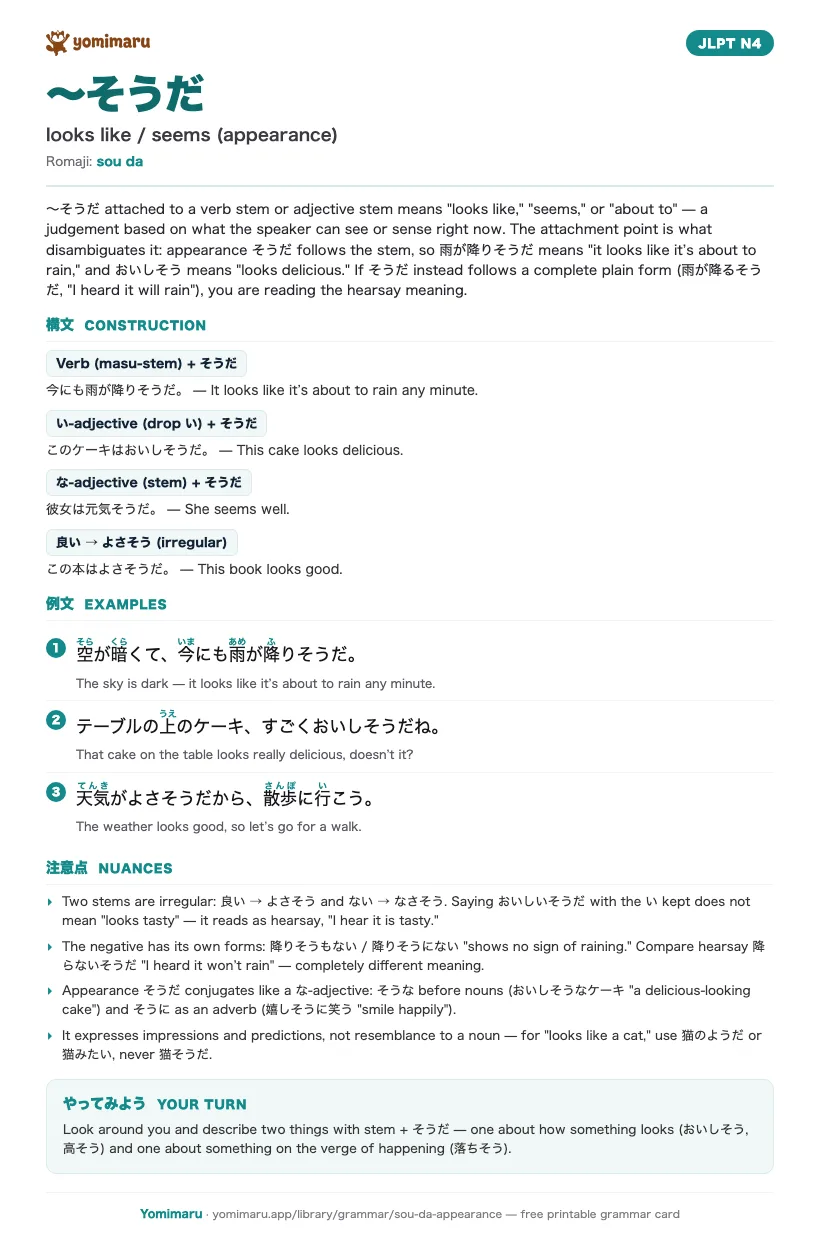
〜そうだ means “looks like / seems (appearance)”. It is a JLPT N4 pattern: below are its construction, the nuances that trip learners up, and the sentences where real Japanese writers use it.
A free one-page study card for 〜そうだ (looks like / seems (appearance)), JLPT N4: what it means, how it attaches, 3 example sentences with furigana, and the nuances that trip learners up. Read it right here, or take the PDF or PNG with you. We never ask for an email for this card.
The attachment point is what disambiguates it: appearance そうだ follows the stem, so 雨が降りそうだ means "it looks like it’s about to rain," and おいしそう means "looks delicious." If そうだ instead follows a complete plain form (雨が降るそうだ, "I heard it will rain"), you are reading the hearsay meaning.
構文Construction
Verb (masu-stem) + そうだ
今にも雨が降りそうだ。 — It looks like it’s about to rain any minute.
い-adjective (drop い) + そうだ
このケーキはおいしそうだ。 — This cake looks delicious.
な-adjective (stem) + そうだ
彼女は元気そうだ。 — She seems well.
良い → よさそう (irregular)
この本はよさそうだ。 — This book looks good.
例文In a sentence
空が暗くて、今にも雨が降りそうだ。
The sky is dark — it looks like it’s about to rain any minute.
テーブルの上のケーキ、すごくおいしそうだね。
That cake on the table looks really delicious, doesn’t it?
天気がよさそうだから、散歩に行こう。
The weather looks good, so let’s go for a walk.
注意点Nuances
Saying おいしいそうだ with the い kept does not mean "looks tasty" — it reads as hearsay, "I hear it is tasty."
The negative has its own forms: 降りそうもない / 降りそうにない "shows no sign of raining." Compare hearsay 降らないそうだ "I heard it won’t rain" — completely different meaning.
Appearance そうだ conjugates like a な-adjective: そうな before nouns (おいしそうなケーキ "a delicious-looking cake") and そうに as an adverb (嬉しそうに笑う "smile happily").
It expresses impressions and predictions, not resemblance to a noun — for "looks like a cat," use 猫のようだ or 猫みたい, never 猫そうだ.
How 〜そうだ differs from similar patterns
〜そうだ — Same surface, different attachment: appearance follows the stem (降りそうだ = "looks about to rain"), hearsay follows the complete plain form (降るそうだ = "I heard it will rain").
〜ようだ — 〜ようだ (and みたい) also mean "seems," but cover resemblance and inference from evidence; stem + そうだ is an on-the-spot visual impression or an "about to happen" prediction.
練習Your Turn
Tip
Look around you and describe two things with stem + そうだ — one about how something looks (おいしそう, 高そう) and one about something on the verge of happening (落ちそう).
〜そうだ (looks like / seems (appearance)) in real sentences
Each one is quoted from a published Japanese text in this library and links to the story it came from. Some use older spellings, or break off where the sentence carried on. They are transcribed exactly as their authors wrote them.
〜そうだ sits at JLPT N4 in the 302-point taxonomy every text in this library is tagged against. Each text is read for the patterns it contains, which is what lets this page list every text that uses 〜そうだ and pull its example sentences out of them.
The example sentences were not written to demonstrate the rule. They are quoted from published Japanese texts in this library (The Lost Child at the Beach and Mr. Duck and Mr. Chicken among them), and each one links back to the story it came from, so you can read the sentence where it actually happened.
質問Questions
〜そうだ: questions & answers
How can I tell appearance そうだ from hearsay そうだ?
Check the attachment point. Appearance そうだ follows an incomplete stem — 降り, おいし, 元気 — so 降りそうだ means "it looks about to rain." Hearsay そうだ follows a complete plain form, so 降るそうだ means "I heard it will rain." In short: stem = what you see, plain form = what you heard.
Why is it よさそう and not いいそう?
The adjective 良い is irregular here: its stem takes an extra さ, giving よさそう "looks good." The same さ appears in ない → なさそう. If you said いいそうだ, it would parse as hearsay — "I hear it is good."
How do I say "it doesn’t look like it will rain"?
Use the special negative 降りそうもない or 降りそうにない. Putting a plain negative before そうだ instead (降らないそうだ) flips you into hearsay — "I heard it will not rain." For adjectives, use なさそう: おいしくなさそう "doesn’t look tasty."
Is there a printable 〜そうだ cheat sheet?
Yes. A free one-page 〜そうだ (looks like / seems (appearance)) study card sits at the top of this page, as both a PDF and a PNG. It carries the JLPT N4 meaning, how the pattern attaches, 3 example sentences with furigana, and the nuances learners get wrong. You do not need an account or an email address to download it.
始めるStart free
Read the grammar you just studied
Yomimaru turns every text in the library into a reading lesson: furigana tuned to your JLPT level, tap-to-look-up on any word, and an English breakdown of the vocabulary and grammar in each sentence. It is all free, and we never ask for a card.