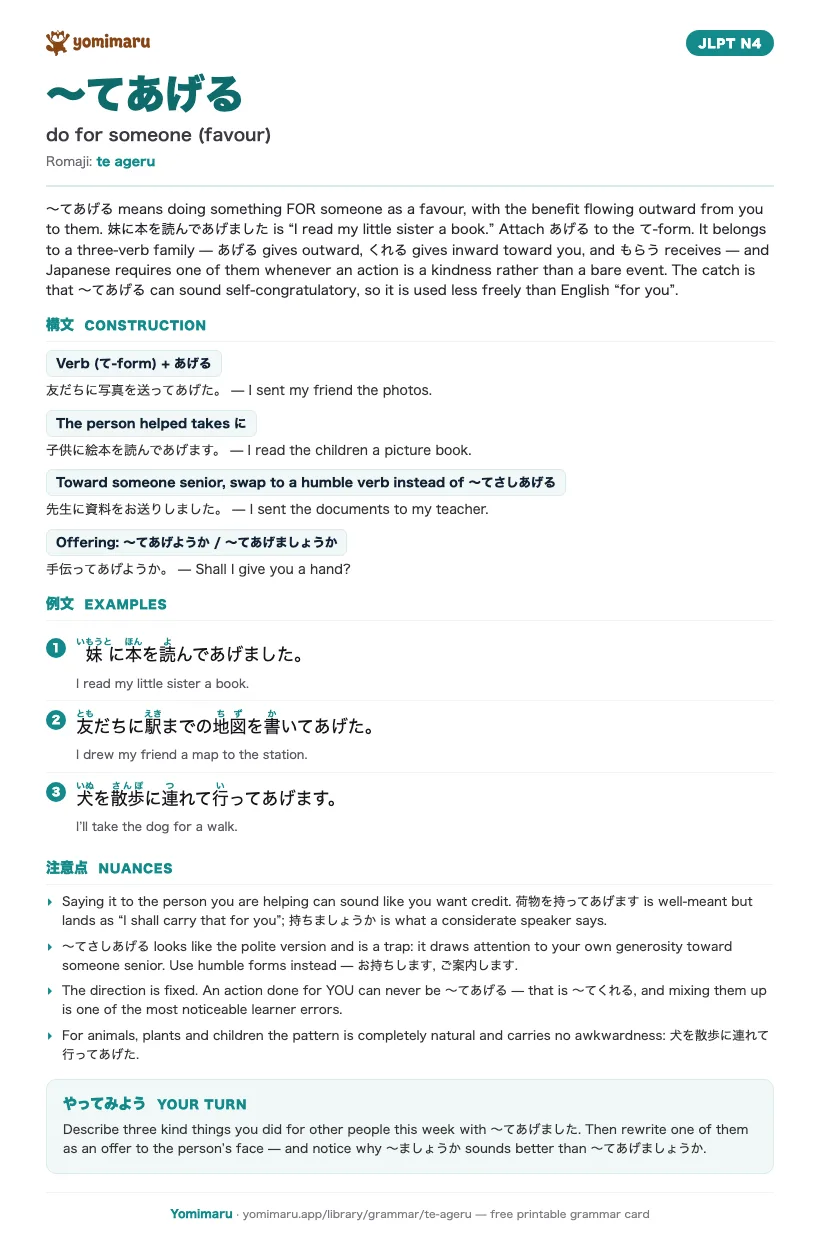
〜てあげる means “do for someone (favour)”. It is a JLPT N4 pattern: below are its construction, the nuances that trip learners up, and the sentences where real Japanese writers use it.
A free one-page study card for 〜てあげる (do for someone (favour)), JLPT N4: what it means, how it attaches, 3 example sentences with furigana, and the nuances that trip learners up. Read it right here, or take the PDF or PNG with you. We never ask for an email for this card.
妹に本を読んであげました is “I read my little sister a book.” Attach あげる to the て-form. It belongs to a three-verb family — あげる gives outward, くれる gives inward toward you, and もらう receives — and Japanese requires one of them whenever an action is a kindness rather than a bare event. The catch is that 〜てあげる can sound self-congratulatory, so it is used less freely than English “for you”.
構文Construction
Verb (て-form) + あげる
友だちに写真を送ってあげた。 — I sent my friend the photos.
The person helped takes に
子供に絵本を読んであげます。 — I read the children a picture book.
Toward someone senior, swap to a humble verb instead of 〜てさしあげる
先生に資料をお送りしました。 — I sent the documents to my teacher.
Offering: 〜てあげようか / 〜てあげましょうか
手伝ってあげようか。 — Shall I give you a hand?
例文In a sentence
妹に本を読んであげました。
I read my little sister a book.
友だちに駅までの地図を書いてあげた。
I drew my friend a map to the station.
犬を散歩に連れて行ってあげます。
I’ll take the dog for a walk.
注意点Nuances
荷物を持ってあげます is well-meant but lands as “I shall carry that for you”; 持ちましょうか is what a considerate speaker says.
〜てさしあげる looks like the polite version and is a trap: it draws attention to your own generosity toward someone senior. Use humble forms instead — お持ちします, ご案内します.
The direction is fixed. An action done for YOU can never be 〜てあげる — that is 〜てくれる, and mixing them up is one of the most noticeable learner errors.
For animals, plants and children the pattern is completely natural and carries no awkwardness: 犬を散歩に連れて行ってあげた.
How 〜てあげる differs from similar patterns
〜てくれる — 〜てくれる is the same favour pointing the other way: someone does it for you. 教えてあげた means I taught them; 教えてくれた means they taught me.
〜てやる — 〜てやる is the blunt, downward version of 〜てあげる — used with children, animals, close friends, and sometimes with an edge of defiance.
〜てもらう — 〜てもらう receives the favour instead of giving it, and puts the emphasis on your gratitude: 教えてもらった (“I had them teach me”).
練習Your Turn
Tip
Describe three kind things you did for other people this week with 〜てあげました. Then rewrite one of them as an offer to the person’s face — and notice why 〜ましょうか sounds better than 〜てあげましょうか.
〜てあげる (do for someone (favour)) in real sentences
Each one is quoted from a published Japanese text in this library and links to the story it came from. Some use older spellings, or break off where the sentence carried on. They are transcribed exactly as their authors wrote them.
〜てあげる sits at JLPT N4 in the 302-point taxonomy every text in this library is tagged against. Each text is read for the patterns it contains, which is what lets this page list every text that uses 〜てあげる and pull its example sentences out of them.
The example sentences were not written to demonstrate the rule. They are quoted from published Japanese texts in this library (The Ginkgo Nut and The Magic Flute among them), and each one links back to the story it came from, so you can read the sentence where it actually happened.
質問Questions
〜てあげる: questions & answers
When should I avoid 〜てあげる?
When you are speaking to the person you are helping, especially anyone senior. 手伝ってあげます implies you are being generous; 手伝いましょうか simply offers. Keep 〜てあげる for describing what you did to a third party.
What is the difference between 〜てあげる and 〜てくれる?
Direction. 〜てあげる means you do something for someone else; 〜てくれる means someone does something for you. 貸してあげた is “I lent it to them”, 貸してくれた is “they lent it to me”.
Is 〜てさしあげる the polite version of 〜てあげる?
Grammatically yes, socially no. Because it highlights your own kindness toward someone above you, it often sounds presumptuous. Japanese uses humble verb forms there instead — お送りします rather than 送ってさしあげます.
Is there a printable 〜てあげる cheat sheet?
Yes. A free one-page 〜てあげる (do for someone (favour)) study card sits at the top of this page, as both a PDF and a PNG. It carries the JLPT N4 meaning, how the pattern attaches, 3 example sentences with furigana, and the nuances learners get wrong. You do not need an account or an email address to download it.
始めるStart free
Read the grammar you just studied
Yomimaru turns every text in the library into a reading lesson: furigana tuned to your JLPT level, tap-to-look-up on any word, and an English breakdown of the vocabulary and grammar in each sentence. It is all free, and we never ask for a card.