〜てやるdo for (blunt benefactive): Meaning & Examples
te yaru · JLPT N4
JLPT N410 textsStudy card
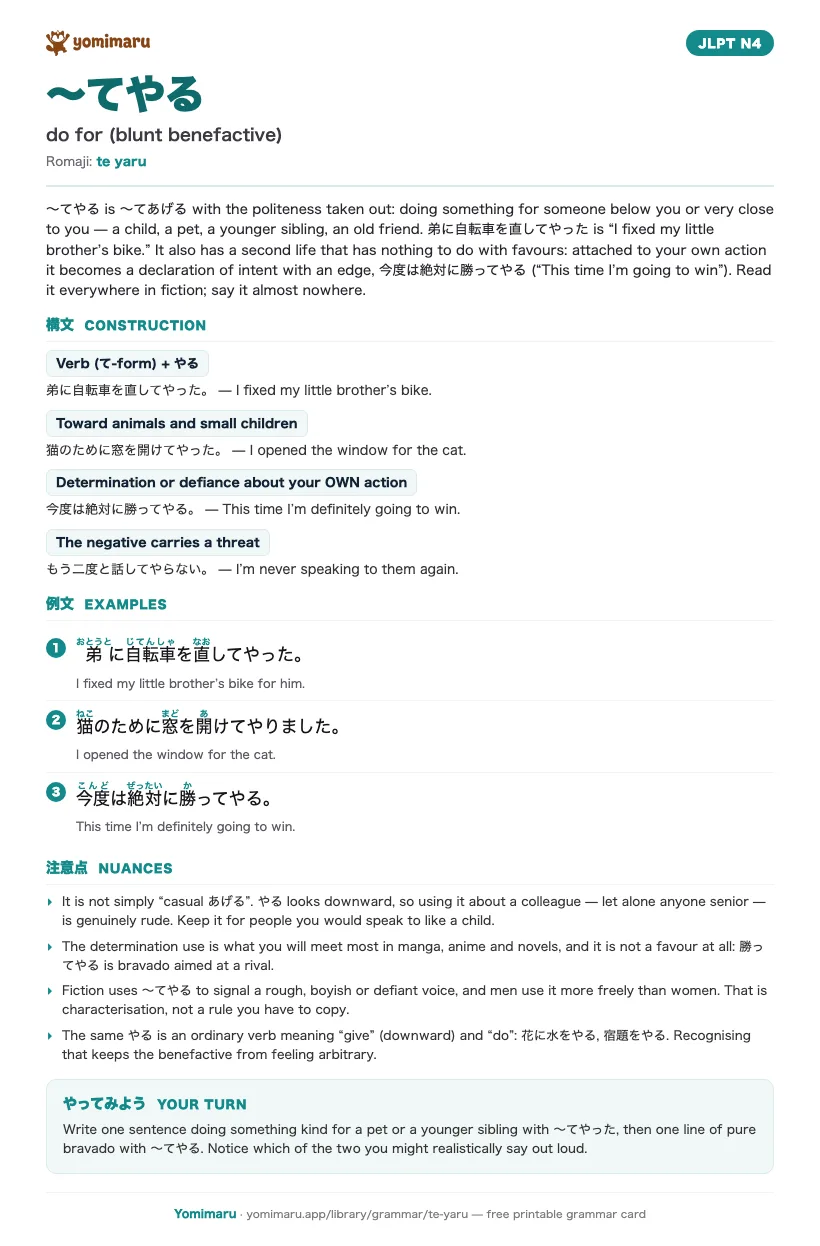
〜てやる means “do for (blunt benefactive)”. It is a JLPT N4 pattern: below are its construction, the nuances that trip learners up, and the sentences where real Japanese writers use it.
A free one-page study card for 〜てやる (do for (blunt benefactive)), JLPT N4: what it means, how it attaches, 3 example sentences with furigana, and the nuances that trip learners up. Read it right here, or take the PDF or PNG with you. We never ask for an email for this card.
弟に自転車を直してやった is “I fixed my little brother’s bike.” It also has a second life that has nothing to do with favours: attached to your own action it becomes a declaration of intent with an edge, 今度は絶対に勝ってやる (“This time I’m going to win”). Read it everywhere in fiction; say it almost nowhere.
構文Construction
Verb (て-form) + やる
弟に自転車を直してやった。 — I fixed my little brother’s bike.
Toward animals and small children
猫のために窓を開けてやった。 — I opened the window for the cat.
Determination or defiance about your OWN action
今度は絶対に勝ってやる。 — This time I’m definitely going to win.
The negative carries a threat
もう二度と話してやらない。 — I’m never speaking to them again.
例文In a sentence
弟に自転車を直してやった。
I fixed my little brother’s bike for him.
猫のために窓を開けてやりました。
I opened the window for the cat.
今度は絶対に勝ってやる。
This time I’m definitely going to win.
注意点Nuances
やる looks downward, so using it about a colleague — let alone anyone senior — is genuinely rude. Keep it for people you would speak to like a child.
The determination use is what you will meet most in manga, anime and novels, and it is not a favour at all: 勝ってやる is bravado aimed at a rival.
Fiction uses 〜てやる to signal a rough, boyish or defiant voice, and men use it more freely than women. That is characterisation, not a rule you have to copy.
The same やる is an ordinary verb meaning “give” (downward) and “do”: 花に水をやる, 宿題をやる. Recognising that keeps the benefactive from feeling arbitrary.
How 〜てやる differs from similar patterns
〜てあげる — 〜てあげる is the neutral-to-polite version of the same outward favour. If you are unsure which to use, it is almost always 〜てあげる.
〜てくれる — 〜てくれる points the favour inward, toward you. 〜てやる always points away from you, and down.
〜てしまう — Both can carry attitude, but 〜てしまう is about the action being finished or regretted, while 〜てやる is about who it was aimed at.
練習Your Turn
Tip
Write one sentence doing something kind for a pet or a younger sibling with 〜てやった, then one line of pure bravado with 〜てやる. Notice which of the two you might realistically say out loud.
〜てやる (do for (blunt benefactive)) in real sentences
Each one is quoted from a published Japanese text in this library and links to the story it came from. Some use older spellings, or break off where the sentence carried on. They are transcribed exactly as their authors wrote them.
〜てやる sits at JLPT N4 in the 302-point taxonomy every text in this library is tagged against. Each text is read for the patterns it contains, which is what lets this page list every text that uses 〜てやる and pull its example sentences out of them.
The example sentences were not written to demonstrate the rule. They are quoted from published Japanese texts in this library (The Heartless Man and One Fire among them), and each one links back to the story it came from, so you can read the sentence where it actually happened.
質問Questions
〜てやる: questions & answers
Is 〜てやる rude?
It can be. やる looks down at the person receiving the favour, which is fine for pets, small children and close family, and offensive about a colleague or a superior. When in doubt use 〜てあげる, or drop the benefactive altogether.
Why does 〜てやる sometimes mean determination rather than a favour?
Because the “downward” force can point at a situation instead of a person. 見てろよ、やってやる is aimed at whatever is in your way, and it reads as defiance because of that. This use is extremely common in fiction and sport.
What is the difference between 〜てやる and 〜てあげる?
They describe the same outward favour at different social levels. 〜てあげる is neutral and usable with most people; 〜てやる is blunt and downward, and marks the recipient as someone below you or very close.
Is there a printable 〜てやる cheat sheet?
Yes. A free one-page 〜てやる (do for (blunt benefactive)) study card sits at the top of this page, as both a PDF and a PNG. It carries the JLPT N4 meaning, how the pattern attaches, 3 example sentences with furigana, and the nuances learners get wrong. You do not need an account or an email address to download it.
始めるStart free
Read the grammar you just studied
Yomimaru turns every text in the library into a reading lesson: furigana tuned to your JLPT level, tap-to-look-up on any word, and an English breakdown of the vocabulary and grammar in each sentence. It is all free, and we never ask for a card.