〜ていたwas doing (past continuous): Meaning & Examples
te ita · JLPT N4
JLPT N46 textsStudy card
〜ていた means “was doing (past continuous)”. It is a JLPT N4 pattern: below are its construction, the nuances that trip learners up, and the sentences where real Japanese writers use it.
A free one-page study card for 〜ていた (was doing (past continuous)), JLPT N4: what it means, how it attaches, 3 example sentences with furigana, and the nuances that trip learners up. Read it right here, or take the PDF or PNG with you. We never ask for an email for this card.
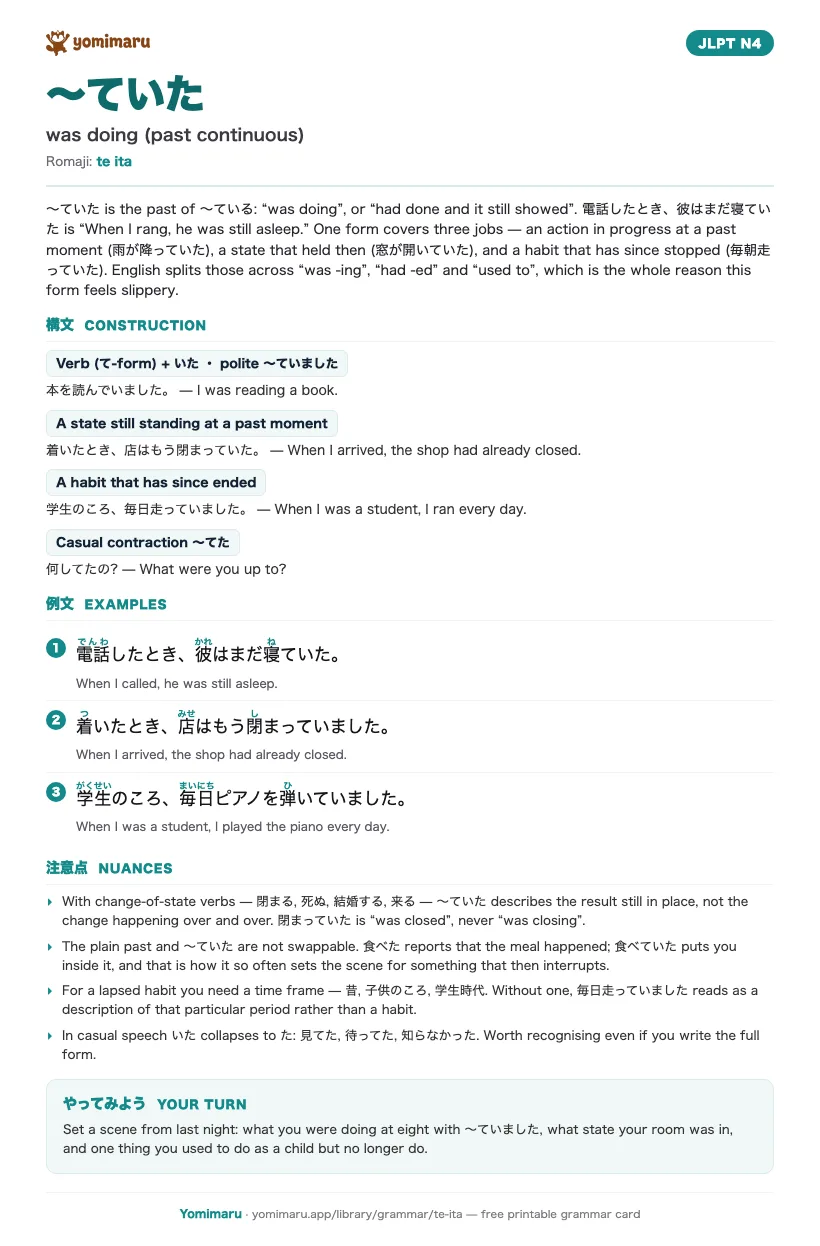
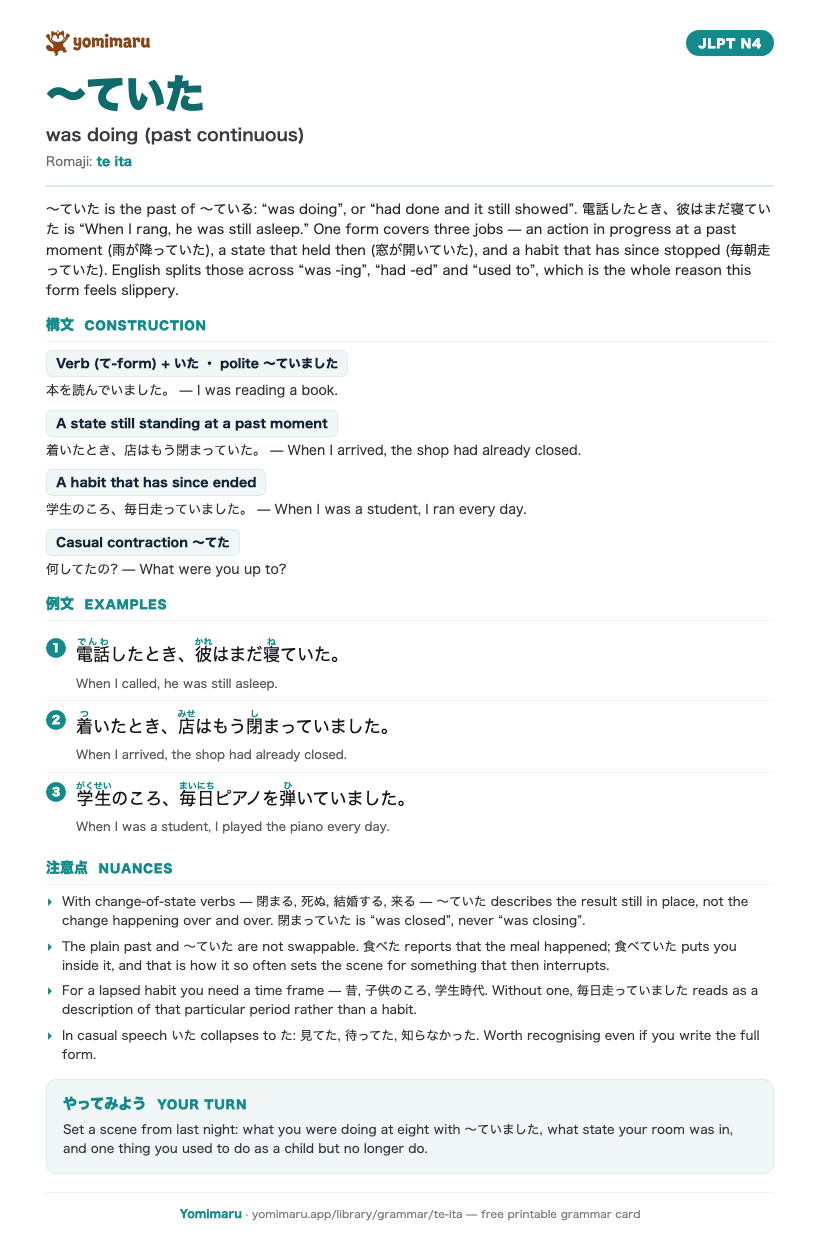
電話したとき、彼はまだ寝ていた is “When I rang, he was still asleep.” One form covers three jobs — an action in progress at a past moment (雨が降っていた), a state that held then (窓が開いていた), and a habit that has since stopped (毎朝走っていた). English splits those across “was -ing”, “had -ed” and “used to”, which is the whole reason this form feels slippery.
構文Construction
Verb (て-form) + いた ・ polite 〜ていました
本を読んでいました。 — I was reading a book.
A state still standing at a past moment
着いたとき、店はもう閉まっていた。 — When I arrived, the shop had already closed.
A habit that has since ended
学生のころ、毎日走っていました。 — When I was a student, I ran every day.
Casual contraction 〜てた
何してたの? — What were you up to?
例文In a sentence
電話したとき、彼はまだ寝ていた。
When I called, he was still asleep.
着いたとき、店はもう閉まっていました。
When I arrived, the shop had already closed.
学生のころ、毎日ピアノを弾いていました。
When I was a student, I played the piano every day.
注意点Nuances
閉まっていた is “was closed”, never “was closing”.
The plain past and 〜ていた are not swappable. 食べた reports that the meal happened; 食べていた puts you inside it, and that is how it so often sets the scene for something that then interrupts.
For a lapsed habit you need a time frame — 昔, 子供のころ, 学生時代. Without one, 毎日走っていました reads as a description of that particular period rather than a habit.
In casual speech いた collapses to た: 見てた, 待ってた, 知らなかった. Worth recognising even if you write the full form.
How 〜ていた differs from similar patterns
〜ている — 〜ている is the present of this exact form. Every meaning here has a present-tense twin: 寝ている (“is asleep”) → 寝ていた (“was asleep”).
〜たものだ — 〜たものだ also reports a past habit but adds nostalgia — “ah, I used to…”. 〜ていた is neutral about how you feel.
練習Your Turn
Tip
Set a scene from last night: what you were doing at eight with 〜ていました, what state your room was in, and one thing you used to do as a child but no longer do.
〜ていた (was doing (past continuous)) in real sentences
Each one is quoted from a published Japanese text in this library and links to the story it came from. Some use older spellings, or break off where the sentence carried on. They are transcribed exactly as their authors wrote them.
〜ていた sits at JLPT N4 in the 302-point taxonomy every text in this library is tagged against. Each text is read for the patterns it contains, which is what lets this page list every text that uses 〜ていた and pull its example sentences out of them.
The example sentences were not written to demonstrate the rule. They are quoted from published Japanese texts in this library (The Promise and The Strange Man's Eye among them), and each one links back to the story it came from, so you can read the sentence where it actually happened.
質問Questions
〜ていた: questions & answers
What is the difference between 〜ていた and the plain past?
食べた tells you the eating happened and is over. 食べていた places you in the middle of it, so it is what you use to describe the background to another event: 食べていたとき、電話が鳴った (“I was eating when the phone rang”).
Can 〜ていた mean “used to”?
Yes, when a time frame makes clear you are talking about a past stretch of life: 昔はタバコを吸っていました (“I used to smoke”). Without that frame it reads as an action in progress at one moment instead.
What does 〜てた mean?
It is the casual contraction of 〜ていた: 見てた for 見ていた, 待ってた for 待っていた. Very common in conversation, and normal in messages between friends, but avoid it in writing you would submit.
Is there a printable 〜ていた cheat sheet?
Yes. A free one-page 〜ていた (was doing (past continuous)) study card sits at the top of this page, as both a PDF and a PNG. It carries the JLPT N4 meaning, how the pattern attaches, 3 example sentences with furigana, and the nuances learners get wrong. You do not need an account or an email address to download it.
始めるStart free
Read the grammar you just studied
Yomimaru turns every text in the library into a reading lesson: furigana tuned to your JLPT level, tap-to-look-up on any word, and an English breakdown of the vocabulary and grammar in each sentence. It is all free, and we never ask for a card.