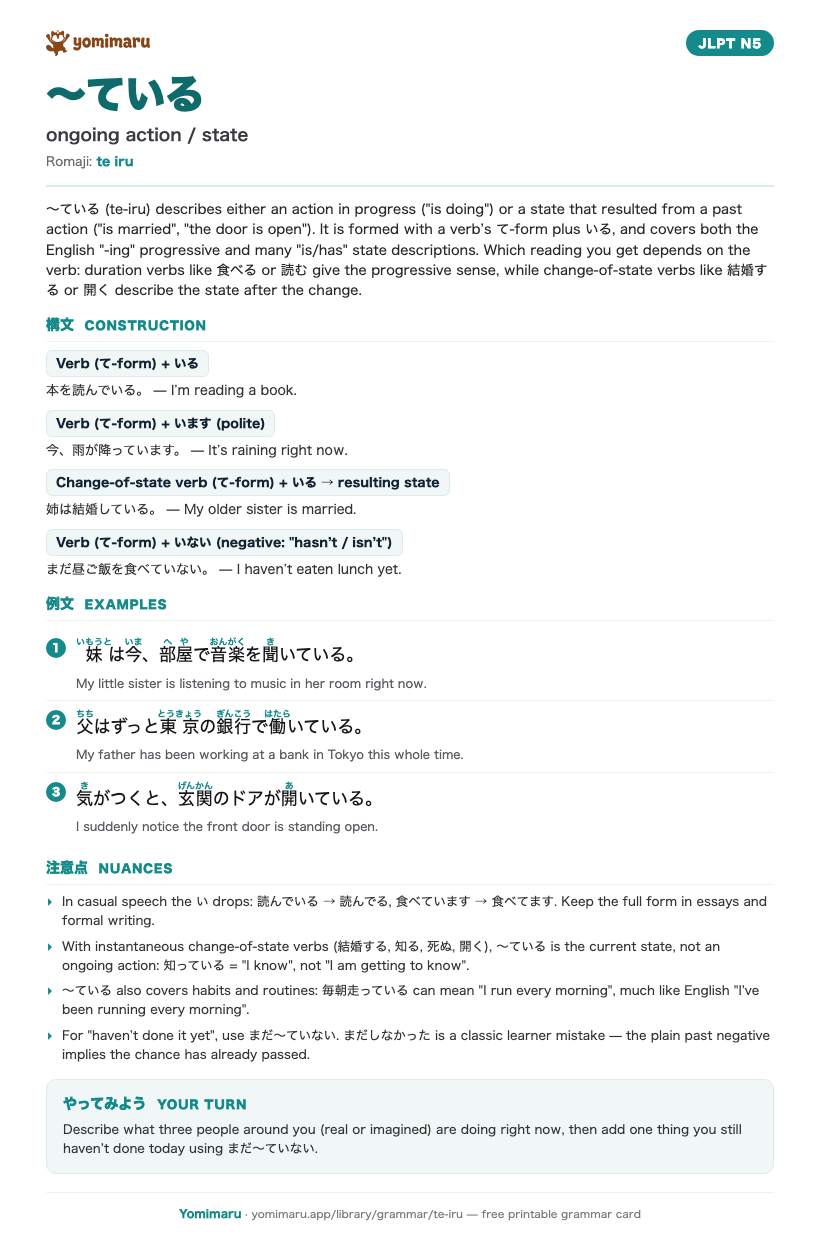
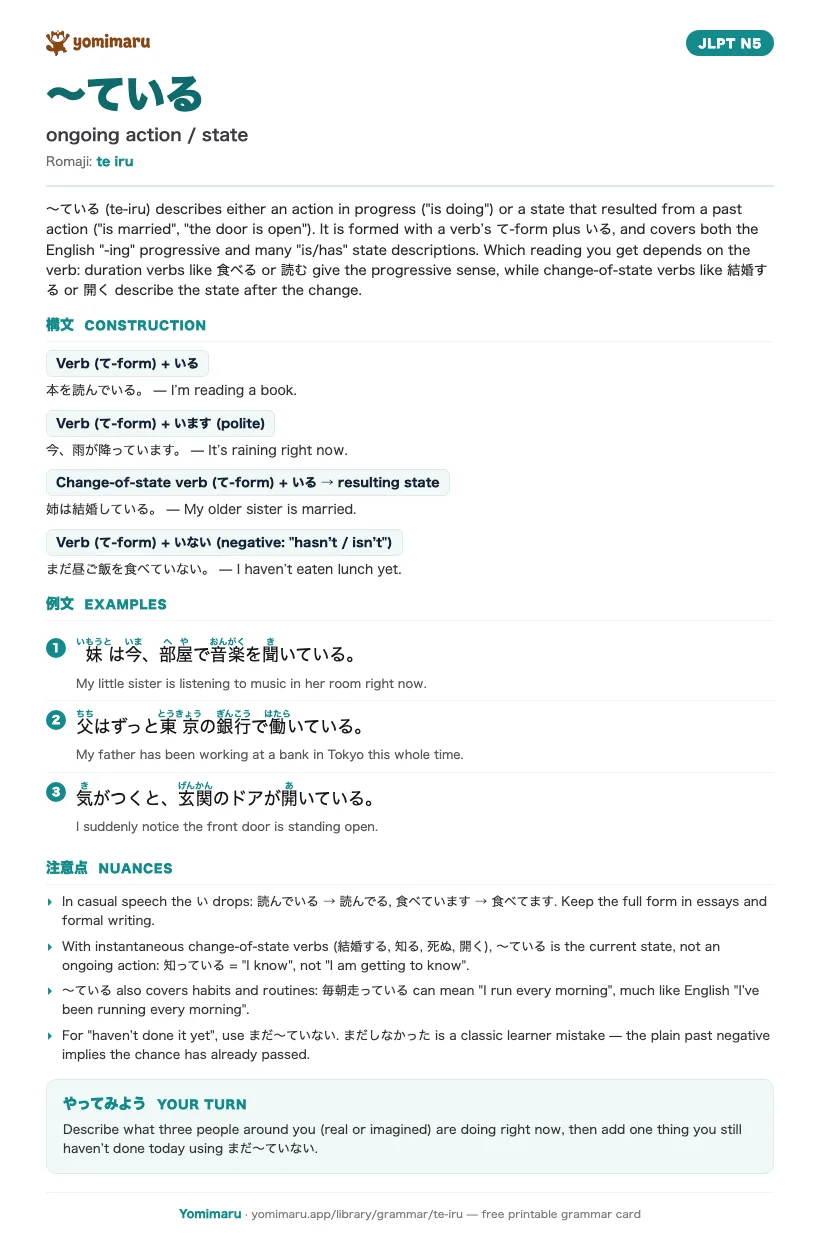
〜ている means “ongoing action / state”. It is a JLPT N5 pattern: below are its construction, the nuances that trip learners up, and the sentences where real Japanese writers use it.
A free one-page study card for 〜ている (ongoing action / state), JLPT N5: what it means, how it attaches, 3 example sentences with furigana, and the nuances that trip learners up. Read it right here, or take the PDF or PNG with you. We never ask for an email for this card.
It is formed with a verb’s て-form plus いる, and covers both the English "-ing" progressive and many "is/has" state descriptions. Which reading you get depends on the verb: duration verbs like 食べる or 読む give the progressive sense, while change-of-state verbs like 結婚する or 開く describe the state after the change.
構文Construction
Verb (て-form) + いる
本を読んでいる。 — I’m reading a book.
Verb (て-form) + います (polite)
今、雨が降っています。 — It’s raining right now.
Change-of-state verb (て-form) + いる → resulting state
姉は結婚している。 — My older sister is married.
Verb (て-form) + いない (negative: "hasn’t / isn’t")
まだ昼ご飯を食べていない。 — I haven’t eaten lunch yet.
例文In a sentence
妹は今、部屋で音楽を聞いている。
My little sister is listening to music in her room right now.
父はずっと東京の銀行で働いている。
My father has been working at a bank in Tokyo this whole time.
気がつくと、玄関のドアが開いている。
I suddenly notice the front door is standing open.
注意点Nuances
Keep the full form in essays and formal writing.
With instantaneous change-of-state verbs (結婚する, 知る, 死ぬ, 開く), 〜ている is the current state, not an ongoing action: 知っている = "I know", not "I am getting to know".
〜ている also covers habits and routines: 毎朝走っている can mean "I run every morning", much like English "I’ve been running every morning".
For "haven’t done it yet", use まだ〜ていない. まだしなかった is a classic learner mistake — the plain past negative implies the chance has already passed.
How 〜ている differs from similar patterns
〜ていた — 〜ていた is simply the past of 〜ている — an action that was in progress, or a state that held, at some past moment.
〜てある — 〜てある also describes a resulting state, but implies someone deliberately did the action: 窓が開いている just says the window is open; 窓が開けてある suggests somebody opened it on purpose.
練習Your Turn
Tip
Describe what three people around you (real or imagined) are doing right now, then add one thing you still haven’t done today using まだ〜ていない.
〜ている (ongoing action / state) in real sentences
Each one is quoted from a published Japanese text in this library and links to the story it came from. Some use older spellings, or break off where the sentence carried on. They are transcribed exactly as their authors wrote them.
〜ている sits at JLPT N5 in the 302-point taxonomy every text in this library is tagged against. Each text is read for the patterns it contains, which is what lets this page list every text that uses 〜ている and pull its example sentences out of them.
The example sentences were not written to demonstrate the rule. They are quoted from published Japanese texts in this library (The Fainting Doll and Two Frogs among them), and each one links back to the story it came from, so you can read the sentence where it actually happened.
質問Questions
〜ている: questions & answers
What is the difference between 〜ている and 〜てる?
〜てる is the contracted casual form — the い simply drops in speech: 食べている → 食べてる, and politely 食べています → 食べてます. It is perfectly natural in conversation and texting, but stick to the full 〜ている in formal writing.
Why does 結婚している mean "is married" and not "is getting married"?
Verbs like 結婚する, 知る, and 死ぬ describe a change that happens in an instant, so 〜ている expresses the state after that change. To talk about the event itself you say 結婚する (will marry) or 結婚した (got married).
How do I say "I haven’t done it yet" in Japanese?
Use まだ〜ていない: まだ宿題をしていない means "I haven’t done my homework yet." まだしなかった sounds off because the plain past negative frames the timeframe as finished. This pattern appears constantly in native text, so a little reading practice on Yomimaru makes it automatic fast.
Is there a printable 〜ている cheat sheet?
Yes. A free one-page 〜ている (ongoing action / state) study card sits at the top of this page, as both a PDF and a PNG. It carries the JLPT N5 meaning, how the pattern attaches, 3 example sentences with furigana, and the nuances learners get wrong. You do not need an account or an email address to download it.
始めるStart free
Read the grammar you just studied
Yomimaru turns every text in the library into a reading lesson: furigana tuned to your JLPT level, tap-to-look-up on any word, and an English breakdown of the vocabulary and grammar in each sentence. It is all free, and we never ask for a card.


 確認
確認