〜かどうか means “whether or not”. It is a JLPT N4 pattern: below are its construction, the nuances that trip learners up, and the sentences where real Japanese writers use it.
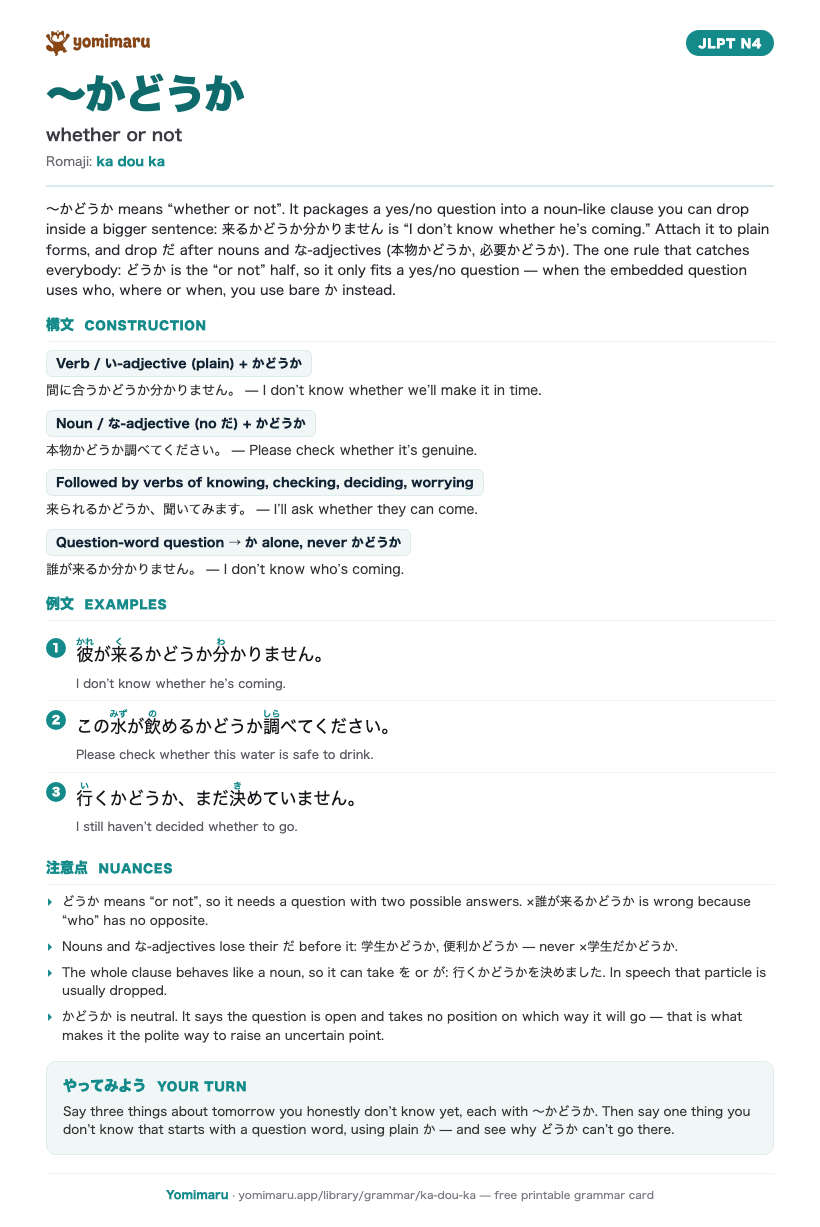
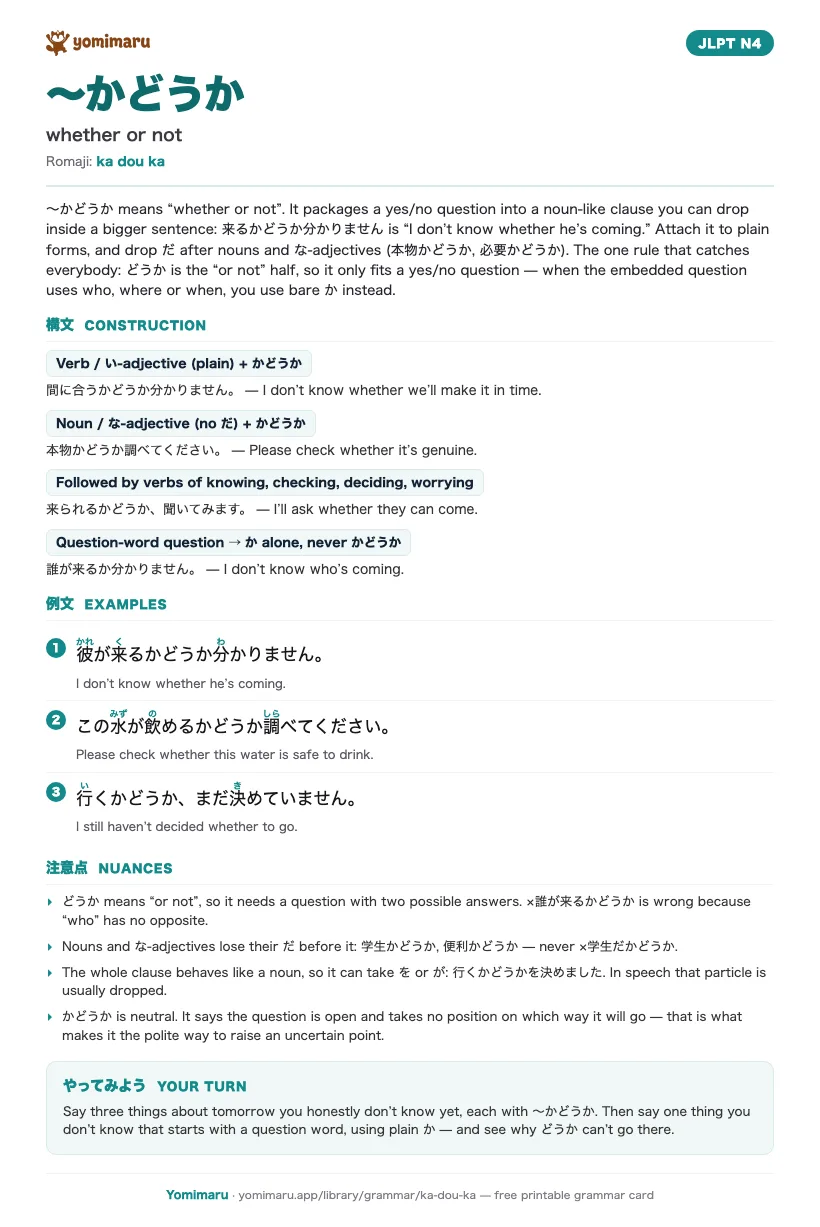
A free one-page study card for 〜かどうか (whether or not), JLPT N4: what it means, how it attaches, 3 example sentences with furigana, and the nuances that trip learners up. Read it right here, or take the PDF or PNG with you. We never ask for an email for this card.
It packages a yes/no question into a noun-like clause you can drop inside a bigger sentence: 来るかどうか分かりません is “I don’t know whether he’s coming.” Attach it to plain forms, and drop だ after nouns and な-adjectives (本物かどうか, 必要かどうか). The one rule that catches everybody: どうか is the “or not” half, so it only fits a yes/no question — when the embedded question uses who, where or when, you use bare か instead.
構文Construction
Verb / い-adjective (plain) + かどうか
間に合うかどうか分かりません。 — I don’t know whether we’ll make it in time.
Followed by verbs of knowing, checking, deciding, worrying
来られるかどうか、聞いてみます。 — I’ll ask whether they can come.
Question-word question → か alone, never かどうか
誰が来るか分かりません。 — I don’t know who’s coming.
例文In a sentence
彼が来るかどうか分かりません。
I don’t know whether he’s coming.
この水が飲めるかどうか調べてください。
Please check whether this water is safe to drink.
行くかどうか、まだ決めていません。
I still haven’t decided whether to go.
注意点Nuances
×誰が来るかどうか is wrong because “who” has no opposite.
Nouns and な-adjectives lose their だ before it: 学生かどうか, 便利かどうか — never ×学生だかどうか.
The whole clause behaves like a noun, so it can take を or が: 行くかどうかを決めました. In speech that particle is usually dropped.
かどうか is neutral. It says the question is open and takes no position on which way it will go — that is what makes it the polite way to raise an uncertain point.
How 〜かどうか differs from similar patterns
〜のではないか — 〜のではないか floats a suspicion (“isn’t it that…?”); 〜かどうか leaves the question genuinely open and leans neither way.
なら — なら supposes something IS true and reacts to it (行くなら…); かどうか keeps its truth unresolved.
練習Your Turn
Tip
Say three things about tomorrow you honestly don’t know yet, each with 〜かどうか. Then say one thing you don’t know that starts with a question word, using plain か — and see why どうか can’t go there.
〜かどうか (whether or not) in real sentences
Each one is quoted from a published Japanese text in this library and links to the story it came from. Some use older spellings, or break off where the sentence carried on. They are transcribed exactly as their authors wrote them.
〜かどうか sits at JLPT N4 in the 302-point taxonomy every text in this library is tagged against. Each text is read for the patterns it contains, which is what lets this page list every text that uses 〜かどうか and pull its example sentences out of them.
The example sentences were not written to demonstrate the rule. They are quoted from published Japanese texts in this library (The Crab's Barber Business and The Embassy's Cleanup Agency among them), and each one links back to the story it came from, so you can read the sentence where it actually happened.
質問Questions
〜かどうか: questions & answers
What does かどうか mean?
It means “whether or not” and turns a yes/no question into a clause you can embed. 雨が降る (“it will rain”) becomes 雨が降るかどうか分かりません (“I don’t know whether it will rain”).
When should I use か instead of かどうか?
Whenever the embedded question contains a question word — 誰, 何, どこ, いつ, どうして. Those questions have no “or not”, so you use bare か: 何時に始まるか教えてください.
Do I keep だ before かどうか?
No. Nouns and な-adjectives attach directly: 学生かどうか, 安全かどうか. Verbs and い-adjectives use their plain form as-is: 行くかどうか, 高いかどうか.
Is there a printable 〜かどうか cheat sheet?
Yes. A free one-page 〜かどうか (whether or not) study card sits at the top of this page, as both a PDF and a PNG. It carries the JLPT N4 meaning, how the pattern attaches, 3 example sentences with furigana, and the nuances learners get wrong. You do not need an account or an email address to download it.
始めるStart free
Read the grammar you just studied
Yomimaru turns every text in the library into a reading lesson: furigana tuned to your JLPT level, tap-to-look-up on any word, and an English breakdown of the vocabulary and grammar in each sentence. It is all free, and we never ask for a card.


 確認
確認