How 〜ながら differs from similar patterns
- 〜てから — 〜てから puts the actions in sequence ("after doing A, B"); ながら makes them simultaneous ("doing A while B"). コーヒーを飲んでから勉強する vs コーヒーを飲みながら勉強する.
文法Grammar Point
nagara · JLPT N4
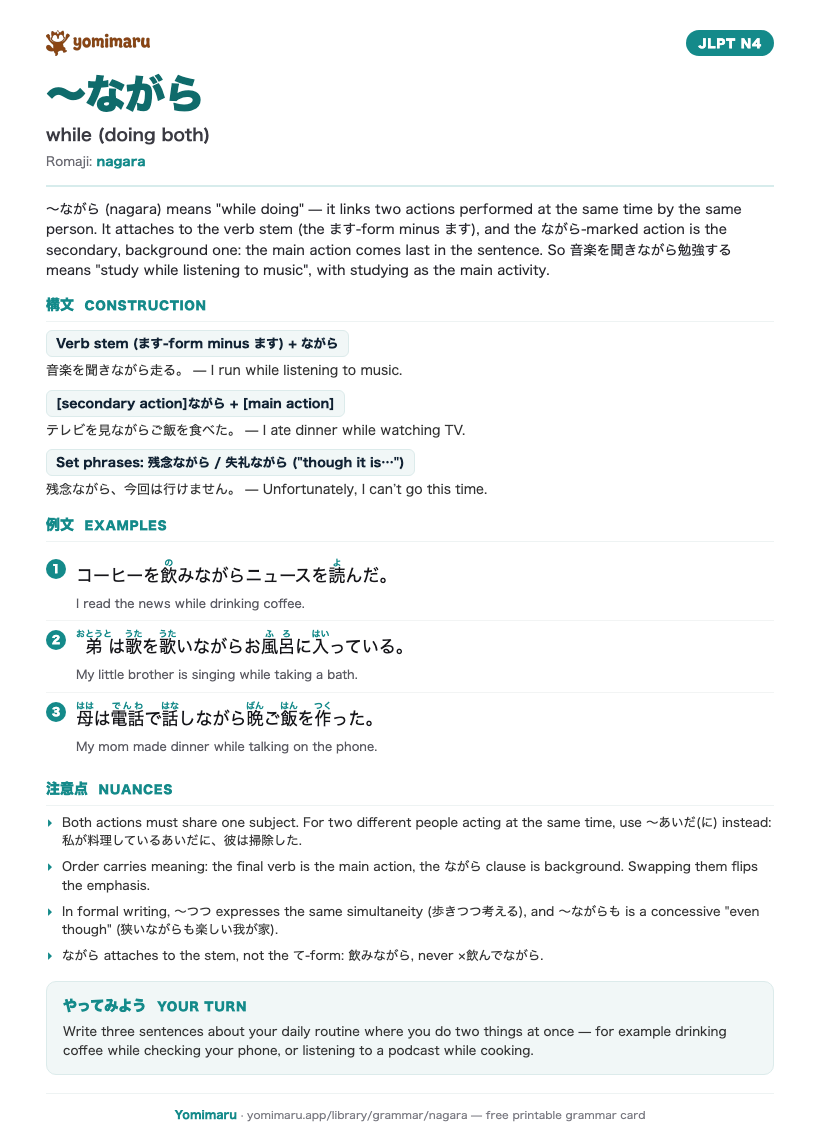
〜ながら means “while (doing both)”. It is a JLPT N4 pattern: below are its construction, the nuances that trip learners up, and the sentences where real Japanese writers use it.
A free one-page study card for 〜ながら (while (doing both)), JLPT N4: what it means, how it attaches, 3 example sentences with furigana, and the nuances that trip learners up. Read it right here, or take the PDF or PNG with you. We never ask for an email for this card.
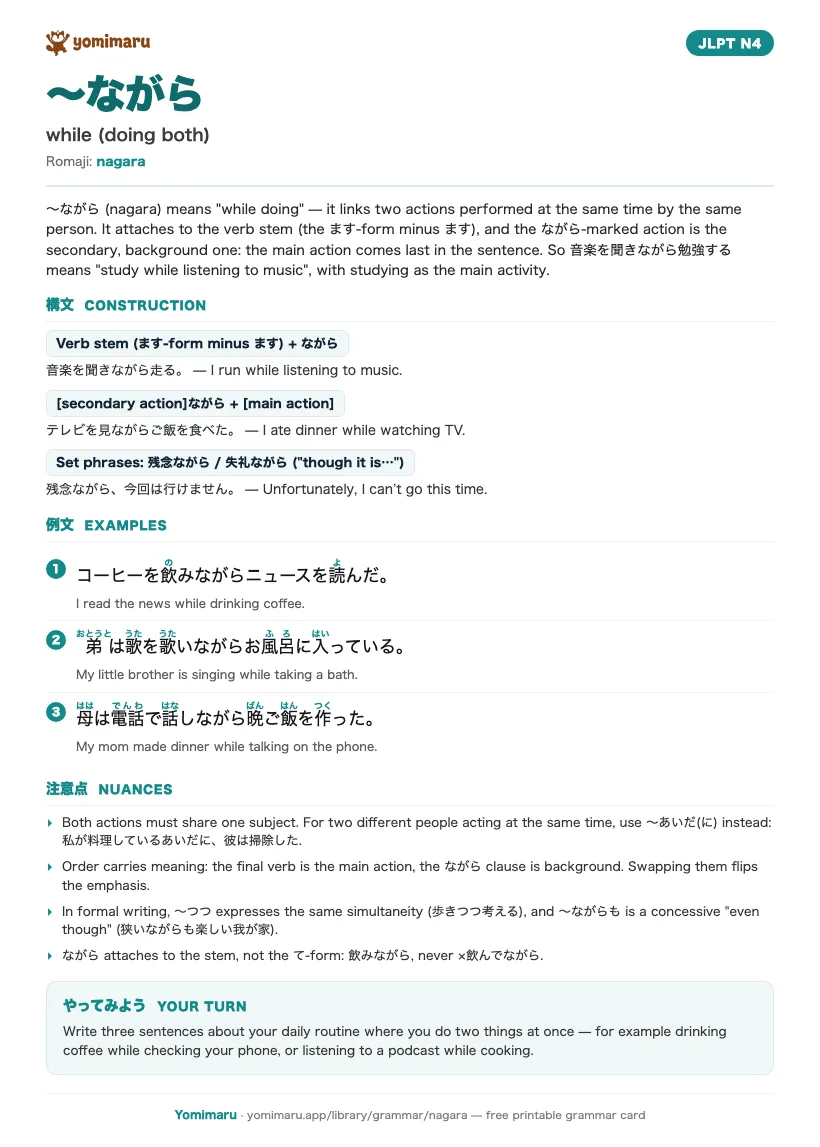
It attaches to the verb stem (the ます-form minus ます), and the ながら-marked action is the secondary, background one: the main action comes last in the sentence. So 音楽を聞きながら勉強する means "study while listening to music", with studying as the main activity.
構文Construction
Verb stem (ます-form minus ます) + ながら
音楽を聞きながら走る。 — I run while listening to music.
[secondary action]ながら + [main action]
テレビを見ながらご飯を食べた。 — I ate dinner while watching TV.
Set phrases: 残念ながら / 失礼ながら ("though it is…")
残念ながら、今回は行けません。 — Unfortunately, I can’t go this time.
例文In a sentence
コーヒーを飲みながらニュースを読んだ。
弟は歌を歌いながらお風呂に入っている。
母は電話で話しながら晩ご飯を作った。
注意点Nuances
練習Your Turn
Each one is quoted from a published Japanese text in this library and links to the story it came from. Some use older spellings, or break off where the sentence carried on. They are transcribed exactly as their authors wrote them.
鼠はチューチューと笑いながら、「それはきっと、この頃この家へ来た小さな三毛猫がおもちゃに持って行ったのだろう」と言いました。
— from Kewpie (N4)
フタリハ ハンブン ヰネムリナガラ、ソレデモ ハナシヲ ツヅケテヰマス。
— from The Festival (N4)
トヒトリデ、ブツブツオコリナガラ、マタホンヲヨミハジメマシタ。
— from Grandma Cat (N4)
と言いながら、今度はお座敷の床の間の壁のまん中をゴリゴリ始めました。
— from Yukiko's Burglar Foil (N3)
4 sentences taken from real Japanese texts, with the grammar removed. Pick what belongs in the gap.
Question 1 of 4
ポケットから銅貨を一枚出して渡しblank、
Answer: ながら — from Excellent English and American Jokes (N3)
波だつ小川が笑いblank走ってゆく。
Answer: ながら — from Laughing Song (N3)
しりきれぞうりを、ひたひたとひきずりblank、村へゆきました。
Answer: ながら — from The Fox's Errand (N3)
すぐにも泥棒を撃ちそうにしblank、
Answer: ながら — from The Money and the Pistol (N3)
Read the texts these came from
Every sentence above came from a free text you can read here in full, with the rest of the story around it.
Appears in 34 of 367 texts in our library.
蔵書The texts
Free to read in full. Furigana over every kanji, a dictionary on any word you tap, and an English breakdown of each sentence.
 Read
仙人
The Hermit
芥川 竜之介
Read
仙人
The Hermit
芥川 竜之介
 Read
顎十郎捕物帳
Agujūrō's Casebook
久生 十蘭
Read
顎十郎捕物帳
Agujūrō's Casebook
久生 十蘭
 Read
キューピー
Kewpie
夢野 久作
Read
キューピー
Kewpie
夢野 久作
 Read
オマツリ
The Festival
村山 籌子
Read
オマツリ
The Festival
村山 籌子
 Read
ネコ ノ オバアサン
Grandma Cat
村山 籌子
Read
ネコ ノ オバアサン
Grandma Cat
村山 籌子
 Read
吝嗇神の宿
The Miser God's Inn
坂口 安吾
Read
吝嗇神の宿
The Miser God's Inn
坂口 安吾
 Read
亀の子を握ったまま
While Holding the Turtle's Child
田中 貢太郎
Read
亀の子を握ったまま
While Holding the Turtle's Child
田中 貢太郎
 Read
荷花公主
The Lotus Princess
田中 貢太郎
Read
洞熊学校を卒業した三人
The Three Who Graduated from the Cave Bear School
宮沢 賢治
Read
英米笑話秀逸
Excellent English and American Jokes
佐々木 邦
Read
荷花公主
The Lotus Princess
田中 貢太郎
Read
洞熊学校を卒業した三人
The Three Who Graduated from the Cave Bear School
宮沢 賢治
Read
英米笑話秀逸
Excellent English and American Jokes
佐々木 邦
 Read
蜘蛛の糸
The Spider's Thread
芥川 竜之介
Read
調帯
The Buzzing Belt
野村 吉哉
Read
笑いの歌
Laughing Song
ブレイク ウィリアム
Read
忘れもの
The Forgotten Thing
原 民喜
Read
飛行機に乗る怪しい紳士
The Suspicious Gentleman on the Airplane
田中 貢太郎
Read
蜘蛛の糸
The Spider's Thread
芥川 竜之介
Read
調帯
The Buzzing Belt
野村 吉哉
Read
笑いの歌
Laughing Song
ブレイク ウィリアム
Read
忘れもの
The Forgotten Thing
原 民喜
Read
飛行機に乗る怪しい紳士
The Suspicious Gentleman on the Airplane
田中 貢太郎
 Read
雪子さんの泥棒よけ
Yukiko's Burglar Foil
夢野 久作
Read
蛙の鳴声
The Frogs' Croak
寺田 寅彦
Read
梅のにおい
The Scent of Plum Blossoms
夢野 久作
Read
狐のつかい
The Fox's Errand
新美 南吉
Read
雪子さんの泥棒よけ
Yukiko's Burglar Foil
夢野 久作
Read
蛙の鳴声
The Frogs' Croak
寺田 寅彦
Read
梅のにおい
The Scent of Plum Blossoms
夢野 久作
Read
狐のつかい
The Fox's Errand
新美 南吉
 Read
狸問答
The Tanuki Dialogue
鈴木 鼓村
Read
似たひと
The Look-Alike
宮本 百合子
Read
狸問答
The Tanuki Dialogue
鈴木 鼓村
Read
似たひと
The Look-Alike
宮本 百合子
 Read
お金とピストル
The Money and the Pistol
夢野 久作
Read
妖怪記
The Yōkai Record
田中 貢太郎
Read
お金とピストル
The Money and the Pistol
夢野 久作
Read
妖怪記
The Yōkai Record
田中 貢太郎
 Read
質屋の通帳
The Pawnshop Passbook
薄田 泣菫
Read
こがらしの ふく ばん
The Night the Cold Wind Blows
小川 未明
Read
質屋の通帳
The Pawnshop Passbook
薄田 泣菫
Read
こがらしの ふく ばん
The Night the Cold Wind Blows
小川 未明
 Read
狸と与太郎
The Tanuki and Yotaro
夢野 久作
Read
狸と与太郎
The Tanuki and Yotaro
夢野 久作
 Read
風
The Wind
竹久 夢二
Read
風
The Wind
竹久 夢二
 Read
天井裏の妖婆
The Witch in the Attic
田中 貢太郎
Read
寒さ
Cold
芥川 竜之介
Read
少女と海鬼灯
The Girl and the Sea Lantern
野口 雨情
Read
一つ枕
The One Pillow
柳川 春葉
Read
天井裏の妖婆
The Witch in the Attic
田中 貢太郎
Read
寒さ
Cold
芥川 竜之介
Read
少女と海鬼灯
The Girl and the Sea Lantern
野口 雨情
Read
一つ枕
The One Pillow
柳川 春葉
 Read
カメサン ノ サウダン
Turtle's Consultation
村山 籌子
Read
カメサン ノ サウダン
Turtle's Consultation
村山 籌子
 Read
指
The Finger
佐左木 俊郎
Read
指
The Finger
佐左木 俊郎
 Read
鼓の音
The Sound of a Drum
田中 貢太郎
Read
鼓の音
The Sound of a Drum
田中 貢太郎
解説Background
〜ながら sits at JLPT N4 in the 302-point taxonomy every text in this library is tagged against. Each text is read for the patterns it contains, which is what lets this page list every text that uses 〜ながら and pull its example sentences out of them.
The example sentences were not written to demonstrate the rule. They are quoted from published Japanese texts in this library (Kewpie and The Festival among them), and each one links back to the story it came from, so you can read the sentence where it actually happened.
質問Questions
No — ながら requires a single subject doing both things at once. For two people acting simultaneously, use 〜あいだ(に) or 〜うちに: 私が料理しているあいだに、彼は掃除した ("while I cooked, he cleaned").
The secondary, background one. The verb that ends the sentence is the main action: 音楽を聞きながら勉強した means studying was the point, with music in the background. Reverse the two and the emphasis flips.
A few set phrases preserve an older concessive ながら meaning "though/despite": 残念ながら "unfortunately (regrettable though it is)" and 失礼ながら "pardon my rudeness, but…". Treat these as fixed expressions rather than the "while doing" pattern.
Yes. A free one-page 〜ながら (while (doing both)) study card sits at the top of this page, as both a PDF and a PNG. It carries the JLPT N4 meaning, how the pattern attaches, 3 example sentences with furigana, and the nuances learners get wrong. You do not need an account or an email address to download it.
始めるStart free
Read the grammar you just studied
Yomimaru turns every text in the library into a reading lesson: furigana tuned to your JLPT level, tap-to-look-up on any word, and an English breakdown of the vocabulary and grammar in each sentence. It is all free, and we never ask for a card.

 確認
確認