
文法Grammar Point
〜から because / since: Meaning & Examples
kara · JLPT N5
JLPT N515 textsQuiz readyStudy card
〜から means “because / since”. It is a JLPT N5 pattern: below are its construction, the nuances that trip learners up, and the sentences where real Japanese writers use it.
一枚Study card
A free one-page study card for 〜から (because / since), JLPT N5: what it means, how it attaches, 3 example sentences with furigana, and the nuances that trip learners up. Read it right here, or take the PDF or PNG with you. We never ask for an email for this card.
How 〜から works
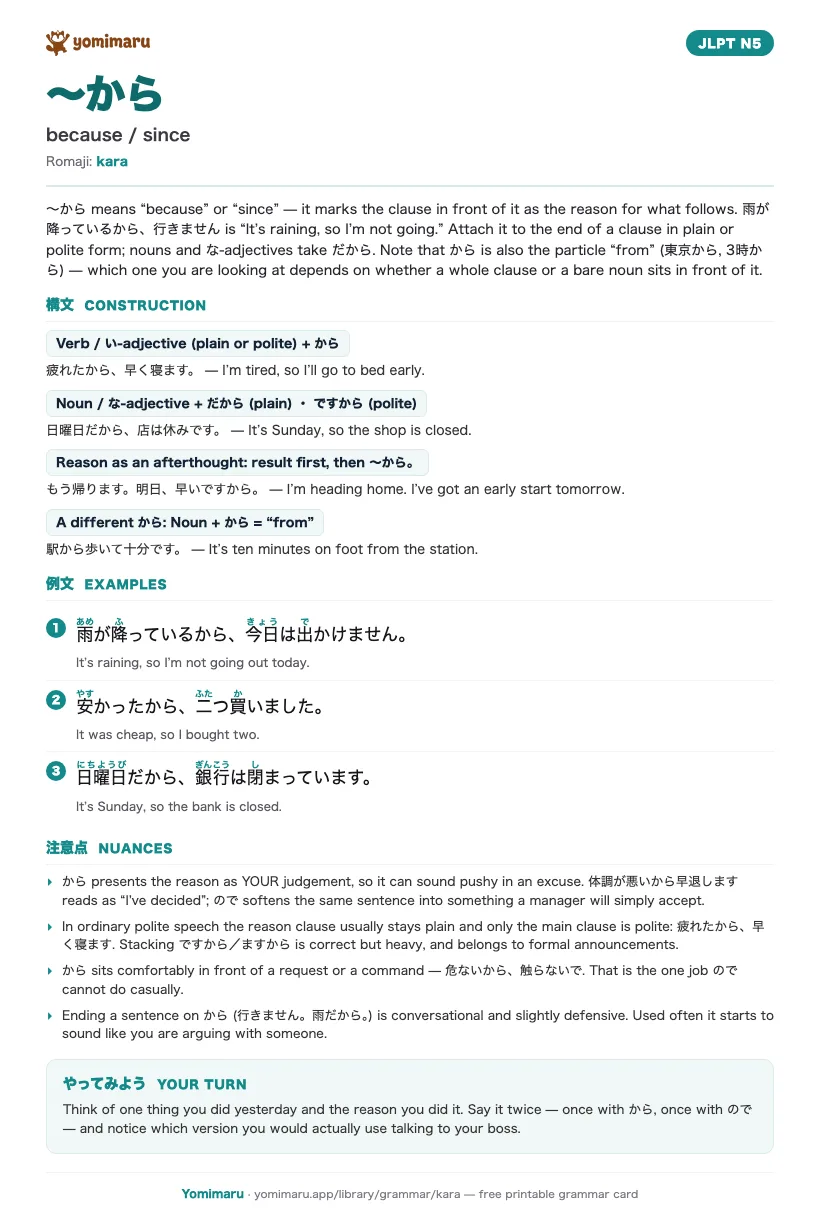
雨が降っているから、行きません is “It’s raining, so I’m not going.” Attach it to the end of a clause in plain or polite form; nouns and な-adjectives take だから. Note that から is also the particle “from” (東京から, 3時から) — which one you are looking at depends on whether a whole clause or a bare noun sits in front of it.
構文Construction
Verb / い-adjective (plain or polite) + から
疲れたから、早く寝ます。 — I’m tired, so I’ll go to bed early.
Noun / な-adjective + だから (plain) ・ ですから (polite)
日曜日だから、店は休みです。 — It’s Sunday, so the shop is closed.
Reason as an afterthought: result first, then 〜から。
もう帰ります。明日、早いですから。 — I’m heading home. I’ve got an early start tomorrow.
A different から: Noun + から = “from”
駅から歩いて十分です。 — It’s ten minutes on foot from the station.
例文In a sentence
雨が降っているから、今日は出かけません。
安かったから、二つ買いました。
日曜日だから、銀行は閉まっています。
注意点Nuances
- 体調が悪いから早退します reads as “I’ve decided”; ので softens the same sentence into something a manager will simply accept.
- In ordinary polite speech the reason clause usually stays plain and only the main clause is polite: 疲れたから、早く寝ます. Stacking ですから/ますから is correct but heavy, and belongs to formal announcements.
- から sits comfortably in front of a request or a command — 危ないから、触らないで. That is the one job ので cannot do casually.
- Ending a sentence on から (行きません。雨だから。) is conversational and slightly defensive. Used often it starts to sound like you are arguing with someone.
練習Your Turn
Tip
Think of one thing you did yesterday and the reason you did it. Say it twice — once with から, once with ので — and notice which version you would actually use talking to your boss.
Think of one thing you did yesterday and the reason you did it. Say it twice — once with から, once with ので — and notice which version you would actually use talking to your boss.
〜から (because / since) in real sentences
Each one is quoted from a published Japanese text in this library and links to the story it came from. Some use older spellings, or break off where the sentence carried on. They are transcribed exactly as their authors wrote them.
あとの にわとりは みんな、めんどりだつたからです。
— from All the Chickens Are Happy (N4)
どうせけちんぼで欲ばりの和尚さんのことだから、みんな自分で食べてしまって、一つもくれないにきまっている。
— from The Priest and the Apprentice (N3)
其上法外に忘れツぽいから、無闇に金子や何かゞ失くなる。
— from Came Without Counting the Money (N2)
されば「名を荷ふ」と書いて「めうが」と読ませる、だから茗荷を喰へば馬鹿になる。
— from The Myoga (N2)
確認Self-check
 確認
確認Practise 〜から: fill in the blank
4 sentences taken from real Japanese texts, with the grammar removed. Pick what belongs in the gap.
Question 1 of 4
-
その人に間違いなく会うために約束をしたのだblank、ほかのよくわかる処で待っていたっていいじゃないか
Answer: から — from The Promise (N3)
-
私が一時の興奮blank殺ってしまったあの迪子
Answer: から — from Old Scar (N1)
-
十二時限り営業まかりならぬというようなお達しは、その頃は出ていなかったblank、十二時頃でも喜んで私たちを迎えたのであった。
Answer: から — from A Summer Night's Adventure (N1)
-
にぎやかだblankすきだ
Answer: から — from Rain (N3)
Read the texts these came from
0 of 4 correct
Every sentence above came from a free text you can read here in full, with the rest of the story around it.
Appears in 15 of 367 texts in our library.
蔵書The texts
15 texts in the library use 〜から
Free to read in full. Furigana over every kanji, a dictionary on any word you tap, and an English breakdown of each sentence.
 Read
ろくろ首
The Long-Necked Monster
小泉 八雲
Read
ろくろ首
The Long-Necked Monster
小泉 八雲

 Read
ネコ ノ オバアサン
Grandma Cat
村山 籌子
Read
ネコ ノ オバアサン
Grandma Cat
村山 籌子

 Read
電灯と浦島
The Electric Light and Urashima
槙村 浩
Read
電灯と浦島
The Electric Light and Urashima
槙村 浩
 Read
にはとり は みんな しあわせ
All the Chickens Are Happy
村山 籌子
Read
にはとり は みんな しあわせ
All the Chickens Are Happy
村山 籌子
 Read
魔法の笛
The Magic Flute
ブラウニング ロバート
Read
魔法の笛
The Magic Flute
ブラウニング ロバート

 Read
和尚さんと小僧
The Priest and the Apprentice
楠山 正雄
Read
和尚さんと小僧
The Priest and the Apprentice
楠山 正雄
 Read
雨
Rain
竹内 浩三
Read
(洋)金の勘定を仕ずに来た
Came Without Counting the Money
三遊亭 円朝
Read
雨
Rain
竹内 浩三
Read
(洋)金の勘定を仕ずに来た
Came Without Counting the Money
三遊亭 円朝

 Read
赤い蝋燭
Red Candle
新美 南吉
Read
約束
The Promise
夢野 久作
Read
赤い蝋燭
Red Candle
新美 南吉
Read
約束
The Promise
夢野 久作
 Read
(和)茗荷
The Myoga
三遊亭 円朝
Read
インチキ文学ボクメツ雑談
A Chat on Exterminating Phony Literature
坂口 安吾
Read
(和)茗荷
The Myoga
三遊亭 円朝
Read
インチキ文学ボクメツ雑談
A Chat on Exterminating Phony Literature
坂口 安吾


解説Background
Where this 〜から explanation comes from
〜から sits at JLPT N5 in the 302-point taxonomy every text in this library is tagged against. Each text is read for the patterns it contains, which is what lets this page list every text that uses 〜から and pull its example sentences out of them.
The example sentences were not written to demonstrate the rule. They are quoted from published Japanese texts in this library (All the Chickens Are Happy and The Priest and the Apprentice among them), and each one links back to the story it came from, so you can read the sentence where it actually happened.
質問Questions
〜から: questions & answers
What is the difference between から and ので?
Both mean “because”. から presents the reason as your own judgement and can sound assertive; ので presents it as an objective fact and sounds softer. That makes ので the safer choice with customers, teachers and bosses. から is also the one you want in front of a request or warning: 危ないから、気をつけて.
Does から come before or after the reason?
After it. Japanese puts the reason first and attaches から to its end, then states the result: 寒いから、窓を閉めます (“It’s cold, so I’ll close the window”). English does the opposite, so the order feels backwards at first. In conversation you can also tack the reason on afterwards: 窓を閉めます。寒いから。
Is the から that means “because” the same as the から that means “from”?
They are written and pronounced the same, and you tell them apart by what precedes them. A bare noun before から gives “from” (家から, 九時から); a whole clause before から gives “because” (高いから, 行くから).
Is there a printable 〜から cheat sheet?
Yes. A free one-page 〜から (because / since) study card sits at the top of this page, as both a PDF and a PNG. It carries the JLPT N5 meaning, how the pattern attaches, 3 example sentences with furigana, and the nuances learners get wrong. You do not need an account or an email address to download it.
始めるStart free
Read the grammar you just studied
Yomimaru turns every text in the library into a reading lesson: furigana tuned to your JLPT level, tap-to-look-up on any word, and an English breakdown of the vocabulary and grammar in each sentence. It is all free, and we never ask for a card.